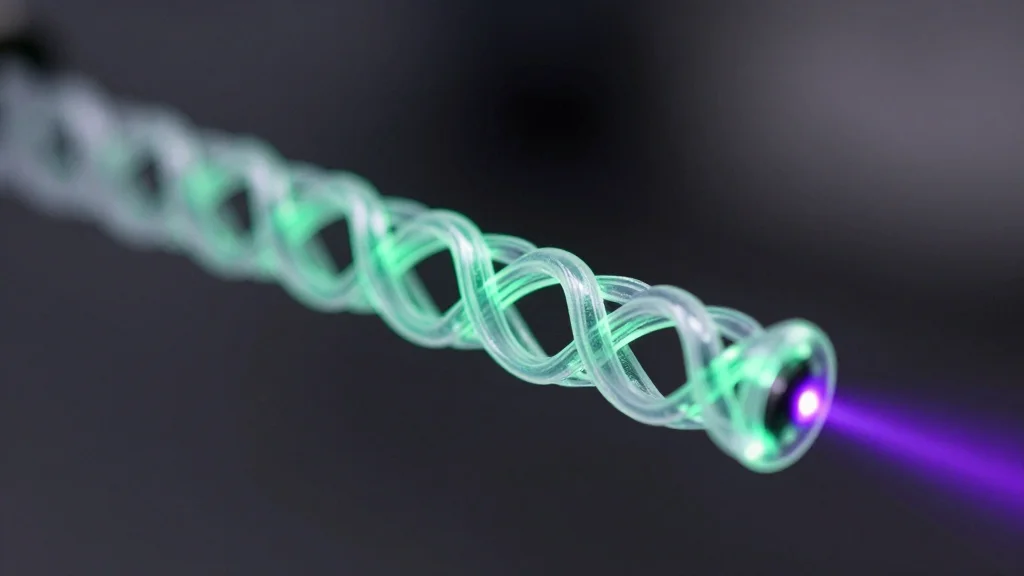
Rice University Demonstrates Giant Light‑Conversion in Chiral Carbon Nanotube Films

Why It Matters
The breakthrough validates a theoretical prediction that has guided nanophotonics research for over a decade, providing a tangible pathway to integrate nonlinear optical functions into nanoscale platforms. By delivering SHG efficiencies 100‑to‑1,000× higher than traditional materials, chiral CNT films could dramatically reduce the size, weight, and power requirements of optical components, a critical need for data‑center interconnects, quantum communication, and wearable sensors. Beyond immediate applications, the work demonstrates a scalable route to isolate and align single‑handed nanomaterials, a longstanding challenge in nanomanufacturing. Mastery of chirality control opens doors to other exotic phenomena—such as chiral plasmonics and spin‑selective transport—that could fuel a new class of devices leveraging the handedness of matter.
Key Takeaways
- •Rice University creates centimeter‑scale films of single‑handed carbon nanotubes.
- •Measured second‑harmonic generation is 100‑to‑1,000× stronger than conventional materials.
- •Collaboration with Tokyo Metropolitan University enabled isolation of pure chiral CNTs.
- •Exciton‑mediated nonlinear optics confirmed by experimental data for the first time.
- •Potential to shrink optical communication components and enable flexible photonic chips.
Pulse Analysis
The discovery arrives at a moment when the semiconductor industry is scrambling to overcome the bandwidth ceiling of electronic interconnects. Optical interconnects, especially those that can be monolithically integrated onto chips, are seen as the next frontier. However, the bulkiness and limited efficiency of existing nonlinear crystals have kept many proposals at the prototype stage. Chiral CNT films, with their unprecedented SHG efficiency and compatibility with flexible substrates, could tip the balance toward practical deployment.
Historically, carbon nanotubes have suffered from a gap between promise and manufacturability. Their extraordinary mechanical and electrical properties have been well documented, yet the inability to produce large, uniform, chirally pure assemblies has hampered commercial uptake. This work not only bridges that gap for optical applications but also establishes a manufacturing blueprint that could be adapted for other chiral nanomaterials. Companies investing in photonic integration—such as Intel, Lumentum, and emerging startups—will likely monitor the scalability of Rice's roll‑to‑roll approach closely.
Looking ahead, the key risk lies in translating laboratory‑scale SHG performance to mass‑produced devices that operate under varied temperature and environmental conditions. If the research community can resolve stability and integration challenges, chiral CNT films could become the linchpin of a new generation of ultracompact, energy‑efficient photonic systems, reshaping markets from data centers to consumer wearables.
Rice University Demonstrates Giant Light‑Conversion in Chiral Carbon Nanotube Films
Comments
Want to join the conversation?
Loading comments...