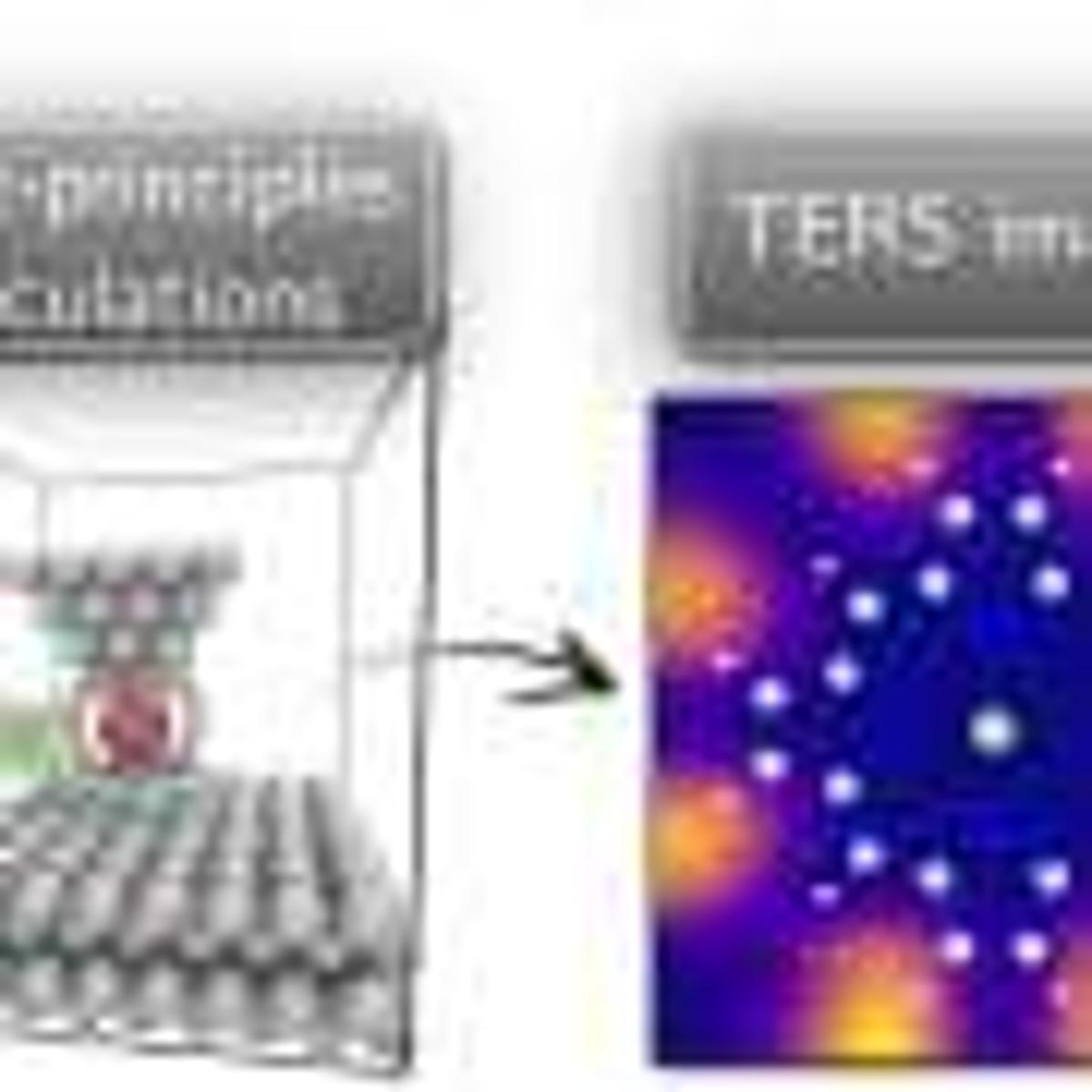
Seeing How Atoms Vibrate at the Ångström Scale
•February 11, 2026
0
Why It Matters
Accurate TERS interpretation unlocks atom‑level insight into structure‑property relationships, accelerating material design across electronics, catalysis, and polymers.
Key Takeaways
- •TERS achieves Ångström‑scale vibrational imaging.
- •First‑principles simulations crucial for TERS interpretation.
- •Metal substrates alter molecular vibrational signatures.
- •Study published in ACS Nano.
- •MPI teams lead methodology advancement.
Pulse Analysis
Tip‑enhanced Raman spectroscopy (TERS) has emerged as a powerful tool for visualizing molecular vibrations with spatial resolution that rivals the size of individual atoms. By coupling a plasmonic nano‑antenna to a scanning probe tip, TERS concentrates the electromagnetic field into a sub‑nanometer hotspot, enabling Raman signals to be collected from regions only a few Ångströms across. This capability opens a direct window onto the local bonding environment, lattice dynamics, and defect states that dictate the performance of semiconductors, catalysts, and polymer interfaces.
The recent work by Krystof Brezina, Mariana Rossi and Yair Litman demonstrates that realistic, first‑principles calculations are indispensable for decoding the complex contrast observed in TERS images. Density‑functional theory provides atomistic vibrational frequencies and Raman tensors, which can be mapped onto the tip‑enhanced field distribution calculated for the metallic substrate. Their simulations reveal that charge transfer and image‑charge effects reshape the vibrational intensity patterns, often masking intrinsic molecular modes. Without such quantum‑level insight, experimental spectra risk misinterpretation, especially when molecules interact strongly with gold or silver surfaces.
By establishing a reliable computational pipeline, the MPI teams have set a new benchmark for nanoscale vibrational spectroscopy, accelerating the design of next‑generation materials. Researchers can now predict how surface chemistry, strain, or dopants will appear in TERS maps before performing experiments, reducing trial‑and‑error cycles and guiding synthesis toward targeted functionalities. Industries ranging from semiconductor manufacturing to renewable energy catalysis stand to benefit, as atom‑level insight enables optimization of charge transport, catalytic activity, and mechanical resilience. The ACS Nano publication signals broader adoption of theory‑driven TERS across academia and industry.
Seeing how atoms vibrate at the Ångström scale
0
Comments
Want to join the conversation?
Loading comments...