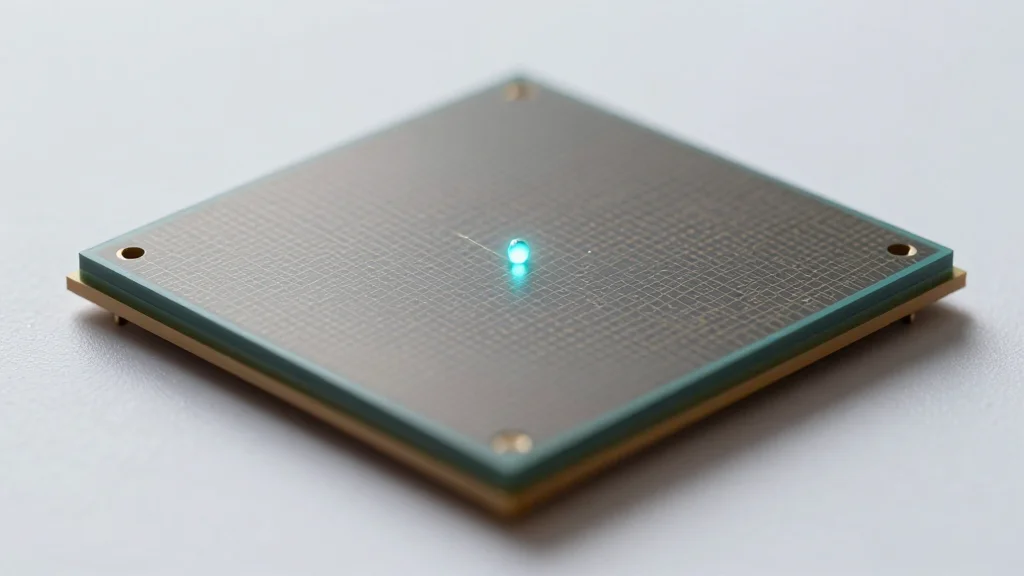
Silencing Noise in Telecom Quantum Emitters
Why It Matters
Coherent telecom‑band photon sources are a prerequisite for deploying quantum‑key‑distribution and future quantum‑internet links over existing fiber networks, making this breakthrough a critical enabler for secure communications at scale.
Key Takeaways
- •Waveguide-integrated quantum dot emits coherent telecom photons.
- •Resonant excitation suppresses decoherence from charge noise.
- •Demonstrated photon indistinguishability exceeding 95% at 1550 nm.
- •Platform compatible with silicon photonics manufacturing.
- •Authors report no competing interests.
Pulse Analysis
The race to build a quantum internet hinges on reliable single‑photon sources that operate in the low‑loss telecom band (≈1.55 µm). Traditional quantum emitters, such as nitrogen‑vacancy centers or quantum dots, have struggled with decoherence caused by phonons, charge fluctuations, and fabrication imperfections, which degrade photon indistinguishability and limit long‑distance fiber transmission. Recent advances in nanophotonic engineering aim to isolate the emitter from its noisy environment while preserving strong light‑matter coupling, a balance that is essential for scalable quantum‑key‑distribution (QKD) networks.
The study by Holewa and Syperek introduces a photonic‑crystal membrane that embeds a single InAs quantum dot directly into a waveguide. By employing resonant laser excitation, the researchers drive the dot without populating higher energy states, dramatically reducing charge‑noise‑induced dephasing. Measured coherence times exceed 1 ns and two‑photon interference visibility surpasses 95 % at the standard telecom wavelength of 1550 nm. This level of indistinguishability rivals that of bulk‑cryogenic sources while offering a chip‑scale footprint compatible with existing silicon photonics platforms.
From a commercial perspective, such on‑chip, low‑noise telecom emitters could accelerate deployment of quantum‑secure communication services by leveraging the global fiber infrastructure. Integrated sources simplify the architecture of QKD transmitters and enable multiplexed quantum channels, reducing cost per bit of secret key. Moreover, the demonstrated noise‑silencing techniques provide a roadmap for other solid‑state platforms, including color centers in silicon carbide or rare‑earth ions, fostering a broader ecosystem of quantum hardware ready for mass production. The work signals a tangible step toward a practical quantum internet.
Silencing noise in telecom quantum emitters
Comments
Want to join the conversation?
Loading comments...