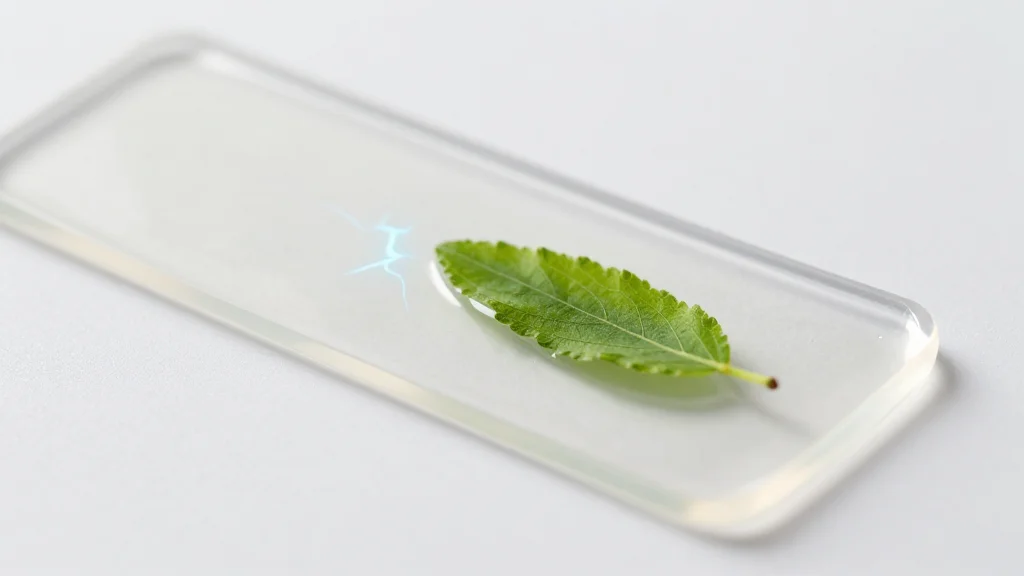
Stevia‑Based Hydrogel Boosts Transparent, Stretchable Electronics

Why It Matters
The stevia‑PVA hydrogel bridges a gap between performance and affordability in the nanotech arena. By delivering high mechanical strength, robust electrical output, and optical transparency with a commodity sweetener, the breakthrough challenges the prevailing notion that advanced flexible electronics require expensive, rare‑earth or nanomaterial inputs. Its recyclability further addresses environmental concerns that have hampered large‑scale deployment of wearable sensors. If the material scales as anticipated, it could catalyze a new class of disposable or low‑cost smart devices—think medical patches, interactive clothing, and gesture‑controlled interfaces—without the price premium that currently limits market penetration. The approach also opens research avenues for other food‑derived polymers, potentially expanding the palette of sustainable nanomaterials.
Key Takeaways
- •Stevia‑PVA hydrogel achieves >25 MPa tensile strength and >510% elongation at break.
- •Electrical output reaches ~800 V, 3‑8× higher than conventional hydrogel TENGs.
- •Device maintains >70% light transmittance, enabling transparent wearables.
- •Stable performance over 16,000 cycles and 30 days storage; recyclable with ~600 V output after reuse.
- •Rise time of 13 ms enables rapid motion sensing; machine‑learning classification shows high accuracy.
Pulse Analysis
The S‑TENG represents a strategic shift from material‑centric innovation to ingredient‑centric engineering. Historically, triboelectric nanogenerators have relied on exotic 2D crystals such as MoS₂ or graphene to boost output, driving up cost and complicating manufacturing. By leveraging stevia—a low‑cost, globally abundant sweetener—the researchers have decoupled performance from price, a move that could reshape the economics of flexible electronics.
From a market perspective, the timing aligns with a surge in demand for self‑powered wearables, especially in remote health monitoring and sports analytics. Companies that can source a high‑performance, recyclable substrate at commodity prices will gain a decisive advantage over incumbents locked into proprietary material supply chains. Moreover, the water‑assisted recycling process addresses a critical pain point: the lifecycle cost of disposable sensors.
Looking ahead, the key challenge will be translating laboratory‑scale hydrogel sheets into roll‑to‑roll manufacturing lines while preserving the delicate hydrogen‑bond network that underpins performance. If the research team can demonstrate consistent quality at scale, we may see a wave of venture capital inflows targeting “bio‑derived nanomaterials” startups, echoing the recent funding surge in biodegradable polymers. The broader nanotech ecosystem should watch closely, as the stevia breakthrough could inspire similar low‑cost, sustainable approaches across energy harvesting, soft robotics, and beyond.
Stevia‑Based Hydrogel Boosts Transparent, Stretchable Electronics
Comments
Want to join the conversation?
Loading comments...