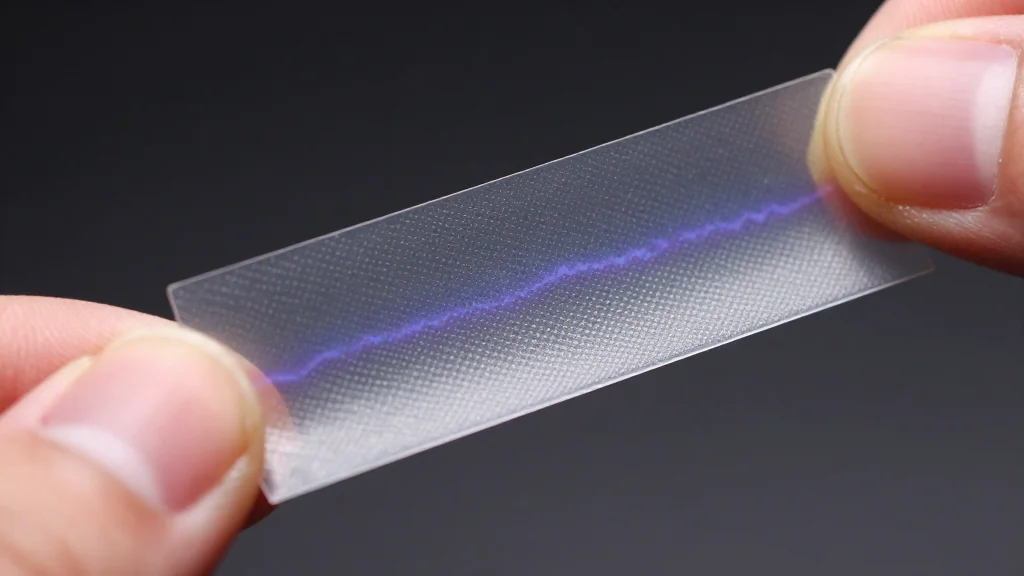
Stretchable Carbon‑Nanotube Metasurfaces Enable Tunable Terahertz Beam Steering

Why It Matters
The ability to mechanically tune terahertz wavefronts opens a new design space for reconfigurable photonic systems. Current THz beam‑steering solutions rely on electronic phase shifters or bulky mechanical mirrors, both of which add latency, power draw, and weight. Stretchable SWCNT metasurfaces combine ultrathin form factor with broadband conductivity, enabling on‑the‑fly adjustments without complex circuitry. This could lower barriers for integrating THz links into mobile platforms, drones, and wearable scanners, accelerating adoption of THz technologies beyond laboratory prototypes. Moreover, the approach demonstrates that carbon‑nanotube films can survive substantial strain while preserving electromagnetic performance, a proof point for broader nanophotonic applications. As the industry pushes toward 6G and beyond, where spectrum beyond 300 GHz becomes essential, such mechanically agile components may become foundational building blocks for next‑generation wireless infrastructure and security imaging systems.
Key Takeaways
- •Stretchable SWCNT metasurfaces fabricated on 21 mm × 21 mm silicone substrates
- •Focal length shifts from 19.4 mm to >27 mm under 20% strain
- •Beam‑steering angle changes by 3.68% (–19.69° to –16.01°)
- •Devices retain optical function over repeated deformation cycles
- •Potential to replace bulky electronic phase‑shifters in THz communications
Pulse Analysis
The emergence of mechanically tunable terahertz metasurfaces marks a pivot from purely electronic control toward hybrid electromechanical architectures. Historically, THz beam steering has been dominated by semiconductor phase‑array chips, which suffer from high power consumption and limited scalability. By leveraging the intrinsic elasticity of SWCNT films, Zhang's team sidesteps these constraints, offering a passive, low‑energy alternative that can be actuated with simple stretch mechanisms. This aligns with a broader trend in nanophotonics where flexibility and conformability are prized for integration into non‑planar devices.
From a market perspective, the timing is critical. Telecom operators are already field‑testing 6G prototypes that require bandwidths well into the THz regime. The ability to dynamically adjust focal length and steering without active electronics could reduce the bill of materials for base‑station antennas and enable lightweight, deployable THz links for remote or disaster‑relief scenarios. Security agencies, too, stand to benefit; portable scanners that can adapt their beam profile on demand would improve resolution and penetration depth while maintaining a compact footprint.
Challenges remain. Scaling the SWCNT deposition process to wafer‑scale production while preserving uniform conductivity is non‑trivial, and long‑term fatigue under real‑world environmental stresses must be quantified. Nonetheless, the proof‑of‑concept demonstrated by Zhang's group provides a clear roadmap: integrate stretchable metasurfaces with micro‑actuators, explore multi‑layer designs for richer phase control, and partner with THz system manufacturers to validate performance in end‑to‑end link tests. If these steps succeed, the technology could catalyze a new class of adaptive THz devices, reshaping both the communications and imaging landscapes.
Stretchable Carbon‑Nanotube Metasurfaces Enable Tunable Terahertz Beam Steering
Comments
Want to join the conversation?
Loading comments...