Structured Selective Activation for Bubble‐Controlled High‐Rate Alkaline OER
•February 2, 2026
0
Why It Matters
Mitigating bubble‑induced and ohmic losses boosts energy efficiency at industrial current densities, accelerating alkaline electrolyzer deployment for green hydrogen. The simple structural strategy lowers capital costs by avoiding exotic materials.
Key Takeaways
- •Asymmetric activation reduces bubble overpotential.
- •1000 mA cm⁻² at 408 mV achieved.
- •PTFE coating provides stable electrolyte pathways.
- •Micromilled geometry directs unidirectional bubble release.
- •Performance stable for >100 hours.
Pulse Analysis
Efficient bubble management has long been a bottleneck for alkaline oxygen evolution reaction (OER) systems. When gas bubbles cling to electrode surfaces, they block active sites and increase resistance, forcing higher cell voltages and eroding overall efficiency. Traditional solutions rely on complex catalyst formulations or high‑pressure flow designs, which add cost and complicate scale‑up. Understanding these limitations underscores why a geometry‑driven approach can be a game‑changer for large‑scale hydrogen production.
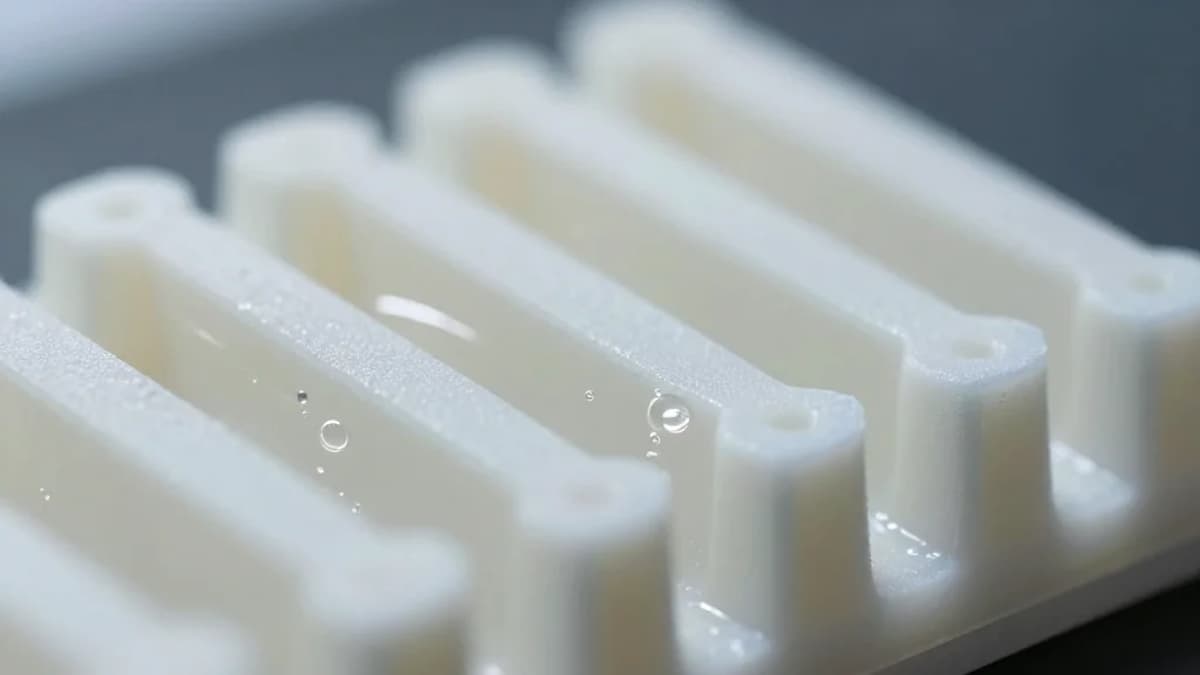
The newly reported asymmetric NiFe‑R electrode tackles the problem at its root by integrating selective activation with a micromilled, PTFE‑coated framework. Deactivated zones act as built‑in channels, allowing fresh electrolyte to sweep past active sites while guiding bubbles along a predetermined path. This structural choreography reduces transport overpotential, enabling a record‑low 408 mV at 1000 mA cm⁻² and delivering an electrochemically active surface area‑normalized current density of 210 mA cm⁻². Moreover, the amorphous NiFe catalyst and durable PTFE layer sustain these metrics for over 100 hours, demonstrating that performance gains are not fleeting.
Beyond the laboratory, the design’s simplicity promises rapid translation to commercial alkaline electrolyzers. Micromilling and PTFE coating are established manufacturing techniques, making the electrode compatible with existing production lines and keeping material costs modest. By delivering high current density with minimal voltage penalty, the technology can lower the levelized cost of hydrogen, a critical metric for renewable energy adoption. Future work may explore scaling the micro‑channel architecture to larger electrode formats and integrating it with renewable‑powered systems, further cementing its role in the decarbonization roadmap.
Structured Selective Activation for Bubble‐Controlled High‐Rate Alkaline OER
0
Comments
Want to join the conversation?
Loading comments...