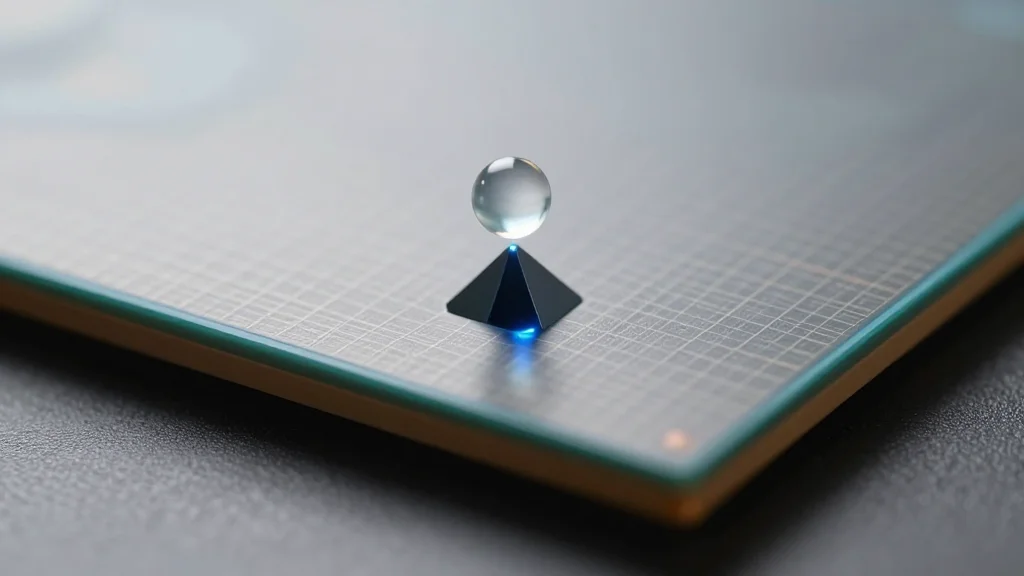
Tapered Silicon Nanopores Make Single Protein Detection Faster and Clearer
Key Takeaways
- •Pyramidal silicon nanopores focus electric field for faster protein capture
- •SiO₂ lining reduces protein adhesion, improving signal clarity
- •7 nm pore detects α‑synuclein with 5.6 SNR at 200 mV
- •Real‑time current feedback halts etching for sub‑10 nm openings
- •Adjustable pore sizes enable detection of IgG and ferritin
Pulse Analysis
Nanopore sensing has emerged as a powerful platform for single‑molecule analysis, yet its commercial adoption has been hampered by a delicate balance between translocation speed and signal clarity. Traditional cylindrical solid‑state pores spread the electric field across the channel, which weakens the electrophoretic pull on target proteins and increases the likelihood of surface interactions that blur ionic current signatures. Biological pores, while highly selective, lack the robustness and scalability required for mass‑manufactured diagnostic devices. The field therefore seeks a solid‑state solution that can simultaneously accelerate capture and preserve a high signal‑to‑noise ratio.
The new pyramidal silicon nanopore addresses this need through a two‑pronged design. By tapering the channel to a sub‑10 nm tip, the electric field becomes concentrated at the sensing region, boosting the probability that a protein is drawn into the constriction and generating a pronounced current blockade. Simultaneously, a thin SiO₂ coating renders the interior hydrophilic, repelling negatively charged proteins from the walls and curbing nonspecific adsorption. The researchers refined the fabrication workflow with an in‑situ current‑feedback loop that terminates wet etching the moment a through‑hole forms, followed by controlled thermal oxidation that both narrows the aperture and creates the oxide lining. Performance data—such as a 0.18 ms dwell time and a 5.6 SNR for α‑synuclein at 200 mV—demonstrate a clear advantage over silicon nitride and graphene nanopores.
Beyond the laboratory, this architecture could accelerate the rollout of label‑free protein assays for clinical and research settings. The ability to tailor pore diameters—from 7 nm for small, fast‑moving proteins to 14 nm for larger complexes—offers a versatile platform adaptable to multiplexed panels. However, translating the proof‑of‑concept to real biological samples will require handling complex matrices, overlapping events, and long‑term stability of the SiO₂ surface. Continued integration with microfluidic sample preparation and advanced signal‑processing algorithms could unlock high‑throughput, point‑of‑care diagnostics that leverage the speed and precision of solid‑state nanopores.
Tapered silicon nanopores make single protein detection faster and clearer
Comments
Want to join the conversation?