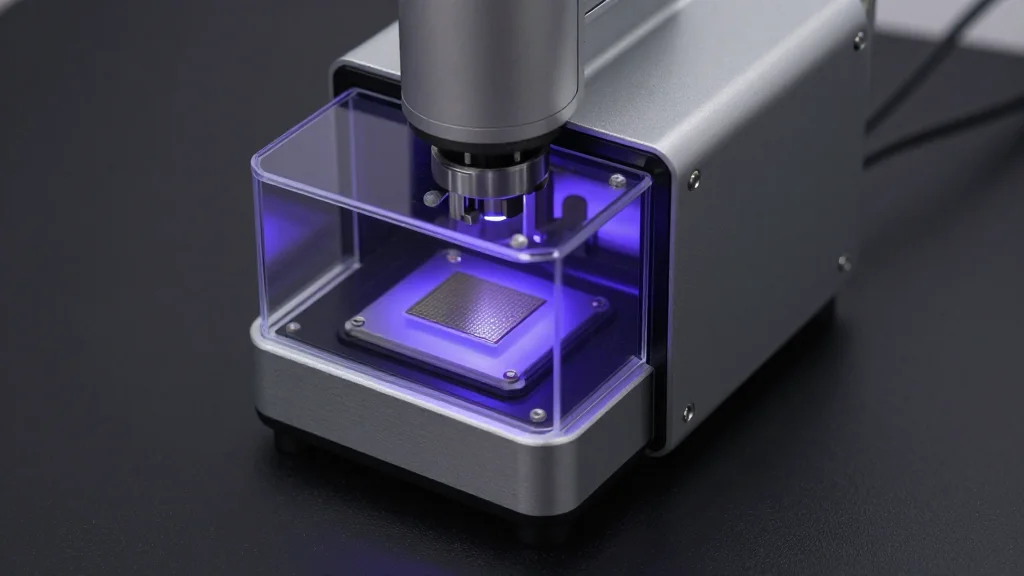
Texas Engineers Unveil Tabletop EUV Printer That Cuts Nanostructure Patterning to Minutes

Why It Matters
The ability to pattern 3‑D nanostructures in minutes rather than days could dramatically accelerate the semiconductor innovation pipeline. By lowering the cost barrier, more universities, small companies, and interdisciplinary teams can experiment with advanced chip architectures, potentially leading to breakthroughs in memory density, photonic computing, and quantum hardware. Additionally, the technology’s cross‑disciplinary relevance—spanning medicine, materials science, and quantum information—means that a single tool could catalyze progress across several high‑impact sectors. In a market where the leading EUV lithography suppliers dominate a $10 billion equipment segment, a tabletop alternative introduces a new competitive dynamic. Even if the device remains a research instrument, its existence pressures incumbent vendors to consider more modular, cost‑effective offerings for the growing ecosystem of fab‑light innovators.
Key Takeaways
- •UT Austin engineers built a tabletop EUV lithography device that cuts patterning time from days to minutes.
- •The system uses volumetric 3‑D patterning to print multiple layers simultaneously.
- •Commercial EUV machines cost > $200 million and occupy entire rooms; the new device is a low‑cost, modular alternative.
- •Researchers aim to expand capabilities to non‑periodic structures and sub‑10 nm features.
- •Potential applications span semiconductor memory, photonics, quantum computing, and nanomedicine.
Pulse Analysis
The tabletop EUV printer represents a strategic inflection point for the semiconductor research community. Historically, access to EUV lithography has been confined to a few megafabs and a handful of well‑funded corporate labs. By stripping the technology down to its essential components, the Texas team not only reduces capital expenditure but also democratizes the experimental workflow. This could lead to a proliferation of niche chip designs that would otherwise be shelved due to prohibitive tooling costs.
From a market perspective, the move challenges the duopoly of EUV equipment manufacturers, who have built business models around high‑margin, high‑price machines. While the tabletop device is unlikely to threaten their core fab‑scale sales, it creates a new segment—research‑grade EUV—that could grow into a multi‑billion‑dollar niche as more institutions adopt the technology. Vendors may respond with scaled‑down, plug‑and‑play modules or service contracts aimed at academic and startup customers.
Looking ahead, the real test will be whether the prototype can transition from periodic patterning to the complex, irregular geometries required for next‑generation logic and quantum devices. Success would not only validate the engineering approach but also unlock a cascade of downstream innovations, from custom photonic crystals to on‑chip quantum emitters. For now, the announcement signals a shift from exclusivity toward inclusivity in nanofabrication, setting the stage for a more vibrant and diversified semiconductor ecosystem.
Texas Engineers Unveil Tabletop EUV Printer That Cuts Nanostructure Patterning to Minutes
Comments
Want to join the conversation?
Loading comments...