These Tiny Holes Could Change How the World Cleans Water
Why It Matters
By delivering near‑molecular selectivity with far lower energy demand, POMbranes can dramatically reduce operating costs and greenhouse‑gas footprints in high‑volume water‑treatment processes, accelerating the shift toward circular manufacturing.
Key Takeaways
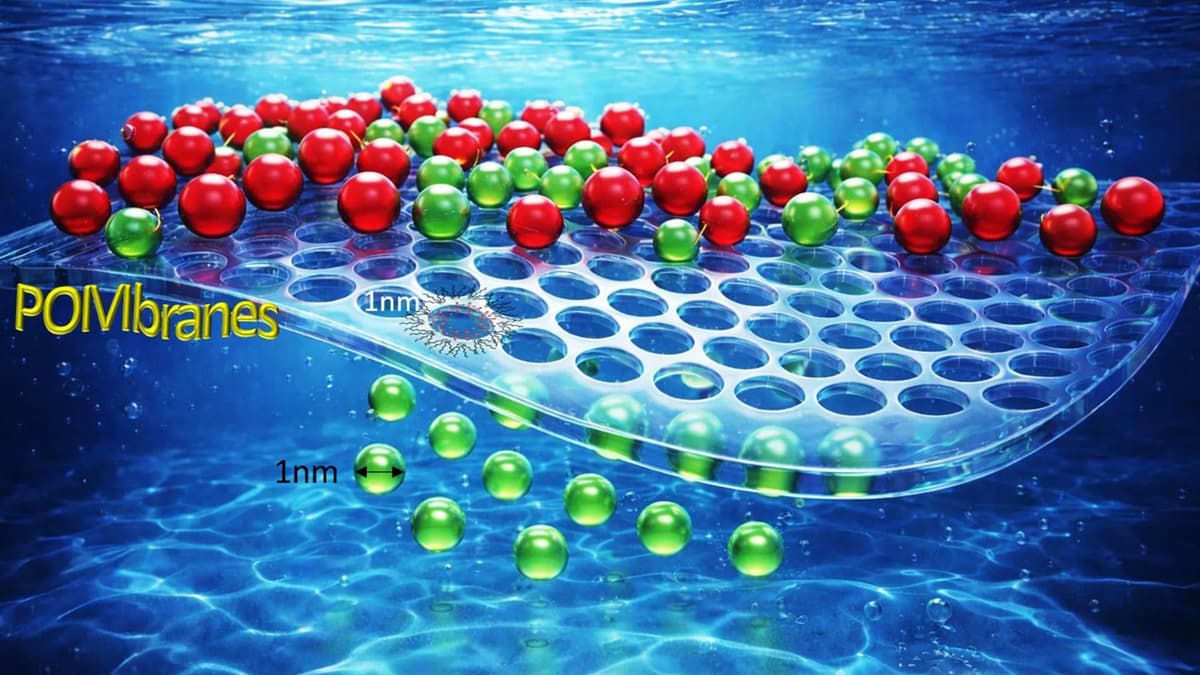
- •POMbranes feature permanent 1 nm pores for ultra‑selective filtration
- •Membranes achieve ~10× higher separation efficiency than conventional polymers
- •Flexible, pH‑stable films can be produced as large‑area sheets
- •Enables energy‑saving water reuse in textiles and pharma manufacturing
- •Platform technology adaptable to diverse industrial separation challenges
Pulse Analysis
Industrial separation accounts for up to half of global manufacturing energy use, prompting a search for alternatives that cut costs and emissions. Traditional distillation and polymer membranes suffer from uneven pore sizes and degradation, limiting their efficiency. Researchers have turned to nature for inspiration, mimicking aquaporin channels that move water molecules with atomic precision. By embedding polyoxometalate clusters—tiny metal rings with a permanent 1 nm aperture—into a crystalline lattice, the new POMbranes achieve a level of molecular discrimination previously unattainable in synthetic membranes.
The POMbrane’s design leverages flexible linker chains that self‑assemble on water, forming defect‑free, ultrathin sheets that can be rolled or stacked for industrial scale. Laboratory tests show the membranes separate molecules differing by just 100–200 Daltons, delivering roughly ten times the selectivity of conventional polymer films while maintaining flexibility across a broad pH range. Because the pores are immutable, performance remains stable over time, addressing a key weakness of existing technologies. Moreover, the manufacturing process is compatible with large‑area roll‑to‑roll production, paving the way for rapid commercialization.
For sectors such as Indian textiles and global pharmaceuticals—where water reuse and solvent recovery are critical—the impact could be transformative. Precise dye removal and drug purification become less energy‑intensive, reducing freshwater demand and chemical waste. The broader market for wastewater‑treatment equipment, projected to exceed $250 billion by 2030, offers a sizable revenue runway for companies that adopt POMbranes. As sustainability mandates tighten and carbon pricing rises, the membrane’s ability to lower operational footprints positions it as a cornerstone technology for the next generation of circular manufacturing.
These tiny holes could change how the world cleans water
Comments
Want to join the conversation?
Loading comments...