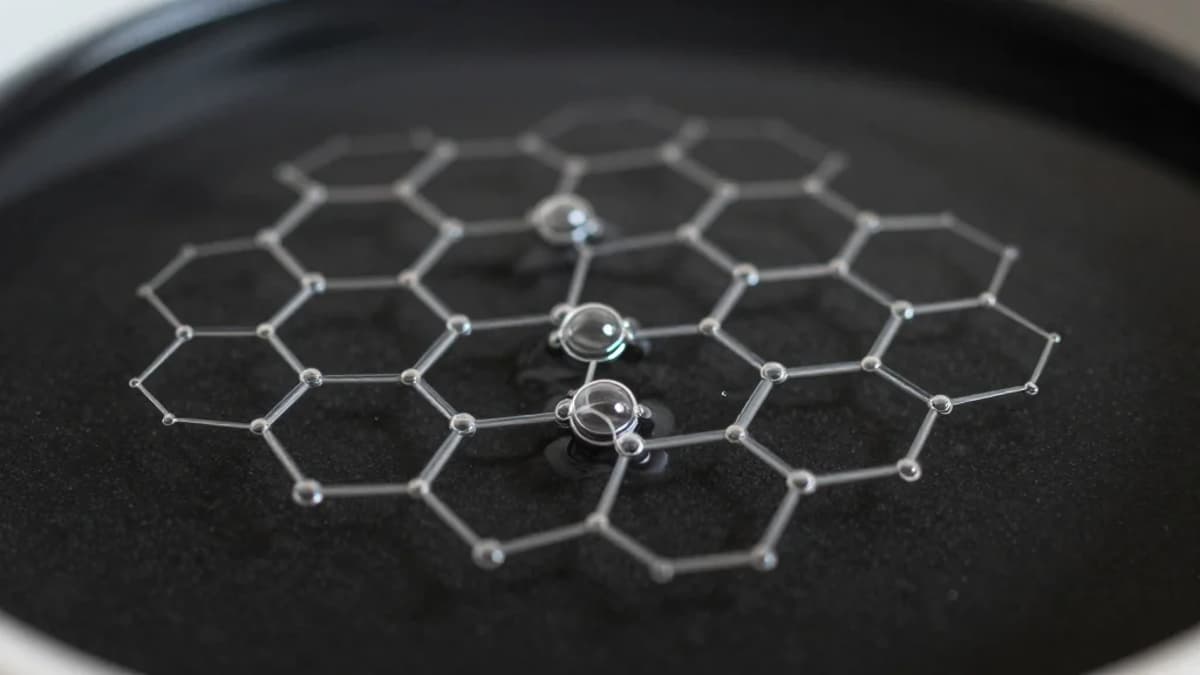
Ultraclean Self‐Assembly on Micro‐Bubble Lattice
•February 25, 2026
0
Why It Matters
Residue‑free micro‑patterning unlocks sustainable production of high‑performance biomaterials, wearables, and medical devices, addressing contamination challenges that hinder current water‑based processes.
Key Takeaways
- •Underwater microbubble lattice enables residue‑free micro‑assembly.
- •Capillary adhesion binds objects without chemical residues.
- •Wettability and size ratio dictate assembly efficiency.
- •Technique compatible with cell‑laden microgels for biomedical use.
- •Scalable for massive patterning in water‑based manufacturing.
Pulse Analysis
Water‑based manufacturing has become a cornerstone of sustainable electronics, biomaterials, and medical device production, yet the industry still struggles with contaminant‑free micro‑patterning. Conventional lithography and polymer‑based adhesives often leave residues that alter the physical or biochemical properties of delicate components. The recent development of an underwater micro‑bubble lattice offers a fundamentally different route: gaseous receptors form a transient, capillary‑driven scaffold that captures micro‑objects without any solid binder. This ultraclean approach preserves the native state of each particle, addressing a long‑standing gap in green fabrication. Moreover, the method reduces energy consumption by eliminating high‑temperature curing steps.
The assembly process relies on two controllable parameters: surface wettability contrast and the particle‑to‑bubble size ratio. By patterning a hydrophilic substrate adjacent to a hydrophobic region, bubbles nucleate at the interface and present a water‑air meniscus that exerts capillary forces on contacting particles. Numerical simulations confirm that optimal adhesion occurs when the particle diameter approaches the bubble curvature, maximizing contact line length while preventing wetting. Because the bubbles dissolve harmlessly after transfer, no tenacious residues remain, eliminating the cleaning steps required by conventional glue‑based methods. The approach works across a broad range of particle materials, from polymers to metals.
Beyond proof‑of‑concept, the technique has already demonstrated compatibility with cell‑laden microgels, opening pathways for tissue‑engineered scaffolds and personalized drug‑delivery platforms. Its residue‑free nature also aligns with the stringent regulatory demands of medical device fabrication, where surface contamination can trigger costly re‑qualification. Moreover, the ability to co‑assemble heterogeneous particles through selective bubble regeneration promises high‑throughput manufacturing of multifunctional wearables and sensors. As industries push toward fully aqueous production lines, micro‑bubble‑mediated self‑assembly could become a standard tool for scalable, ultraclean micro‑fabrication. Future work will focus on integrating real‑time bubble control for dynamic patterning.
Ultraclean Self‐Assembly on Micro‐Bubble Lattice
0
Comments
Want to join the conversation?
Loading comments...