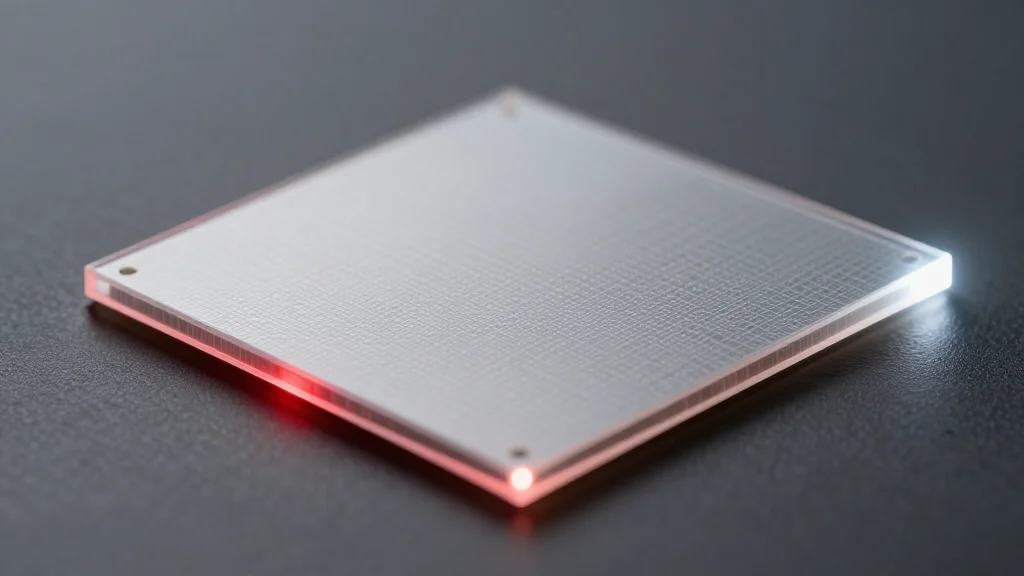
UNSW Sydney Unveils 8.2% Efficient Nanophotonic Upconverter to Boost Solar Panels

Why It Matters
The upconverter tackles a fundamental inefficiency in silicon photovoltaics: the inability to harvest infrared photons that constitute a sizable share of the solar spectrum. By converting these photons into usable visible light, the technology promises to push commercial solar‑panel efficiencies beyond the current 20‑22% ceiling, directly impacting the cost‑per‑watt metric that drives solar adoption worldwide. Beyond energy, the solid‑state nanophotonic platform showcases how precise molecular engineering at the nanoscale can solve macroscopic engineering challenges. The approach could accelerate nanotech applications in sectors ranging from telecommunications—where infrared‑to‑visible conversion can improve detector sensitivity—to advanced manufacturing, where controlled photon upconversion may enable new photopolymerisation pathways. In each case, the ability to integrate a nanostructured, solid‑state layer into existing production lines lowers barriers to commercialization, a critical step for the broader nanotech ecosystem.
Key Takeaways
- •UNSW’s nanophotonic upconverter achieves 8.2% photon‑conversion efficiency, among the highest reported
- •Device uses a liquid triplet‑fusion medium solidified within an alumina nano‑scaffold
- •Solid‑state design enables compatibility with semiconductor‑style manufacturing
- •Potential to raise solar‑module efficiency by 2‑3 percentage points, adding billions in revenue
- •Researchers plan a 10 cm² demonstrator and field trials with a commercial PV maker in late 2026
Pulse Analysis
UNSW’s breakthrough arrives at a pivotal moment for the solar industry, which is increasingly looking to nanotechnology to break through the efficiency plateau of silicon cells. Historically, upconversion has been a laboratory curiosity—liquid systems offered higher conversion rates but were impractical for mass production, while solid‑state attempts fell short on efficiency. By engineering a hybrid medium that behaves like a solid on the relevant timescales, UNSW has effectively merged the best of both worlds. This convergence could compress the technology adoption curve dramatically, moving the concept from a decade‑long research niche to a commercial add‑on within a few years.
From a market perspective, the value proposition is clear: even a modest uplift in module efficiency translates into lower levelized cost of electricity (LCOE) and faster payback periods for solar investors. Given the projected $1.2 trillion cumulative investment in solar capacity through 2030, a 2‑3% efficiency gain could unlock an additional $30‑40 billion in economic value. Moreover, the solid‑state nature of the upconverter reduces the risk profile for OEMs, who can integrate the layer into existing production lines without extensive retooling. This lowers the barrier for licensing agreements and could spark a wave of strategic partnerships between nanotech firms and traditional PV manufacturers.
Looking ahead, the key risk lies in scaling the nanostructured scaffold while preserving uniformity across large‑area substrates. If UNSW can demonstrate consistent performance at the demonstrator scale, it will likely attract venture capital and corporate R&D funding, accelerating the path to market. The broader nanotech community should watch this development as a template for how molecular‑level control can be harnessed for macro‑scale energy solutions, potentially inspiring similar upconversion strategies in other energy‑conversion domains such as thermophotovoltaics and waste‑heat recovery.
UNSW Sydney Unveils 8.2% Efficient Nanophotonic Upconverter to Boost Solar Panels
Comments
Want to join the conversation?
Loading comments...