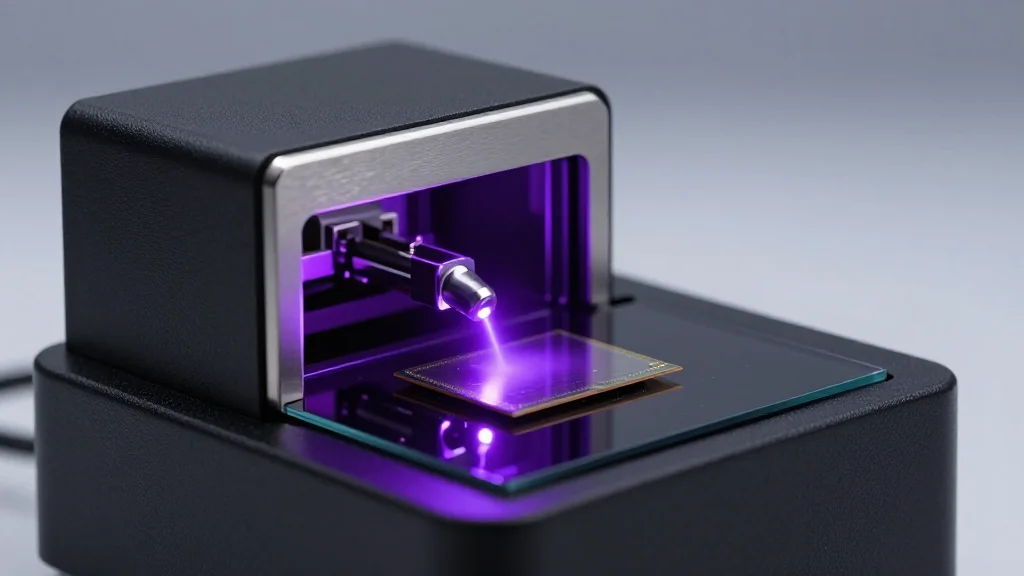
UT Austin Unveils Table‑Top EUV Lithography System, Cutting Semiconductor Research Costs

Companies Mentioned
Why It Matters
The UT Austin tabletop EUV printer directly addresses the $200 million cost barrier that has confined cutting‑edge semiconductor research to a few well‑funded fabs. By making advanced lithography accessible to academic labs, the technology could accelerate discovery in memory, photonics, and quantum devices, shortening the innovation cycle and diversifying the pool of contributors. Moreover, the volumetric 3D patterning method promises to reshape how nanostructures are fabricated, potentially enabling new device architectures that are impractical with traditional layer‑by‑layer approaches. Beyond academia, the democratization of EUV capabilities could stimulate a new wave of startup activity, as entrepreneurs gain the ability to prototype and validate designs without massive capital outlays. This shift may also pressure incumbent equipment manufacturers to develop more modular, cost‑effective solutions, reshaping the economics of the semiconductor supply chain.
Key Takeaways
- •UT Austin built a tabletop EUV lithography system that reduces processing time from days to minutes.
- •The device costs a fraction of commercial EUV machines, which exceed $200 million each.
- •Volumetric 3D patterning prints multiple layers simultaneously, a departure from sequential industrial processes.
- •Research collaborations include material partners at UT Dallas and Johns Hopkins University.
- •Future goals: expand to non‑periodic geometries, increase speed, and release open‑source hardware by Q4 2026.
Pulse Analysis
The emergence of a research‑scale EUV platform marks a pivotal moment for the nanotech ecosystem. Historically, the high capital intensity of EUV lithography has created a de‑facto monopoly for a handful of megafabs, limiting exploratory work to a narrow set of players. UT Austin’s approach flips that model by stripping the hardware to its essentials and re‑imagining the exposure workflow. This could catalyze a cascade of university‑driven innovations, similar to how desktop 3‑D printers democratized rapid prototyping a decade ago.
From a market perspective, the technology threatens to erode the premium pricing power of EUV equipment vendors such as ASML. While the tabletop system will not replace production‑grade tools, its ability to validate concepts early could reduce the risk profile for chip designers, potentially accelerating adoption of advanced nodes. Investors may begin to view academic spin‑outs that leverage this platform as attractive targets, especially in niche markets like neuromorphic memory or integrated photonics where design cycles are short and volume is low.
Looking ahead, the key challenge will be scaling the technique beyond periodic structures and integrating it with existing process flows. If the UT Austin team can demonstrate reliable patterning of arbitrary geometries at commercially relevant pitches, the ripple effect could extend to sectors beyond semiconductors—nanomedicine, quantum hardware, and advanced materials synthesis. The next few years will likely see a flurry of collaborative pilots, standards development, and perhaps a new class of “lab‑fab” service providers that bridge the gap between academic research and industrial production.
UT Austin Unveils Table‑Top EUV Lithography System, Cutting Semiconductor Research Costs
Comments
Want to join the conversation?
Loading comments...