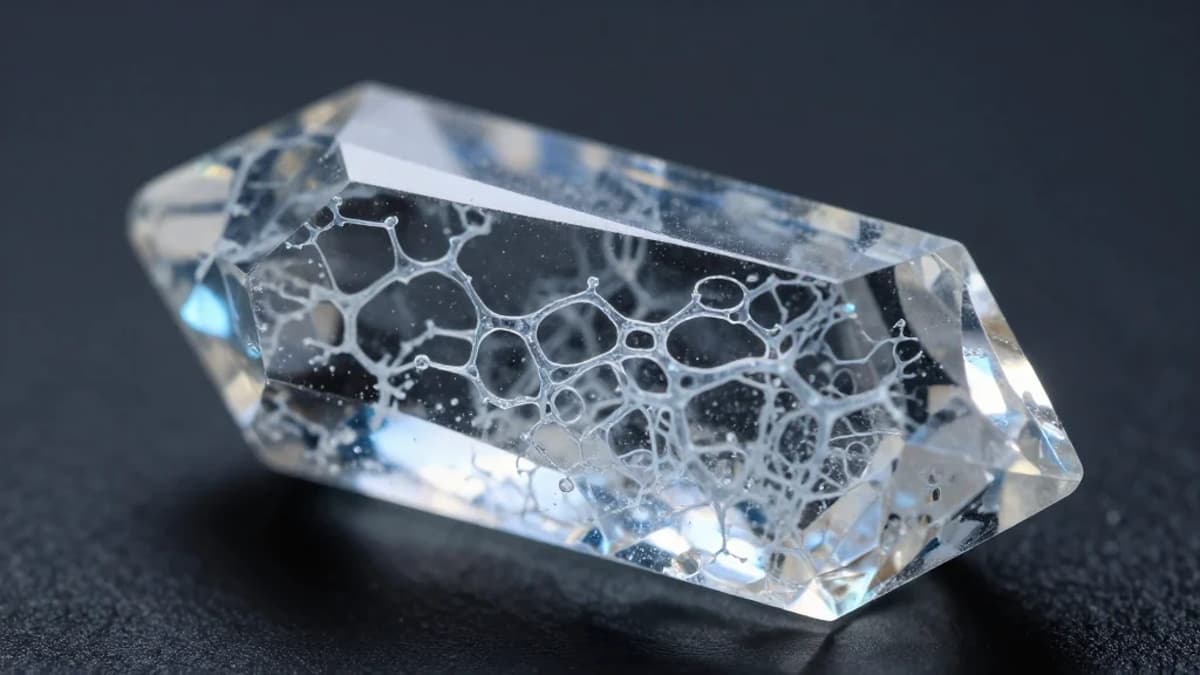
Water Confined in Sub‐Nanochannels of Supramolecular Crystals Exhibiting Ice‐Water‐Like Phase Transition Near Room Temperature
•February 6, 2026
0
Why It Matters
The discovery shows nanoconfined water can melt near ambient conditions, enabling precise control of thermal expansion in advanced functional materials for sensors, actuators, and bio‑inspired technologies.
Key Takeaways
- •Sub‑nanochannels host water showing ice‑to‑liquid transition
- •Crystals exhibit colossal negative thermal expansion near room temperature
- •Crown‑ether rotation drives lattice water disorder
- •K⁺ crystal contracts faster than NH₄⁺ counterpart
- •Findings guide design of temperature‑responsive supramolecular materials
Pulse Analysis
Nanoconfined water has long intrigued scientists because its physical properties diverge dramatically from bulk water, influencing processes from protein folding to mineral formation. When water molecules are restricted to sub‑nanometer dimensions, hydrogen‑bond networks reorganize, leading to altered phase behavior, dielectric response, and transport characteristics. Understanding these anomalies is essential for designing materials that exploit water’s unique thermodynamics, especially in fields such as catalysis, energy storage, and biomimetic engineering.
The newly reported crystals, M(18‑crown‑6)3Al(ox)3·9H2O, combine tetra‑nuclear aluminum oxalate clusters with helical water chains encased in crown‑ether cages. Near 300 K the crown‑ether rings rotate, prompting an order‑to‑disorder shift of the confined water that mirrors the ice‑to‑water transition. This structural rearrangement produces a rare, colossal negative thermal expansion (NTE), quantified at –345.3 m K⁻¹ for the potassium variant and –261.8 m K⁻¹ for the ammonium analogue. Such pronounced NTE, driven by water dynamics rather than lattice vibrations, expands the toolbox for temperature‑compensating composites.
From an application standpoint, materials that contract upon heating can counterbalance the expansion of conventional components, stabilizing precision instruments and aerospace structures. Moreover, the reversible water‑mediated phase change offers a pathway to smart actuators that respond to modest temperature fluctuations without external power. Future research may explore tuning the channel size, ion composition, or crown‑ether chemistry to modulate the transition temperature and NTE magnitude, paving the way for customizable thermal‑responsive supramolecular platforms.
Water Confined in Sub‐Nanochannels of Supramolecular Crystals Exhibiting Ice‐Water‐Like Phase Transition near Room Temperature
0
Comments
Want to join the conversation?
Loading comments...