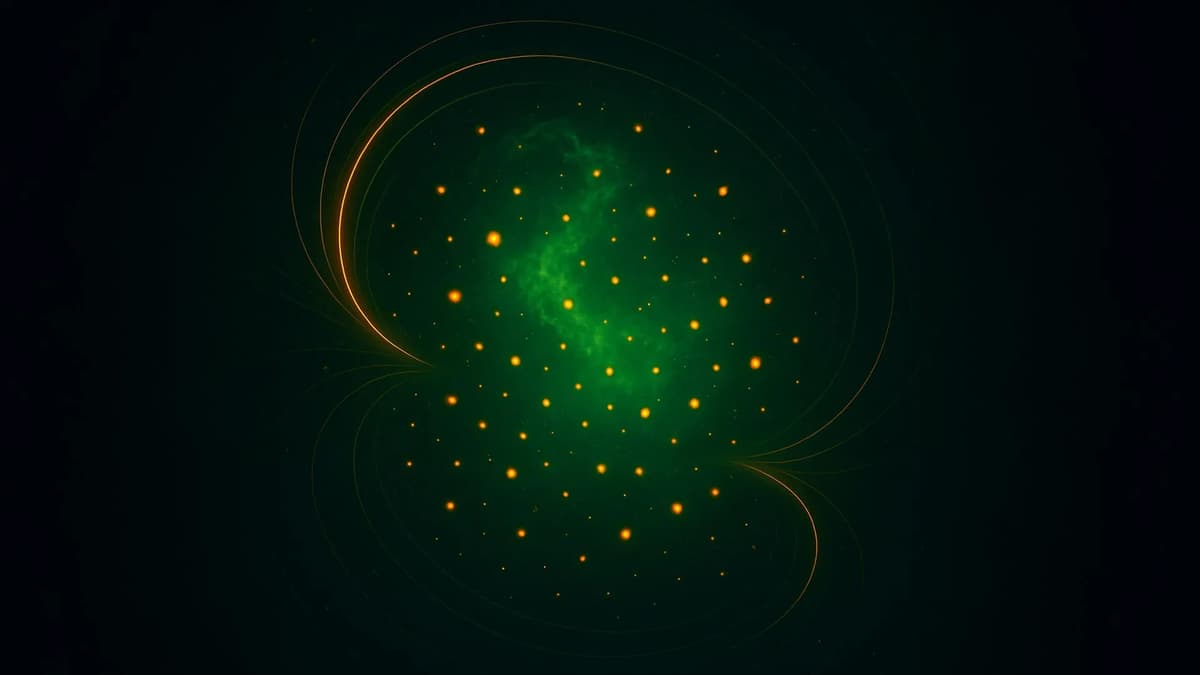
Weak Magnetism Causes Big Changes in a Strange State of Matter
•January 31, 2026
0
Companies Mentioned

Why It Matters
The ability to steer nanoparticle formation with minimal magnetic input provides a low‑cost, scalable tool for advanced manufacturing and deepens our understanding of plasma processes that shape planetary environments.
Key Takeaways
- •Weak magnetic fields alter dusty plasma particle growth rates
- •Electron magnetization changes charge acquisition of nanoparticles
- •Findings enable tailored nanomaterial synthesis via plasma control
- •Research links laboratory plasma behavior to cosmic dust environments
Pulse Analysis
Dusty plasma, a hybrid state where micron‑scale particles coexist with ionized gas, appears in planetary rings, comet tails and in a range of laboratory reactors. The suspended grains acquire charge through collisions with electrons and ions, which in turn influences plasma dynamics and particle aggregation. Because the plasma component dominates the mass and energy balance, even subtle perturbations can cascade into macroscopic changes. Understanding how external fields interact with this delicate charge equilibrium is therefore a cornerstone for both space science and advanced material processing.
The Auburn University team demonstrated that magnetic fields as low as a few millitesla are sufficient to magnetize the lightest plasma constituent—electrons—forcing them onto helical trajectories. This electron magnetization reshapes the local electric field, altering how quickly dust grains collect charge and consequently how fast they grow. In experiments with argon‑acetylene mixtures, the presence of a weak field reduced the nanoparticle growth window from two minutes to under one minute and yielded smaller, more uniform particles. The results reveal a direct, tunable lever for controlling nanostructure size within non‑thermal plasmas.
These insights open pathways for plasma‑based manufacturing of electronics, coatings and quantum‑device components where precise particle dimensions are critical. By adjusting magnetic field strength, engineers could fine‑tune nanoparticle synthesis without altering gas chemistry, reducing process complexity and waste. Moreover, the study bridges laboratory physics with astrophysical phenomena, offering a model for how weak planetary magnetic fields might influence dust aggregation in protoplanetary disks or the solar corona. Future work will likely explore scaling effects and integrate real‑time magnetic diagnostics to further harness this subtle yet powerful control knob.
Weak magnetism causes big changes in a strange state of matter
0
Comments
Want to join the conversation?
Loading comments...