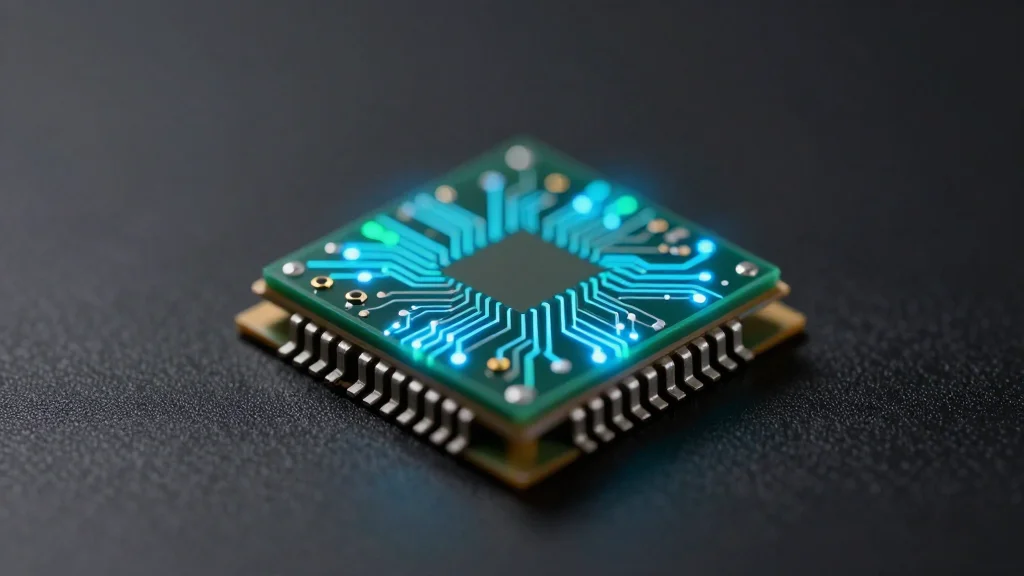
When Light Gets Trapped at Nanoscale: New Ways to Power the Future of Optoelectronics From Bound States in the Continuum to Machine-Learning Design, Photonic Metasurfaces Are Opening Scalable Routes to Efficient Light Control
Why It Matters
By delivering unprecedented light confinement in flat, low‑loss structures, BIC metasurfaces can dramatically improve efficiency and miniaturization of photonic components, accelerating adoption in consumer, medical, and quantum technologies.
Key Takeaways
- •Photonic BICs trap light via destructive interference, enabling quasi‑bound states
- •Machine‑learning inverse design accelerates metasurface creation for complex functionalities
- •All‑dielectric low‑loss materials expand BIC operation from UV to microwave
- •Wafer‑scale fabrication remains the primary hurdle for commercial BIC devices
Pulse Analysis
Modern devices—from smartphone cameras to quantum sensors—rely on precise control of light, yet traditional optical cavities add bulk and limit integration. Bound states in the continuum (BICs) sidestep these constraints by using destructive interference to confine photons in open structures, creating quasi‑BICs that retain extreme field enhancement with minimal radiation loss. This physics reshapes how engineers think about resonators, offering a path to ultrathin, chip‑compatible components that can be layered directly onto electronic platforms.
The rapid evolution of BIC technology is driven by two complementary trends. First, a curated library of low‑loss, all‑dielectric materials now spans the ultraviolet to microwave spectrum, allowing designers to match resonant frequencies to diverse applications. Second, machine‑learning and inverse‑design algorithms automate the discovery of complex meta‑atom geometries, delivering topologically rich states such as super‑BICs, chiral BICs, and flat‑band BICs that were previously inaccessible. These tools compress design cycles from months to days, unlocking new functionalities like ultrafast optical switching and polariton condensation.
Commercializing BIC metasurfaces hinges on scaling production. While laboratory demonstrations prove performance gains in lasing, sensing, and nonlinear optics, translating these gains to wafer‑level fabrication demands tighter process control and cost‑effective patterning. Overcoming this barrier could shrink photonic modules, lower power consumption, and spur a wave of integrated optoelectronic products across consumer electronics, healthcare diagnostics, and emerging quantum platforms. The convergence of material science, AI‑driven design, and manufacturing innovation positions BIC‑based devices as a pivotal catalyst for the next wave of light‑enabled technologies.
When light gets trapped at nanoscale: New ways to power the future of optoelectronics From bound states in the continuum to machine-learning design, photonic metasurfaces are opening scalable routes to efficient light control
Comments
Want to join the conversation?
Loading comments...