New Quantum Boundary Discovered: Spin Size Determines How the Kondo Effect Behaves
Researchers at Osaka Metropolitan University have experimentally realized a Kondo‑necklace model using an organic‑inorganic hybrid crystal, allowing direct comparison of spin‑½ and spin‑1 lattices. Thermodynamic measurements show that spin‑½ moments form non‑magnetic singlets, while spin‑1 moments develop long‑range magnetic order. The work demonstrates that the Kondo effect’s influence flips with spin size, establishing a new quantum boundary. This spin‑size dependence offers a controllable pathway for engineering magnetic or non‑magnetic quantum phases.
Turning Retired Wind Turbine Blades Into High-Performance Lithium-Ion Battery Anodes
Retired wind turbine blades, made of glass‑fiber‑reinforced plastics, can be upcycled into high‑performance silicon‑carbon anodes for lithium‑ion batteries. Researchers at Hebei University of Technology devised a multistep chemical route that transforms the silica‑rich fibers into a porous silicon framework with...
Defect Engineered MoS2 Films Boost Solar CO2 Conversion
Researchers at National Taiwan University have introduced a capped vapor‑liquid‑solid (VLS) method to synthesize wafer‑scale ultrathin Mo₁₋ₓVₓS₂ alloy films with engineered sulfur vacancies. The vanadium‑sulfur‑vacancy (V‑S‑vac) pairs act as highly active sites, boosting solar‑driven CO₂‑to‑CO conversion rates to roughly five...
A Self-Assembling Shortcut to Better Organic Solar Cells
Osaka Metropolitan University researchers have engineered a donor‑acceptor‑donor molecule, TISQ, that self‑assembles into built‑in p/n junctions essential for organic thin‑film solar cells. Depending on solvent polarity, TISQ forms nanoparticle‑like J‑type aggregates or fibrous H‑type aggregates, each exhibiting distinct charge‑transport behavior....

Dual Closed-Loop Insulin System Adds Chemical Safeguard to Protect Against Dangerous Overdoses
Researchers unveiled a wearable dual closed‑loop insulin system that combines a Transformer‑based AI controller with a glucose‑responsive polymer insulin. The chemical safeguard releases insulin only when blood glucose rises, while the AI predicts glucose trends and directs pump delivery. In...
Atomistic Simulation Software CP2K Enables AI Models
CP2K, the open‑source atomistic simulation suite, has released a comprehensive overview aimed at newcomers in theoretical chemistry and materials science. The paper details CP2K’s hybrid classical‑quantum methods, its ability to run on tens of thousands of CPUs or thousands of...
Ultrafast Spectroscopy Allows New Insights Into Energy Flow in Semiconductors
Researchers at the University of Basel employed ultrafast spectroscopy to map energy flow in germanium, a key semiconductor material. By pairing time‑resolved Raman spectroscopy with transient reflection, they tracked electron‑to‑phonon transfer after 30‑fs laser excitation with picosecond resolution. The method...
Atomic Force Microscopy Reveals Nanoscopic Raft Dynamics on Cell Membranes
Scientists at National Taiwan University combined atomic force microscopy with a Hadamard product‑based image reconstruction algorithm to directly visualize membrane raft dynamics on live cells for the first time. The study captured the formation, fusion, and dissolution of nanoscopic rafts...
Atomic-Scale Channels Destroy Water Pollutants that Treatment Plants Cannot Touch
Researchers have engineered a copper‑single‑atom catalyst confined within MXene interlayer nano‑channels (Cu‑SACs/MXene) that achieves 94.9% removal of bisphenol A in just five minutes. The 1.37 nm channels concentrate oxidants and accelerate mass transport, while the isolated Cu atoms cycle between Cu⁺/Cu²⁺ to...
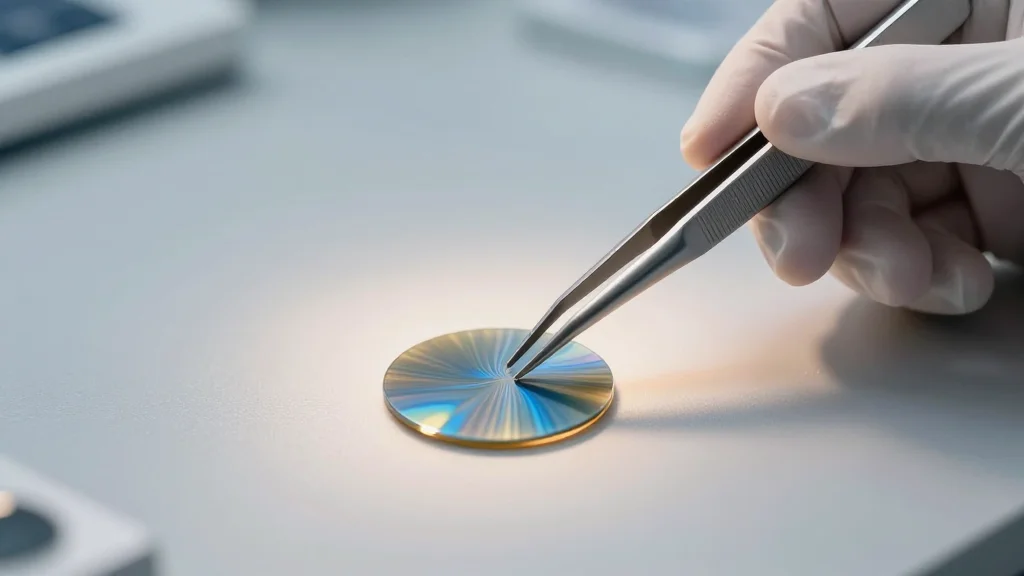
Team Develops a Better Method to Create 2D Superlattices with a Twist
Stanford chemist Fang Liu unveiled a gold‑tape technique that produces ultraclean twisted 2D moiré superlattices with near‑100% yield and centimeter‑scale dimensions. The method replaces the low‑yield Scotch‑tape approach, enabling uniform samples of graphene, MoS₂ and other semiconductors. Using SSRL’s X‑ray...
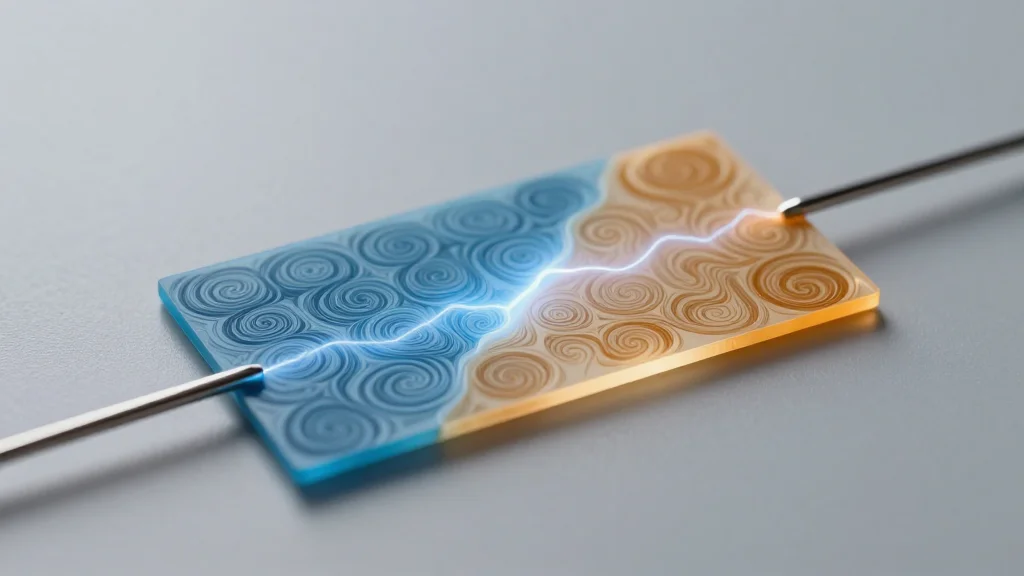
Voltage Pulses Can Flip, Create, and Erase Magnetic Bimerons in Two-Dimensional Ferroelectrics
Researchers have demonstrated that voltage pulses can write, erase, and invert magnetic bimerons in a two‑dimensional ferroelectric by flipping the material's polarization. The flip reverses the Dzyaloshinskii‑Moriya interaction (DMI) chirality, changing the bimeron's topological charge from +1 to ‑1, while an antiferroelectric...