
Theta Lake Targets AI Comms Risks with New Tools
Theta Lake announced a suite of AI‑native compliance upgrades, including CSA STAR AI Level II and ISO/IEC 42001 certifications, a new patent for high‑dimensional data labeling, and three specialized classifiers that monitor AI‑generated communications for manipulation, file‑sharing, and indirect prompt injections. The company also launched a Financial Services AI Governance Series, featuring speakers from SIFMA, Zoom, Cisco and others, to educate risk and compliance teams on emerging AI risks. These moves expand Theta Lake’s regulatory‑focused platform for AI‑driven digital communications, positioning it as a leading provider of governance tools in regulated sectors.

SMCR Reforms Arrive, but Compliance Risk Remains
The FCA’s Phase 1 SMCR reforms, rolling out through 2026, simplify the regime’s structure while keeping accountability standards high. Changes include streamlined certification, clearer breach guidance, and more flexible submission formats, with key updates on 24 April, 10 July and 1 September 2026. The...

Transient.AI Gets Series A Boost for Regulated Markets AI
Transient.AI announced a Series A round led by private‑equity firm NEXT Investors to fund its AI‑native investment‑management platform. The capital will accelerate an international go‑to‑market push, tapping NEXT’s institutional networks across the Americas, EMEA and APAC. At its core is...

PRA to Ease Ring-Fence Rules to Cut Bank Costs
The Prudential Regulation Authority will launch a summer consultation to loosen ring‑fencing rules on shared operational services for the UK’s biggest banks. The proposal would let institutions with more than £35 billion in core deposits (about $44.5 billion) share IT, data‑processing and...

Valid Systems Brings AI Fraud Detection to Snowflake Cloud
Valid Systems has launched an AI‑driven fraud‑detection integration on Snowflake’s AI Data Cloud, allowing financial institutions to run machine‑learning models directly within Snowflake for real‑time decisioning. The solution taps into Valid’s existing pipeline of over 70 million transactions per month, protecting...

Commercial Banks Pushed Towards Perpetual KYC Models
Traditional calendar‑based KYC reviews leave commercial banks blind to real‑time client changes, exposing them to financial‑crime risk and costly compliance gaps. Regulators such as the FCA have intensified scrutiny, levying over £176 million (≈$224 million) in penalties on UK banks in 2024....

DDD Invoices Nets €1.31m to Tackle E-Invoicing Compliance
Slovenian e‑invoicing compliance platform DDD Invoices closed a €1.31 million seed round—about $1.43 million—led by Fil Rouge Capital and 500 Global. The capital will fund expansion into additional countries, deeper integration with existing software stacks, and hires across product, engineering, and go‑to‑market...

Buyside Onboarding Gets an Overhaul as Fenergo Goes Digital
Fenergo has launched a Digital Subscriptions capability within its Investor Portal, unifying KYC, onboarding, and fund subscription into a single digital workflow. The add‑on replaces paper‑based subscription agreements with structured, automated processes that include built‑in compliance controls, audit trails, and...

Sherlocq Launches AI Regulatory Intelligence Platform
Sherlocq, an AI‑native regulatory intelligence platform for the global financial services sector, has launched publicly, branding itself as a new enterprise AI category. The solution spans more than 30 jurisdictions—including the US, UK, Singapore, Hong Kong and the UAE—and delivers three...

Crypto Compliance: The New Banking Capability
Swiss‑born entrepreneur Dennis Wohlfarth founded Cense to give European banks a turnkey way to embed crypto compliance into their core operations. Leveraging a decade of infrastructure, Cense combines automation with human expertise to deliver portfolio‑level analysis of client holdings. The...

Key Compliance Priorities for Investment Managers in 2026
Investment managers face a reshaped compliance landscape in 2026, driven by tighter LP scrutiny despite deregulation, a refocused SEC enforcement agenda, and rising AI adoption without adequate governance. The SEC is shifting from books‑and‑records fines to targeting fraud, negligence, and...

Why Inherent Risk Assessment Is Now a Strategic Tool
Financial crime risk managers are shifting inherent risk assessment from a compliance checkbox to a strategic intelligence function. Arctic Intelligence notes that evolving customer behavior, rapid fintech product cycles, and volatile geopolitics have made exposure highly contextual. Firms now need...

How to Fix AML Over-Classification in Your Firm
Muinmos and FAI Comply hosted a Compliance Café Connect session that highlighted the growing problem of AML over‑classification, where many clients are labeled high‑risk by default. The discussion, led by Muinmos CEO Remonda Kirketerp‑Møller, argued that static, periodic risk reviews...

StarCompliance Launches Explainable AI Compliance Tool
StarCompliance introduced StarAssist, an AI‑powered, explainable compliance tool embedded in its STAR Platform. The solution translates complex rule evaluations into plain‑language explanations, allowing compliance teams to act without leaving their existing workflow. By providing audit‑ready documentation and reducing manual research,...

ASIC Urges Financial Firms to Boost Cyber Defences
The Australian Securities and Investments Commission (ASIC) has issued an open letter urging all licensed financial firms to urgently strengthen cyber resilience in light of frontier artificial intelligence threats. ASIC stresses that AI‑driven attacks can expose vulnerabilities faster and at...

D&B and Claude Team up to Streamline KYC Workflows
Dun & Bradstreet has partnered with Anthropic to embed its Commercial Graph risk data into the Claude AI platform via a Model Context Protocol (MCP) server. The integration lets enterprises build customized KYC and KYB workflows in minutes, merging natural‑language...

How Banks Can Decode Crypto Compliance Risks
Banks can no longer ignore crypto exposure as customers increasingly hold digital assets and move funds through traditional channels. Cense has introduced a two‑step methodology—Detect and Decode—to first surface crypto activity and then rebuild a client’s full digital‑asset portfolio for...

What the EU AI Act Means for Your Recording Estate
Financial firms using AI‑driven communications surveillance must prepare for the EU AI Act, which now expects high‑risk systems to meet strict traceability, documentation and auditability standards. Although the deadline for standalone high‑risk AI has shifted to December 2027 and embedded systems...

How DORA Redefines ICT Exit Planning for Financial Firms
The EU’s Digital Operational Resilience Act (DORA) now obliges financial institutions to maintain a documented, testable ICT exit plan for any service supporting a critical or important function. Simply having a termination clause is insufficient; firms must prove they can...

Finastra and Nammu21 Partner to Speed up Loan Onboarding
Finastra has integrated Nammu21’s document‑intelligence platform with its Loan IQ system via the Nexus Build API. The joint solution automatically extracts and structures data from complex credit agreements, populating Loan IQ without manual entry. This automation speeds loan onboarding, cuts...

Daon Launches Workforce Identity Fraud Prevention Tool
Daon announced a Workforce Identity Fraud Prevention solution that unifies its TrustX, xProof, xAuth and xFace technologies into a single framework. The platform verifies candidate identities during hiring, issues phishing‑resistant passkey authentication, and provides step‑up and continuous re‑verification throughout employment....
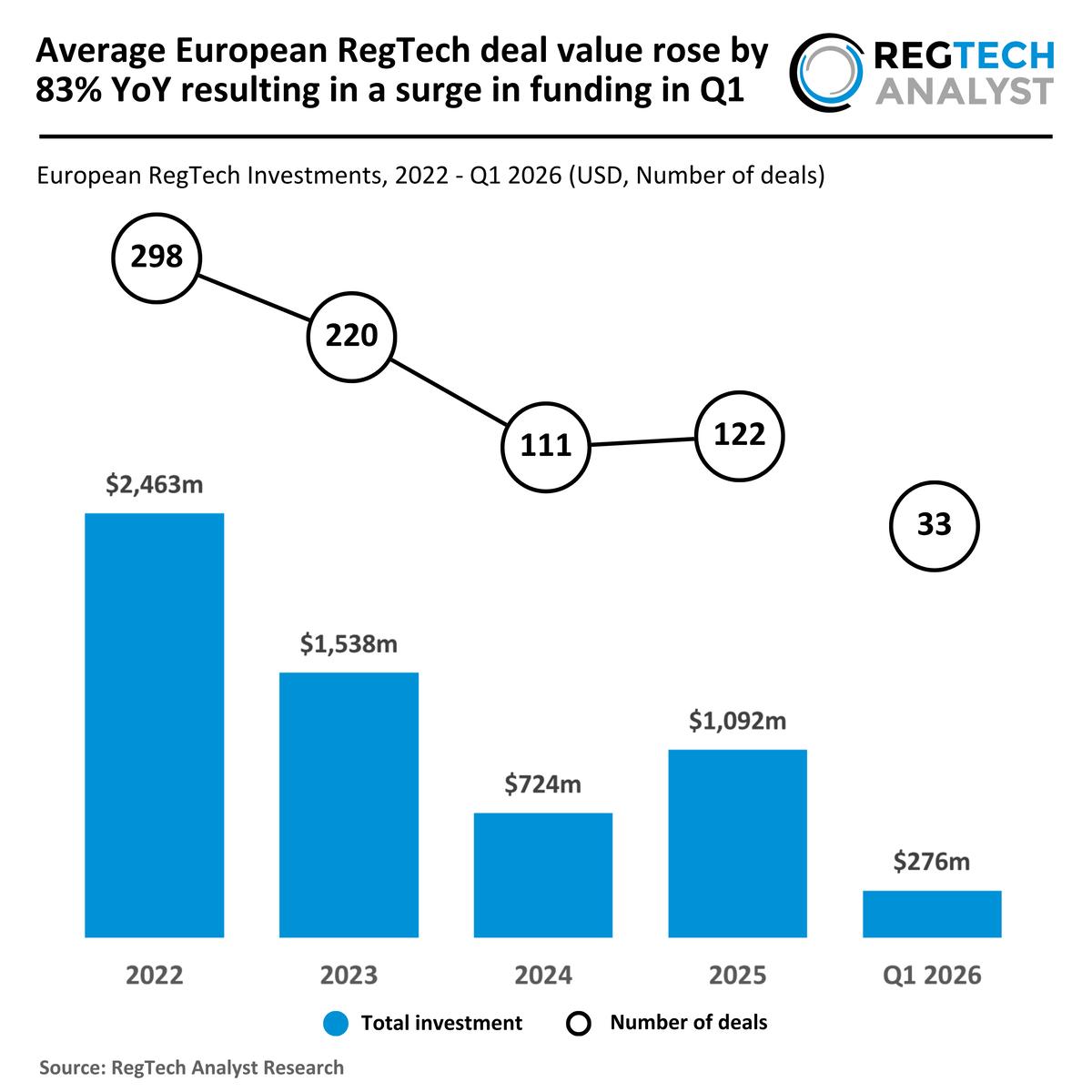
Average European RegTech Deal Value Rose by 83% YoY Resulting in a Surge in Funding in Q1
European RegTech funding surged to $275.6 million in Q1 2026, more than double the $133.6 million raised a year earlier. The average deal size jumped 83% year‑over‑year to $8.4 million, signaling stronger investor confidence. Deal activity is expected to grow 8% in 2026,...

How One Grad Found Purpose in Financial Crime Fighting
A recent personal essay details how a graduate with a humanities background broke into RegTech by ticking a checkbox on a rejection email, landing a content‑automation role at Napier AI. The position quickly evolved into a client‑solutions consultancy, offering a...

Global Regulatory Updates: AIFMD II, UCITS Changes
On 16 April 2026 the EU deadline for transposing AIFMD II expired, activating Directive 2024/927 which amends the 2011 Alternative Investment Fund Managers Directive and the 2009 UCITS Directive. The new regime tightens delegation, liquidity‑risk management, supervisory reporting, depositary services and loan‑origination rules, and...

Who Are Critical ICT Third-Party Providers Under DORA?
EU regulators have officially designated 19 technology firms as Critical ICT Third‑Party Providers (CTPPs) under the Digital Operational Resilience Act (DORA). The designation subjects these vendors—ranging from cloud giants like AWS, Google Cloud and Microsoft to data‑centre operators and fintech...

FCA Non-Financial Misconduct: Is Your Evidence Ready?
On 1 September 2026 the FCA’s Code of Conduct will extend to bullying, harassment and discrimination for every FCA‑authorised firm, not just banks. A 2025 multi‑firm review uncovered 178 internal‑communication breaches, 41% involving senior managers, underscoring regulator focus on non‑financial misconduct. The...

FinScan Expands AML Screening to Digital Wallets
FinScan has upgraded its Payments solution to screen stablecoin transactions and digital‑wallet addresses against global sanctions lists. The enhancement lets banks and fintechs run AML checks on both traditional rails and emerging digital assets through a single API. FinScan’s platform...

Beyond Point Solutions: The Future of AML Compliance
Financial crime compliance is shifting from fragmented point solutions to holistic platforms that combine detection, workflow automation, and scalable architecture. IMTF argues that true effectiveness requires performance across three layers—detection accuracy, operational efficiency, and platform foundation. Its Siron®One solution exemplifies...

AI and the End of Level 1 Compliance Roles
AI is fundamentally reshaping financial‑crime compliance, replacing the traditional Level 1 analyst base with automated digital workers. The technology can gather data, review transactions, draft narratives and apply consistent logic, flattening the pyramid‑style organization. As routine alerts become machine‑handled, banks must...

Spotting Sanctions Evasion Before It Costs Your Business
Sanctions evasion is becoming increasingly sophisticated, with criminals using opaque corporate structures, shell companies, and name‑manipulation to skirt expanding global restrictions. Compliance teams now face a fragmented landscape of U.S., EU, UK and UN sanctions lists that change frequently, raising...

Zamp Nets $30m to Scale Its Sales Tax OS Platform
Zamp, a sales‑tax compliance platform billed as an operating system, announced a $30 million financing round led by Acrew Capital, with participation from Thomson Reuters Ventures and several accounting‑firm partners. The capital will fund three priorities: scaling its accounting‑firm channel, adding...

How Agentic AI Is Reshaping Financial Crime Compliance
Financial institutions face fragmented, manual compliance systems that lag behind continuous crime threats. SymphonyAI’s recent webinar introduced an “always‑on compliance” model powered by agentic AI, which links detection, investigation, and decisioning into a single adaptive workflow. The approach claims up...

Why Your AML Data Vendor Choice Matters More than Ever
Selecting an AML data vendor has become a strategic priority for compliance leaders, not just a regulatory checkbox. Firms increasingly run multiple screening solutions—97% use two or more, and 53% manage eight to ten systems—creating siloed data and high false...

How EMIs Can Close the Gap in AML Architecture
Electronic Money Institutions (EMIs) face AML gaps as instant payment rails leave no buffer for traditional monitoring. Regulators now apply the same due‑diligence standards as banks, exposing structural flaws in legacy AML stacks. Salv argues that consolidating screening, monitoring and...

AI in Tax Reporting: Promise, Limits and What’s Next
Tax reporting firms are rapidly experimenting with generative AI tools like ChatGPT and Claude to streamline data‑intensive compliance tasks. AI excels at document extraction, data transformation, and flagging anomalies, reducing manual spreadsheet work in FATCA and CRS reporting. However, the...

EIDAS 2.0: Should Identity Teams Build or Partner?
eIDAS 2.0 will require European‑focused firms to accept EUDI wallet credentials by December 2027, turning identity verification into a new, cryptographically‑signed attribute model. Building compliance in‑house typically takes 18‑24 months and demands integration with 27 national trust registries, each with its...

Is Identity Becoming the New Perimeter of Financial Regulation?
Regulators are shifting focus from static network perimeters to the identity of participants in financial ecosystems. As products embed across platforms and jurisdictions, accountability remains with the regulated entity, but identity becomes the anchor for risk assessment. Industry leaders like...

MCO Explores Trading Oversight Gaps After SFC Enforcement Action
Hong Kong’s Securities and Futures Commission fined a responsible officer HK$1 million (≈$128,000) and issued a four‑and‑a‑half‑year industry ban after uncovering serious misconduct. The officer executed 25 matched Hang Seng Index options trades between his firm’s proprietary account and a securities...

£3.78m Fine for Bank of Ireland UK’s CoP Failure
The UK Payment Systems Regulator fined Bank of Ireland UK £3,779,300 (about $4.8 million) after the bank missed the Group 1 Confirmation of Payee (CoP) deadline of 31 October 2023, only activating the safeguard in January 2025. During the 14‑month gap, more than 1.14 million new...

AI Governance Gap Puts UK Finance at Risk
A Zango AI report reveals a widening gap between fast‑moving AI adoption and lagging governance in UK and European financial services. Senior leaders from 10 major institutions warn that generative and agentic AI tools are being deployed faster than risk...

Palana S.A. Unites Three Firms in Compliance Platform Play
Palana S.A., a Luxembourg‑London regulatory technology group, merged its Avanterra and Palana Services units into a single entity on 1 April 2026. The unified firm now reports €20.5 million in revenue (about $22.3 million) and employs 120 staff, reflecting a 32% CAGR over the...

Sardine and Modulr Unite on Real-Time Fraud Detection
Sardine has partnered with payments‑automation platform Modulr to embed AI‑driven fraud and anti‑money‑laundering tools into Modulr’s real‑time payment flows. The integration will sit inside Modulr’s Risk & Compliance Hub, covering card and instant‑payment rails across use cases such as payroll,...

Zurich Malaysia Fined for Sanctions Screening Failures
Zurich General Insurance Malaysia (ZGIMB) and Zurich General Takaful Malaysia (ZGTMB) were hit with Administrative Monetary Penalties of RM1,040,000 and RM520,000 respectively, totalling RM1.56 million (approximately $343,000). The fines stem from outdated sanctions screening databases that allowed prohibited entities onto the...

Swiss Ethical Hacking Firm Raises CHF 12m for Expansion
Swiss ethical‑hacking specialist Bug Bounty Switzerland closed a CHF 12 million (≈$13 million) Series A round, co‑led by Direttissima Growth Partners and Deutsche Beteiligungs AG. Both investors took equal minority stakes, and Direttissima’s Philipp Bolliger joined the board. The capital will fund international expansion,...

What Is AI Communications and Why Does It Matter?
AI communications—interactions generated by generative AI tools like ChatGPT, Copilot, and Zoom AI—are emerging as a critical governance challenge for enterprises. A Theta Lake survey of 500 financial services firms shows 99% have adopted AI tools, yet 88% report significant...

QuoIntelligence Raises €7.3m Series A for Threat Intelligence
QuoIntelligence, a Frankfurt‑based threat‑intelligence‑as‑a‑service firm, closed a €7.3 million (≈$8 million) Series A round led by Elevator Ventures and BMH Beteiligungs‑Management Hessen. The capital will fund an expansion of its European analyst team, accelerate product development, and broaden channel partnerships across the continent....

The Real Cost of Building Financial Crime Tools In-House
Many firms attempt to build financial‑crime risk platforms in‑house, believing they’ll save money and retain control. Arctic Intelligence’s analysis shows that RegTech solutions are industrial‑grade ecosystems built on years of regulatory insight, which internal teams cannot match. Specialized talent, built‑in...

How to Choose Broker-Dealer Compliance Software
Broker‑dealer firms face a costly onboarding lag of two to three months before new representatives can generate revenue, a delay that translates into salary expenses without return. Regulatory pressure is intensifying, with FINRA sanctions climbing 77% to $154 million in 2025...

Q2 Targets Account Takeover with New AI Tools
Q2 Holdings introduced two AI‑driven fraud tools—User Activity Monitoring (UAM) and Restricted Entitlements Mode (REM)—to stop account‑takeover attacks in real time. UAM uses behavioural analytics and deterministic rules to flag high‑risk session patterns, while REM automatically limits access or contains...

Why FATCA and CRS Remediation Never Really Ends
Compliance teams repeatedly scramble each year to remediate FATCA and CRS reporting, fixing data gaps and classification conflicts at the last minute. Reliance on spreadsheets and patch‑at‑the‑last‑minute fixes leaves root causes untouched, inflating operational costs, creating knowledge silos, and raising...