FinTech Global’s Third Annual FinCrimeTech50 Names the Leading Innovators Tackling Financial Crime in 2026
FinTech Global released its 2026 FinCrimeTech50, an annual ranking that identifies the most innovative firms fighting financial crime. The list was compiled by analysts who evaluated over 500 nominees on technology impact, innovation, growth and ecosystem contribution. Highlights include AI‑driven AML platforms like Castellum.AI, the Experian‑KYC360 merger, and MCO’s new digital‑asset trading compliance tool. The report underscores the accelerating threat landscape, where generative AI empowers both defenders and criminals.

SymphonyAI Agents Cut Sanctions Workload by 90%
SymphonyAI’s Risk Intelligence (SRI) platform deployed AI‑driven agents for a major U.S. bank, cutting manual sanctions‑screening effort by 90% and slashing alert review time tenfold in a proof‑of‑concept. The agents reduced false positives by 99% and achieved over 98% agreement...

Why AML Failures Cost More than Just Fines
UK firms face mounting AML costs as 87% would sever a partner after a single breach, turning compliance into a survival issue. Recent fines—including a £264.8m (~$335m) penalty in 2021 and a £107.8m (~$137m) fine the year before—highlight regulatory pressure,...

Compliance as a Competitive Edge in FinTech
FinTech executives gathered in Toronto to discuss how compliance is evolving from a regulatory checkbox into a strategic differentiator. The roundtable highlighted the rise of “compliance by design,” urging firms to embed regulatory controls early in product development to avoid...

Why Continuous Learning Stops AI Models Going Stale
Theta Lake, a compliance‑risk technology firm, has made continuous learning a core principle for its AI classifiers, avoiding the common pitfall of one‑off model training. The company enriches training data through extensive text augmentation, multilingual examples, and in‑house labeling to...

FICO Tech Helps Absa Slash Fraud and Double Debt Recovery
Absa Group partnered with analytics firm FICO to embed its Customer Communication Services (CCS) across fraud prevention and debt collection functions, becoming the first South African big‑five bank to use WhatsApp for real‑time fraud verification. The integration with FICO Falcon...

How Nigerian Firms Can Meet CBN’s AML Deadline
On March 2026, the Central Bank of Nigeria updated its Baseline Standards, making automated, real‑time AML/CFT/CPF solutions a legal requirement for all financial institutions. The new framework demands sub‑second transaction screening, near‑real‑time sanctions updates, and AI‑native architectures that can reduce...

Bank of Korea Urged to Adopt Green Monetary Policies
South Korea’s central bank is under growing pressure to embed climate finance into its monetary policy as the won slides to its weakest level since the 2008 crisis and inflation risks rise. Advocacy groups Positive Money and the Institute for...

How Estate Agents Can Tackle Identity Fraud and Financial Crime
The UK property market remains a prime target for money laundering, identity fraud and sanctions abuse, prompting tighter AML and KYC obligations for estate and letting agents. HMRC now classifies agents as “relevant firms” for sanctions reporting and expects five‑year...

KYB Compliance in 2026: What Businesses Need to Know
Know Your Business (KYB) compliance is becoming mandatory across multiple sectors as 2026 regulations tighten under the U.S. Bank Secrecy Act, AMLA, and global FATF standards. The article outlines four core objectives—fraud prevention, regulatory compliance, risk management, and ecosystem integrity—while...

Daintta Secures LDC Backing to Drive Expansion
London‑based Daintta, a specialist professional services firm delivering technology solutions for secure environments, has secured a private‑equity investment from LDC. The funding, part of LDC’s £717 million (≈$917 million) technology portfolio, will back Daintta’s organic growth, expanding its services and deepening capabilities...

Norm AI Sets up Legal Research Lab for AI Agents
Norm AI has launched the Legal AGI Lab, a research initiative aimed at building legal frameworks and compliance infrastructure for AI agents that perform high‑value tasks such as contract negotiation and regulatory decision‑making. The lab focuses on accountability, governance, and...

Why Tax Compliance Goes Beyond Form Collection
Tax compliance is more than filing a form; it requires continuous validation and real‑time monitoring. Comply Exchange warns that unvalidated W‑9/W‑8 documents expose firms to IRS mismatches, penalties, and costly audit fixes. Fragmented storage and manual onboarding create bottlenecks, duplicate...
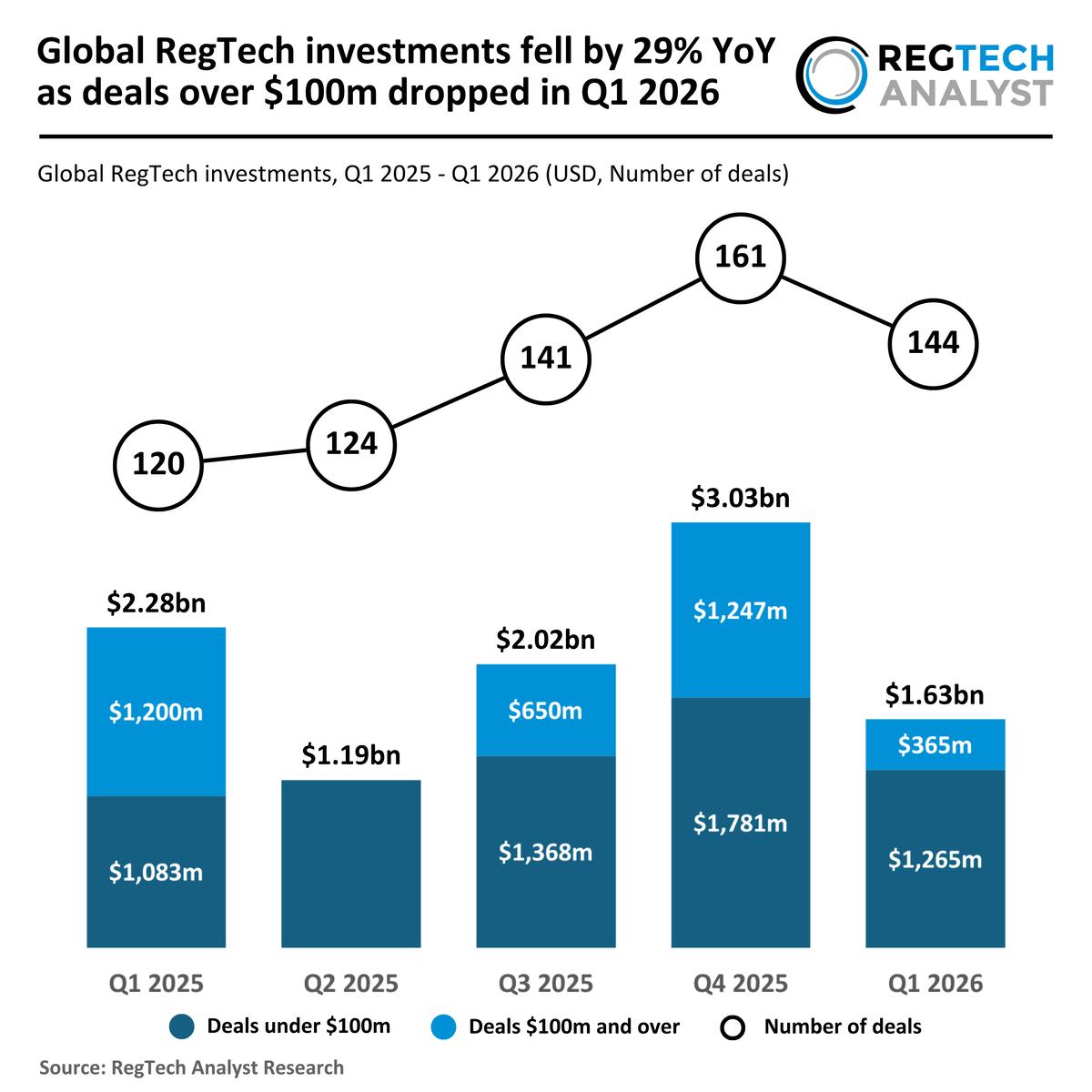
Global RegTech Investments Fell by 29% YoY as Deals over $100m Dropped in Q1 2026
Global RegTech funding slipped 29% year‑over‑year to $1.6 billion in Q1 2026, with total deal count falling to 144. Transactions above $100 million collapsed by 70%, driving the average deal size down to $11.3 million. Despite the downturn, smaller‑ticket deals rose 17%, and AI‑native...

SC Leads Malaysia-China Capital Market Push
Malaysia’s Securities Commission led a high‑level delegation to China under its Capital Market Masterplan 2026‑2030, aiming to deepen bilateral investment ties and attract Chinese institutional investors. The team met regulators including the China Securities Regulatory Commission and the State Administration...

Konfir Joins Experian to Scale Digital Income Checks
Experian has acquired UK‑based digital verification platform Konfir to broaden its income and employment checking capabilities. Konfir leverages Open Banking, payroll and tax data to deliver up to six years of employment history and already serves more than 6,000 businesses...

How Prediction Markets Are Reshaping Compliance Risk
The CFTC, led by new enforcement director David I. Miller, announced that insider‑trading laws apply to prediction‑market contracts, treating them as fraud under the Commodity Exchange Act. Miller outlined enforcement focus on trades that use material nonpublic information from corporate,...

How to Reduce Compliance Risk in Legacy KYC Data
Financial institutions face mounting compliance risk from outdated KYC files, as regulators now deem gaps in ultimate beneficial ownership, source‑of‑wealth and PEP information non‑negotiable. Manual remediation efforts are hampered by fragmented systems, error‑prone spreadsheets, and auditability shortfalls, draining skilled analysts....

How Europe’s New Rules Are Closing the APP Fraud Gap
Europe’s upcoming Payment Services Regulation will obligate payment‑service providers to reimburse victims of personal‑account impersonation fraud and, more critically, to connect to a mandatory, cross‑border fraud‑intelligence exchange. The framework, agreed politically in late 2025, narrows the UK’s geographic limitation by...

Kyckr Appoints Ian Jones as New CTO
Kyckr, the UK‑based RegTech firm specializing in business verification, has hired Ian Jones as its new chief technology officer. Jones brings nearly three decades of technology leadership, including stints as CTO of OpenPlay, director of technology at payments platform xMoney,...

How Sanctions Evasion Went From Lists to Networks
A joint IMTF‑ACSS webinar highlighted that sanctions compliance has moved beyond simple name‑list screening to a network‑centric approach. Evasion now exploits layered global networks, intermediary jurisdictions, and emerging payment methods such as digital assets. Detecting these schemes requires corridor‑based analysis...

Building a GenAI Governance Framework for FinTech Firms
Generative AI has moved from experiment to core operations in financial services, prompting FINRA’s 2026 oversight report that applies existing supervisory rules to AI‑driven activities. The regulator flags hallucinations, bias, concept drift, autonomous agents, and data‑sensitivity as top risks for...

Inside the Push to Centralise Compliance Oversight
Financial institutions are turning to a "compliance control tower" to centralize fragmented oversight across surveillance, risk and regulatory functions. The model layers a central hub over existing RegTech tools, aggregating data into near‑real‑time dashboards. Vendors such as Cardamon, Corlytics and...

Check Fraud in 2026: Why AI Is Now Essential
Check fraud remains a major threat, representing about 30% of all fraud losses in the United States, second only to debit‑card fraud. Reports of suspicious activity tied to check fraud surged 90% from 2021 to 2023, and high‑profile cases involving...

Nine-Figure Raises Dominate in Powerful Q1 for RegTech Deals
The RegTech sector posted a record‑strong first quarter of 2026, raising close to $3 billion globally and $2 billion in the United States across 103 deals. Funding surged 28% year‑over‑year, driven by AI‑focused security firms that alone secured over $1 billion in January,...

Monavate Integrates Sumsub for KYC Compliance
Monavate has integrated Sumsub’s identity‑verification engine into its MonavateOne platform, allowing programme managers to run full KYC checks without separate infrastructure. The live integration, currently covering the UK and the European Economic Area, offers document validation for over 220 countries,...

Capsule Security Raises $7m to Secure AI Agents at Runtime
Capsule Security emerged from stealth with a $7 million seed round led by Lama Partners and participation from Forgepoint Capital International. The startup’s runtime‑first platform aims to secure AI agents while they execute tasks, preventing prompt‑injection attacks, data leaks, and unintended...

How to Simplify DORA Compliance Across Jurisdictions
The EU's Digital Operational Resilience Act (DORA) became enforceable on 17 January 2025, shifting regulators’ focus from implementation to proof of ongoing compliance. A 2024 ESA dry‑run showed only 6.5% of nearly 1,000 firms passed all 116 data‑quality checks, highlighting widespread gaps....

Cross-Border Payments: Balancing AML and Financial Inclusion
Swedish regulators and police have issued new AML/CFT guidance targeting cross‑border payment service providers. The guidance stresses robust customer due diligence, risk indicators and ongoing monitoring while warning against blanket high‑risk labeling of remittance services. It reflects Sweden’s cash‑free transition,...

Five Payment Fraud Trends Reshaping Financial Crime
Tieto Banktech warns that payment fraud is evolving from a purely technical issue to a human‑centred threat. Between 2024 and 2025, social‑manipulation attacks surged 33%, with fraudsters cultivating relationships over days before striking. AI‑driven deepfakes, polished fake e‑commerce sites, and...

What Is a MiKaDiv Solution and How Does It Scale?
MiKaDiv compliance in Germany is an end‑to‑end operating model that governs how shareholder and dividend data are captured, structured, validated and delivered to the Bundeszentralamt für Steuern (BZSt) in XML format. Label emphasizes that a true MiKaDiv solution goes beyond...

Why Automated PEP Screening Is No Longer Optional
Automated screening for politically exposed persons (PEPs) and their close networks is becoming a regulatory imperative. The UK’s Money Laundering Regulations now demand ongoing due diligence not only on PEPs but also on relatives and close associates (RCAs), with continuous...

UAE Central Bank Unveils Nationwide KYC Platform
The Central Bank of the UAE (CBUAE) has signed a technical partnership with Swedish firm Norbloc AB to build a nationwide electronic Know Your Customer (e‑KYC) platform. The system will automate KYC and Know Your Business (KYB) checks, pulling verified...

Vietnam and Australia Partner on FinTech Growth
Vietnam and Australia announced a strategic partnership to accelerate fintech and regtech collaboration, highlighted at a conference in Ho Chi Minh City on April 14. Australia, home to roughly 900 fintech firms and ranked sixth worldwide, will share expertise in...

Key Tax Compliance Deadlines and Rule Changes
Comply Exchange’s March 2026 roundup highlights a shifted Form 1042‑S filing deadline to 17 April 2026 for entities that received a 30‑day extension, and outlines a second‑extension option via Form 8809. The IRS also issued proposed regulations allowing digital‑asset brokers to deliver Form 1099‑DA solely...

Why Design Is the Secret Weapon in AI-Powered Compliance
Quantifind argues that design is as critical as AI for financial‑crime compliance, shaping how investigators interact with complex models. By unifying risk signals, evidence and relationships in a single visual graph, the platform cuts cognitive load and replaces the “enterprise...

SGX-Nasdaq Dual Listing Bill Moves Forward in Singapore
Singapore’s parliament has tabled the Securities and Futures (Amendment) Bill 2026, paving the way for a joint Global Listing Board between SGX and Nasdaq. The legislation would let the Monetary Authority of Singapore prescribe dual‑listing arrangements and permit issuers to...

AI Compliance Startup Haast Closes $12m Series A
AI‑native compliance platform Haast announced a $12 million Series A round, bringing its total US capital to $17.05 million. The round was led by Peak XV Partners with participation from DST Global and Airtree, among others. Haast will use the funds to scale its agentic...

How Investment Advisers Should Manage AI Risk
Artificial intelligence is rapidly permeating financial services, with a McKinsey survey showing 88% of firms piloting AI in 2025, up from 72% the previous year. In the wealth‑management space, adoption is more cautious: only 40% of investment advisers use AI...

Three IDV Mistakes Slowing Your eID Readiness
The identity verification (IDV) sector is rapidly moving away from document‑based checks toward government‑issued digital IDs as AI‑driven fraud escalates. Regulators in Europe and beyond are mandating eID adoption, and large enterprise clients—banks, fintechs, and global platforms—are already demanding compliant...

Why Sanctions Programs Must Move Beyond Name Matching
In 2026 compliance teams face a sharp trade‑off between speed and defensibility as real‑time payments and digital onboarding demand instant decisions. Alessa CEO Holly Sais‑Phillippi warns that reliance on simple name‑matching creates alert noise, high false‑positive rates, and blind spots...

Oracle Taps Lucinity Tech to Enhance AI-Driven Compliance Tools
Oracle is integrating Lucinity’s AI‑native investigation technology into its Financial Crime and Compliance Management (FCCM) platform, embedding AI agents into the Oracle AI Investigator tool. The partnership aims to automate manual investigation tasks, surface relevant context, and guide decision‑making for...

US Expands Cyber Threat Information Sharing to Digital Asset Firms
The U.S. Treasury’s Office of Cybersecurity and Critical Infrastructure Protection has launched a new information‑sharing program that extends the same cyber‑threat intelligence used by traditional banks to eligible digital‑asset firms. The service is provided at no cost and delivers actionable...

Australia’s AML Reforms: Strategies for Success in 2026
Australia’s anti‑money laundering and counter‑terrorism financing reforms will take effect in early 2026, prompting regulators and industry leaders to adopt a risk‑focused, outcomes‑based approach. AUSTRAC’s chief executive signaled a move away from tick‑box compliance toward substantive risk management, encouraging firms...

Zeidler Group Adds Taiwan to Its RegTech Compliance Tool
Zeidler Group, a law‑firm‑backed RegTech provider, has expanded its Marketing Material Review Tool (MMR‑Tool) to cover Taiwan’s securities regulations, including the SITCA Act and related advertising guidelines. The update lets global asset managers automatically vet marketing content against Taiwan’s fair‑presentation...

Why AMLA’s Article 12 Demands a New Approach to Corporate Due Diligence
The EU’s Anti‑Money Laundering Authority (AMLA) draft RTS introduces Article 12(1)(d), obliging firms to perform a qualitative assessment of whether a corporate structure is deliberately opaque, rather than merely identifying owners. Existing customer‑due‑diligence (CDD) programmes, built on binary verification, screening and...

How Canadian Banks Are Able to Master the New AML Rules
Canada is overhauling its anti‑money‑laundering framework by launching the Canada Financial Crimes Agency and amending the PCMLTFA, widening the regulatory perimeter to include mortgage brokers and other non‑bank players. The upcoming real‑time payments infrastructure slated for 2026 will demand instant...

Fingerprint Launches AI-Enhanced Suspect Score Tool
Fingerprint has added AI‑powered recommendations to its Suspect Score fraud detection tool, creating a production‑ready machine‑learning system that trains on each customer’s labeled data. The new engine automatically optimizes signal weights, reduces false positives and lets users preview changes before...

Confluence and ACA Partner to Streamline GIPS Verification
Confluence Technologies and ACA Group have teamed up to automate data feeds between Confluence’s Revolution Composites platform and ACA’s GIPS verification requirements. The integration lets asset managers extract and deliver GIPS‑compliant data with a single click, eliminating manual mining and...

US RegTech Investments Recovered in 2025 Driven by a 61% Surge in Deals Under $100m
US RegTech funding rebounded in 2025, posting a 17% year‑over‑year increase to $5.9 billion across 294 deals. Deal activity under $100 million surged 61%, reaching $3.4 billion, while large transactions above $100 million continued to shrink. Vanta secured a marquee $150 million Series D at a...