
ISO 27001:2013 vs 2022 – A Quick Comparison Guide
ISO 27001:2022 supersedes the 2013 version, introducing a streamlined set of 93 controls organized into four thematic categories—Organizational, People, Physical, and Technological. The update adds 11 new controls targeting cloud security, threat intelligence, secure coding, and data protection, while tightening requirements for risk treatment, monitoring, and documentation of interested parties, including climate considerations. Organizations had a three‑year transition window that ended in October 2025, making 2013 certifications invalid. Compliance firms like Kratikal now guide firms through gap assessments, policy development, and certification audits for the new standard.
NDSS 2025 – WAVEN: WebAssembly Memory Virtualization For Enclaves
Researchers from Southern University of Science and Technology and ByteDance presented WAVEN, a WebAssembly memory virtualization layer designed for trusted execution environments (TEEs). WAVEN enables cross‑module memory sharing and page‑level access control, addressing the linear memory model’s limitations in Wasm‑based...
Shift Left QA for AI Systems. Catching Model Risk Before Production
Shift‑left QA repositions testing to the earliest stages of AI development, targeting data selection, prompt design, and model behavior before any user interface exists. Traditional software QA, which validates deterministic code after UI creation, misses the probabilistic failures that AI...
Corr-Serve Strengthens South Africa’s Cybersecurity Market Through Expanded Seceon Partnership
Corr-Serve has expanded its seven‑year partnership with global cyber‑security firm Seceon, becoming the exclusive distributor for Seceon's AI‑driven Open Threat Management platform across the Southern African Development Community. The deal positions South Africa as the operational hub, delivering real‑time threat...

Browser Wars, Continued: Why Everyone Is Building Their Own AI Browser
The browser has evolved from a simple web gateway into the primary enterprise endpoint, handling over 70% of global traffic. Generative AI agents that can act autonomously inside browsers are turning them into intelligent workspaces, prompting incumbents and startups to...

From Incident to Insight: How Forensic Recovery Drives Adaptive Cyber Resilience
Ransomware attacks now cost $156 million daily, prompting firms to rush system restoration. However, without forensic recovery, organizations lack the evidence needed to confirm breach eradication and understand attacker tactics. Modern forensic solutions capture and analyze digital artifacts in real time,...

The 2025 Phishing Surge Proved One Thing: Chasing Doesn’t Work
In 2025 phishing evolved from a nuisance into a professional, subscription‑based service. Threat actors now rent disposable infrastructure, use generative AI to craft high‑fidelity pages, and repurpose mainstream no‑code platforms, while large language models eliminate the classic bad‑writing tell. These...

Mass Data, Mass Surveillance, and the Erosion of Particularity: The Fourth Amendment in the Age of Geofence Warrants and Artificial...
On Jan. 16, 2026 the Supreme Court granted certiorari in United States v. Chatrie, asking whether bulk geofence warrants satisfy the Fourth Amendment’s particularity requirement. A geofence warrant compels a data custodian to hand over location records for every device within a...
10 Questions Enterprise Leaders Should Ask Before Running a Red Teaming Exercise
Red Teaming simulates real‑world attacker behavior across people, processes, and technology, going beyond traditional penetration testing that only flags technical flaws. It helps enterprises verify whether detection, response, and containment capabilities can stop a breach before business damage occurs. Leaders...
How ASPM Protects Cloud-Native Applications From Misconfigurations and Exploits
Application Security Posture Management (ASPM) consolidates vulnerability, misconfiguration, and runtime data into a single, continuous risk model for cloud‑native applications. By graph‑linking code commits, container images, Kubernetes objects, and cloud resources, ASPM reveals which findings are truly exploitable. This unified...
What Are Drive-By Download Attacks?
Drive‑by download attacks automatically install malware when a user visits a compromised website, requiring no clicks or consent. They exploit outdated browsers, plugins, or operating systems, often via malicious scripts, malvertising, or exploit kits. The resulting payloads range from trojans...

Someone Is Impersonating Me on Instagram — and Meta Doesn’t Give a Sh*t
Technology veteran Alan Shimel discovered an Instagram account impersonating him, using the handle shimel.alan, which quickly followed 85 of his contacts and received follow‑backs from ten. He reported the account through Meta’s built‑in AI‑driven reporting tool, only to receive an...

This Guide Will Show You How to Create SAML Identity Management.
The guide walks CTOs and VPs of Engineering through building SAML‑based identity management for enterprise single sign‑on, covering claim design, certificate handling, and a step‑by‑step migration from ADFS. It explains how to configure assertions, secure metadata, and align SAML with...
NDSS 2025 – Rethinking Trust In Forge-Based Git Security
The NDSS 2025 paper introduces gittuf, a decentralized security layer for Git repositories that removes reliance on a single trusted forge. By distributing policy declaration, activity tracking, and enforcement among all contributors, gittuf lets developers independently verify changes. The system...

Why AI Is Making Attack Surface Management Mandatory
Amit Sheps of CyCognito warns that AI is rapidly expanding enterprise attack surfaces, making traditional vulnerability hunting insufficient. He stresses that without continuous external discovery and clear ownership mapping, security teams cannot prioritize true risk. AI both creates new entry...

ZEST Security Adds AI Agents to Identify Vulnerabilities That Pose No Actual Risk
ZEST Security introduced AI Sweeper Agents that assess whether discovered vulnerabilities can actually be exploited in a given IT environment. The solution uses three specialized agents—Analysis, Environment‑Evaluation, and Validation—to match exploit requirements against an organization’s configuration. ZEST reports that more...

Securing the Future: Practical Approaches to Digital Sovereignty in Google Workspace
The recent Thales‑Google Workspace webinar highlighted practical ways to achieve digital sovereignty through client‑side encryption and Thales CipherTrust. It underscored how Google Workspace’s zero‑trust architecture, regional data storage, and external key management give organizations control over encryption keys. The discussion...
NSFOCUS AI-Scan Gains Recognition From Authoritative Institution
International Data Corporation (IDC) highlighted NSFOCUS AI‑SCAN in its October 2025 report, ranking it highly across six core LLM‑security dimensions. The platform offers comprehensive model, data, content, and application security, plus industry‑specific adaptation and unified management. AI‑SCAN currently supports more than...
NDSS 2025 – Tweezers
The NDSS 2025 paper introduces Tweezers, a framework that leverages an event attribution‑centric tweet embedding to detect security events on Twitter. By focusing on semantic attribution rather than simple keyword matching, Tweezers achieves higher precision and broader coverage than prior...
NDSS 2025 – Dissecting Payload-Based Transaction Phishing On Ethereum
The paper presented at NDSS 2025 reveals a new, sophisticated phishing vector on Ethereum called payload‑based transaction phishing (PTXPHISH). Researchers built the first ground‑truth dataset of 5,000 phishing transactions and identified four main tactics across eleven sub‑categories. Their rule‑based detection...
What SaaS Security ROI Looks Like in Practice
AppOmni released an ROI report showing SaaS security delivers tangible operational benefits quickly. Customers reported saving roughly 146 manual hours each month and a 24% reduction in audit findings after gaining visibility. The study found measurable value within two weeks...
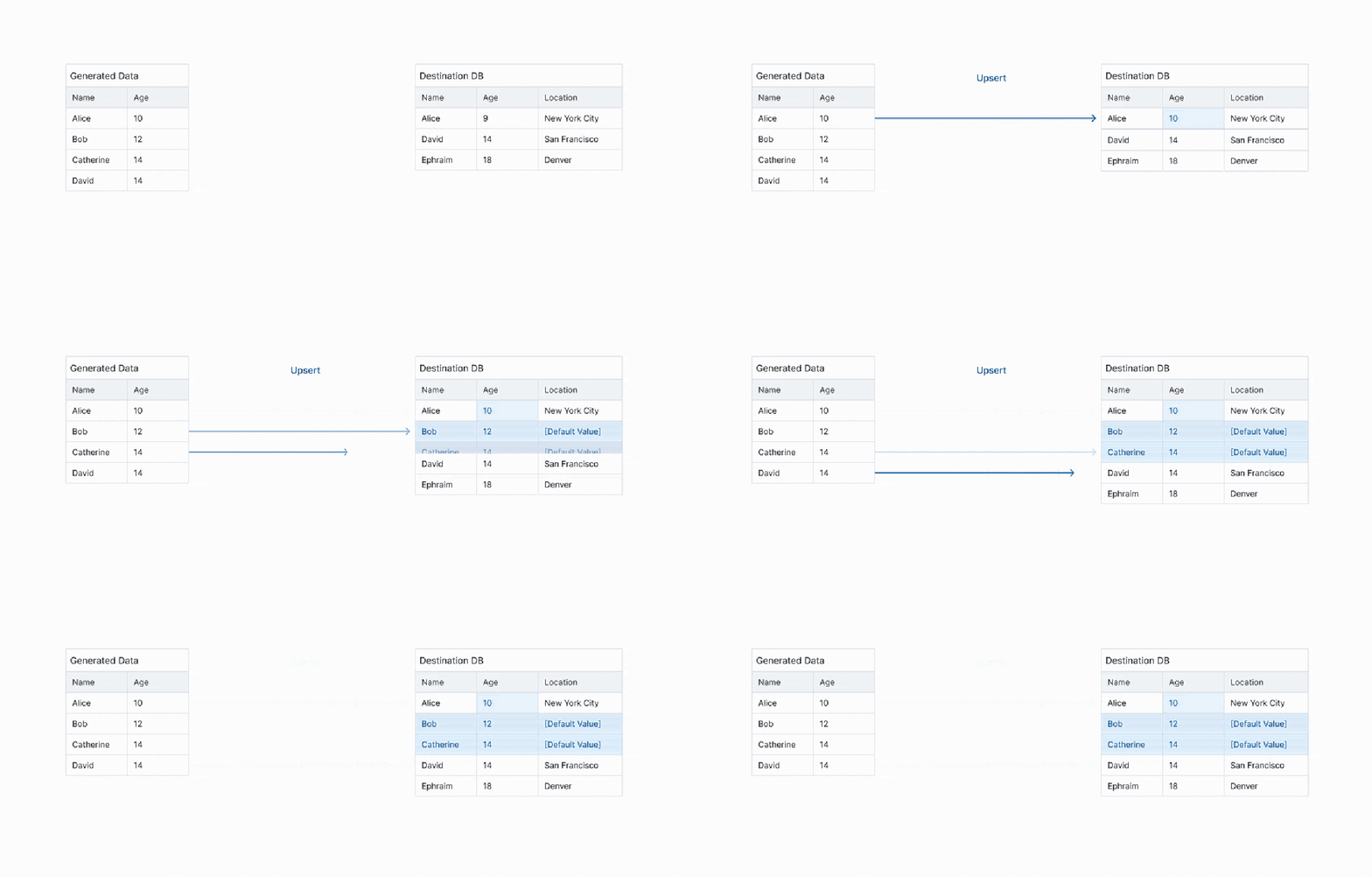
Using Data Upsert to Optimize Test Data Management
Tonic.ai has added upsert capabilities to its test‑data platform, allowing teams to insert new records while updating existing ones without overwriting valuable test data. The feature supports preserving legacy fixtures, merging multiple data subsets, and retaining mock data for unreleased...
How Realm Data Haven Solves Long-Term Log Storage and Fast Resupply for SOC Teams
Realm introduced Data Haven, a dedicated long‑term log archive that separates storage from real‑time SIEM detection. The platform automatically routes all telemetry to secure, low‑cost storage without manual configuration and normalizes logs on ingest. Analysts retrieve archived data by simple...

Executive Brief: Questions AI Is Creating that Security Can’t Answer Today
AI‑assisted development now dominates software creation, with 92% of developers using tools like GitHub Copilot and AI‑generated code comprising roughly 40% of new code. Traditional application security controls, designed for post‑commit review, fail to see code at the moment it...

Enterprise-Grade Identity Verification for AI-Enhanced Workflows
Enterprises accelerating AI adoption face a critical gap in identity verification. A GBG report shows 31% of businesses struggle to detect fraud during onboarding, exposing AI workflows to manipulation. Enterprise‑grade verification combines biometrics, document validation, API checks, MFA and continuous...

NSFOCUS Enters the Global Top Tier of DDoS Security: NSFOCUS DDoS Solutions Positioned in the MarketsandMarkets™ Star Quadrant
NSFOCUS has been placed in the Star Quadrant of MarketsandMarkets' Global DDoS Protection and Mitigation Security Market Forecast to 2030, marking its entry into the industry’s top tier. The ranking reflects NSFOCUS’s mature technology stack, broad solution portfolio, and expanding...

Attribute-Based Access Control (ABAC): Complete Guide with Policy Examples
Businesses are abandoning passwords for B2C apps, citing high friction and security risks. Password resets cost about $70 each and cause significant support expenses, while passwordless solutions can boost conversion rates by more than 10%. The CIAM market is expanding,...
Integrating Enzoic Alerts Into Microsoft Sentinel with Azure Logic Apps
Enzoic’s real‑time breach alerts can now be piped into Microsoft Sentinel using Azure Logic Apps, turning each webhook into a Sentinel incident. The guide walks through provisioning a Log Analytics workspace, creating a consumption‑based Logic App, parsing Enzoic’s JSON payload,...
Introducing Mend.io’s AI Security Maturity Survey + Compliance Checklist Available Today
Mend.io launched an interactive AI Security Maturity Survey and a companion Compliance Checklist to help organizations assess and document AI risk. The tools map to OWASP AIMA, NIST AI RMF, ISO 42001 and the upcoming EU AI Act, delivering a personalized...
NDSS 2025 – Studying the Defensive Registration Practices of the Fortune 500
Researchers at NDSS 2025 examined defensive domain registrations by Fortune 500 firms, uncovering 19,523 domains registered across 447 companies. The study found most firms register only a handful of domains, yet they collectively rely heavily on online brand protection (OBP)...

The Zero Risk Trap: How to Ditch Perfection and Prioritize Real Cyber Resilience
Cybersecurity leaders are trapped in a zero‑risk mindset, chasing perfect audit scores while real threats evolve. The article argues that this pursuit leads to burnout, misallocated resources, and a false sense of security. It proposes a shift toward ruthless risk...

The Data Center Is Secure, But Your Users Are Not
Data centers now feature layered physical safeguards, redundant systems and zero‑trust digital controls, creating a robust perimeter. Despite these defenses, most breaches stem from human error, especially phishing and weak passwords. The article highlights that 90 % of 2021 data breaches...

Why Smart Contract Security Can’t Wait for “Better” AI Models
In 2024, smart‑contract vulnerabilities cost the Web3 ecosystem $1.42 billion across 149 incidents, with access‑control flaws alone responsible for $953.2 million. While the community debates perfect AI solutions, current AI‑powered static analysis tools already capture roughly 80 % of known issues, and models...

Cybersecurity in the Age of AIOps: Proactive Defense Strategies for IT Leaders
Cybersecurity AIOps combines AI, machine learning, and automation to transform traditional security operations. It enables real‑time threat detection, reduces human error, and shifts defenses from reactive to proactive. Key strategies include predictive analytics, automated response, alert prioritization, cross‑team collaboration, and...
The Hidden Cybersecurity Risk of “Integrated” Security Platforms
Security vendors increasingly market ‘integrated’ platforms as a way to simplify protection, but most are merely stitched collections of separate tools. This architectural shortcut leaves each product with its own data model, causing delayed correlation and siloed response actions that...
How to Configure KeyLocker for JarSigner Using the DigiCert KSP Library?
Developers can now sign Java .jar files using DigiCert’s cloud‑based KeyLocker, which keeps private keys inside FIPS‑compliant HSMs. By installing the DigiCert KeyLocker Tools and configuring environment variables, the smctl command registers the DigiCert KSP library and synchronizes the desired...

Just-in-Time (JIT) Provisioning: How Automated User Provisioning Works in SSO
Just‑in‑Time (JIT) provisioning automates user account creation the moment a worker logs in via SSO, using SAML or OIDC claims. The approach eliminates manual onboarding steps, cuts admin time, and reduces typo‑related security gaps. However, JIT only creates accounts; it...
Top 10 HIPAA Compliance Software Solutions
The article ranks the ten leading HIPAA compliance software platforms, emphasizing a shift from periodic checklists to continuous, automated compliance operations. It highlights that 2025 healthcare breaches averaged $7.42 million per incident, prompting regulators to add MFA, full‑encryption, and annual audits....

Real-Time Threat Intelligence: Empowering Proactive Cybersecurity with Seceon
Seceon Inc. unveiled an AI‑driven real‑time threat intelligence platform that continuously monitors networks, endpoints, cloud services, and user identities. By fusing machine‑learning, behavioral analytics, and global threat feeds, the solution identifies zero‑day attacks, insider threats, and fileless malware as they...

Outsourcing IT Support: Benefits, Risks, and Smart Next Steps
The episode outlines how fast‑growing SaaS companies can outsource IT support by contracting for clear outcomes, defining precise scopes, and applying zero‑trust controls. It emphasizes data‑driven metrics such as First Contact Resolution, MTTR, and CSAT to justify the move, while...
Entity Resolution Vs. Identity Verification: What Security Teams Actually Need
The episode clarifies the distinction between identity verification—confirming a person’s claimed identity at a specific moment—and entity resolution—linking disparate identity fragments into a unified profile. It explains why security teams, facing credential exposure and reuse, need entity resolution combined with...
OAuth Scopes & Consent: Complete Guide to Secure API Authorization
The episode explains OAuth scopes as granular permission strings that let users grant apps only the access they need, illustrating real‑world examples from healthcare, retail, and finance and showing how consent screens translate technical scopes into plain language. It covers...

Who’s Stalking Whom? ICE Uses Social Media and Phone Surveillance System to Track Protesters
U.S. Immigration and Customs Enforcement has deployed a surveillance suite built by PenLink, a Cobwebs Technologies subsidiary, to harvest location data from hundreds of millions of mobile devices. The system integrates the social‑media scraper Tangles and the mapping tool Webloc,...
NDSS 2025 – Compiled Models, Built-In Exploits
Researchers at NDSS 2025 unveiled a systematic study of bit‑flip attacks targeting deep‑learning executables compiled by modern DL compilers. Unlike prior work that focused on flipping weights within frameworks, the new approach exploits publicly known model structure embedded in the...

Will 2026 See a ‘ChatGPT Moment’ for Microchip Implants?
In 2026 Neuralink announced high‑volume production of its brain‑computer interface, aiming for hundreds to low‑thousands of implants, while competitor Merge Labs raised $252 million to develop AI‑linked neural devices. Recent medical milestones include an ALS patient typing via a Neuralink chip,...

JFrog Researchers Uncover RCE Exploit for Existing Redis Database Vulnerability
JFrog researchers have demonstrated a remote code execution (RCE) exploit for Redis vulnerability CVE‑2025‑62507, leveraging a stack buffer overflow triggered by the XACKDEL command with multiple IDs. The flaw, originally rated 8.8 CVSS, now warrants urgent patching to Redis version 8.3.2....
How Attackers Target Financial Applications and VAPT Stops Them?
Financial applications faced a staggering 1.2 billion attacks in 2025, double the frequency of other sectors. Exploitation of known CVEs jumped 74%, while API abuse and business‑logic flaws emerged as primary breach vectors. The report underscores the necessity of Vulnerability Assessment...
Identity Management Challenges in Pharma & Biotech SaaS Platforms (And How to Solve Them)
Pharma and biotech firms are accelerating SaaS adoption for drug discovery, clinical trials, and manufacturing, but fragmented identity and access management (IAM) threatens compliance and intellectual‑property protection. The life‑sciences software market hit $16.1 billion in 2024 and is growing 11‑13% annually,...
Is Your Data Truly Secure with Free AI Tools
Enterprises are increasingly dependent on non‑human identities (NHIs) such as tokens, keys, and certificates to power cloud and DevOps workflows. The article argues that many organizations still treat these machine passports like afterthoughts, exposing them to breach risk and compliance...
How Is AI Improving the Management of Cloud Secrets
Non‑human identities (NHIs) such as machine tokens and keys now outnumber human accounts, making their secret management a critical security priority. Organizations are shifting from point‑solution secret scanners to comprehensive NHI platforms that cover discovery, classification, monitoring, and automated rotation....