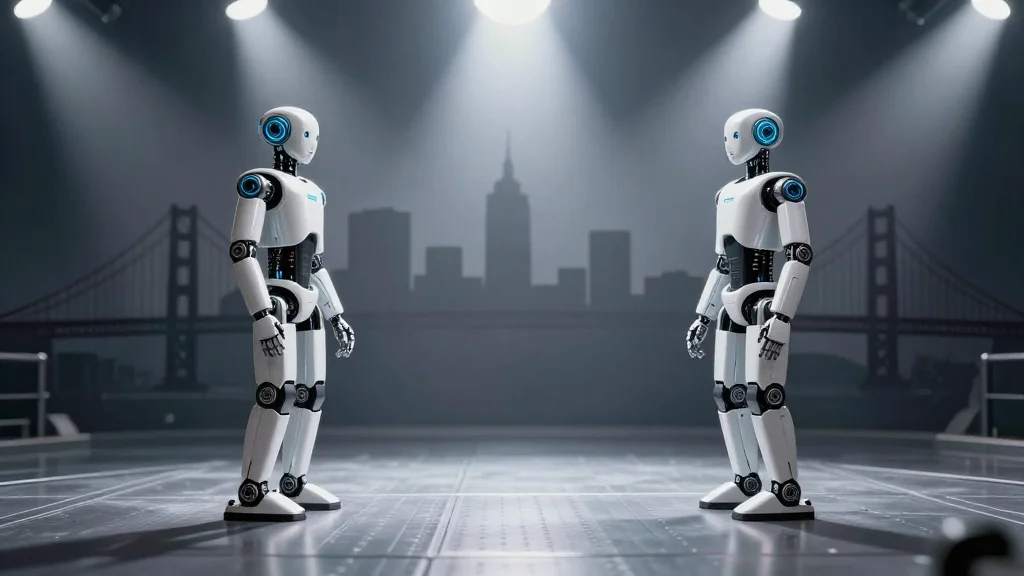
Humanoid Robot Fight Goes Viral as Bay Area Store Prepares for Season 1 Launch

Companies Mentioned
Why It Matters
The viral robot fight marks a turning point where humanoid robots move from laboratory prototypes to mainstream entertainment. By showcasing robots in a combat setting that mirrors human sports, the event lowers psychological barriers and familiarizes the public with advanced robotics in everyday contexts. The hybrid store‑arena model also demonstrates a viable commercial pathway, blending product sales with experiential events that can generate recurring revenue. Beyond the Bay Area, the adoption of humanoid robots at the Asian Beach Games signals that large‑scale sporting events are beginning to integrate robotics for logistics, audience interaction and possibly future competitive formats. This convergence could accelerate investment in robot perception, balance and agility, driving faster innovation cycles across both consumer and industrial robotics sectors.
Key Takeaways
- •Cix Liv’s store in San Francisco hosted the first public duel between Engine and Unitree humanoid robots, sparking a viral video with millions of views.
- •The fight promotes the Ultimate Fighting Bots league’s Season 1 debut on May 14 at Temple SF.
- •Store will operate as a retail space by day and a robot‑combat arena by night, offering nightly fights and dance‑offs.
- •Humanoid robots were also used at the 6th Asian Beach Games in Sanya, showing broader adoption in large‑scale events.
- •UFB plans a second high‑profile battle on Venice Beach in October, aiming to turn robot combat into a touring sport.
Pulse Analysis
The emergence of robot combat as a spectator sport reflects a broader shift in how robotics companies monetize technology. Historically, revenue has come from industrial sales, logistics contracts or research grants. By creating a live‑event ecosystem, firms can tap into ticket revenue, sponsorships, and ancillary merchandise—similar to the esports model that turned video‑game competition into a multi‑billion‑dollar industry. The San Francisco store’s dual‑purpose design is especially clever: it provides a tangible retail experience while generating content that fuels social media virality, a feedback loop that can dramatically lower customer acquisition costs.
From a technology standpoint, the fight showcases the maturity of balance, locomotion and real‑time perception in humanoid platforms. Unitree’s ability to run at over 4.4 mph and climb stairs, combined with Engine’s logistics‑grade robustness, suggests that the hardware is now capable of handling the unpredictable dynamics of a combat arena. This could accelerate development of safety‑critical applications such as disaster‑response robots that must navigate chaotic environments.
However, scaling robot sports will require clear governance. Unlike traditional combat sports, autonomous robots raise unique liability questions—who is responsible if a robot injures a spectator or damages property? Industry groups will need to establish standards for impact forces, fail‑safe mechanisms and data privacy, especially as leagues aim to personalize robots with voice recognition and name‑calling features. The next few months, culminating in the May 14 launch, will be a litmus test for whether the hype can be translated into a sustainable, regulated entertainment sector.
Humanoid Robot Fight Goes Viral as Bay Area Store Prepares for Season 1 Launch
Comments
Want to join the conversation?
Loading comments...