Lovable Raises $330M at a $6.6B Valuation to Turn Non-Developers Into Software Builders
•December 18, 2025
0
Companies Mentioned


Why It Matters
By democratizing software creation, Lovable unlocks a latent workforce of builders, driving faster product cycles and cost savings for Fortune‑500 firms while spawning new revenue‑generating startups.
Key Takeaways
- •$330M Series B at $6.6B valuation.
- •100k+ projects created daily, 25M first-year total.
- •Enterprises cut development cycles from weeks to days.
- •New startups generate $1M+ ARR within months.
- •Integrations deepen with Notion, Jira, Linear, Miro.
Pulse Analysis
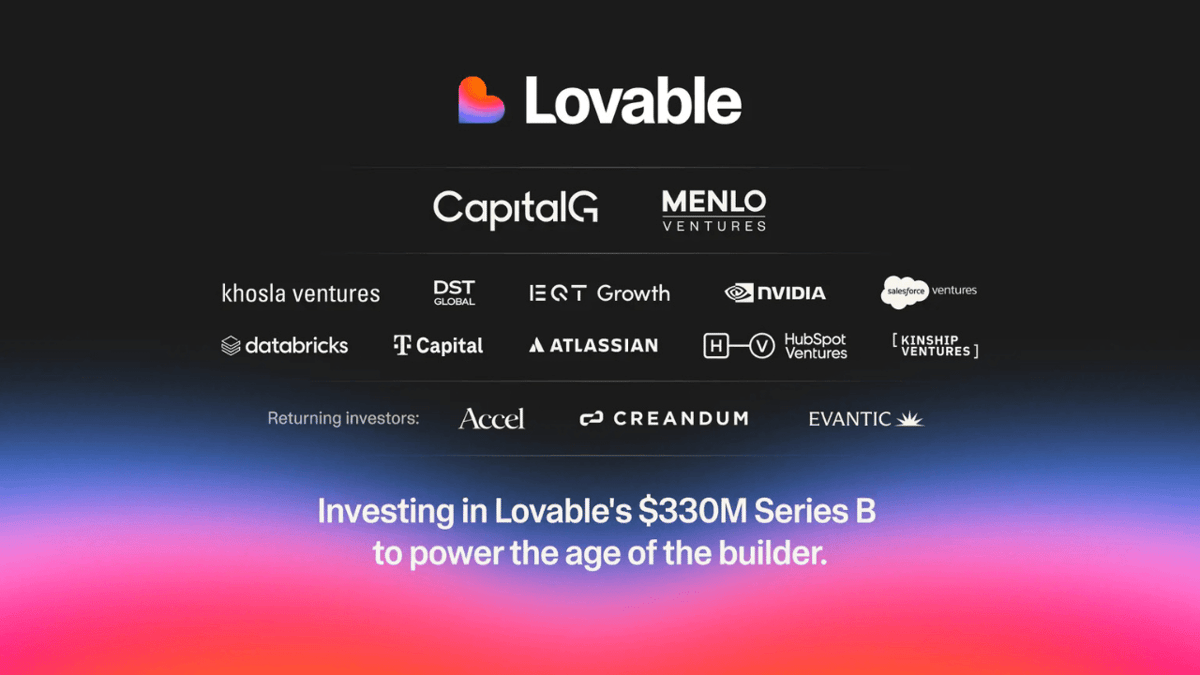
The no‑code movement has moved from hobbyist tools to enterprise‑grade platforms, and Lovable’s latest funding round underscores that transition. Backed by heavyweight investors such as CapitalG, Nvidia’s NVentures, and Salesforce Ventures, the company is positioned to capture a sizable share of the $21 billion low‑code market. Its focus on real‑world production—offering hosting, databases, and payment processing—distinguishes it from pure prototyping solutions and aligns with the growing demand for end‑to‑end, citizen‑developer workflows.
Enterprise adoption stories illustrate the tangible business impact. Deutsche Telekom compressed a four‑week, 20‑person project into a four‑day sprint, while Zendesk reduced a six‑week prototype timeline to three hours. These efficiency gains translate into faster time‑to‑market, lower engineering overhead, and the ability to run multiple initiatives concurrently. For product managers, marketers, and operations teams, the platform removes traditional bottlenecks, enabling them to iterate directly on functional interfaces rather than relying on lengthy hand‑offs to engineering.
Beyond internal use, Lovable is spawning a new class of startups that achieve rapid revenue traction without traditional development resources. Companies like Lumoo, ShiftNex, and QuickTables have reached six‑figure ARR within months, demonstrating the platform’s capacity to accelerate go‑to‑market strategies. As Lovable deepens integrations with collaboration suites such as Notion, Jira, and Miro, it further embeds itself into existing digital ecosystems, creating network effects that reinforce its market position. The combination of robust enterprise backing, measurable productivity gains, and a thriving builder community suggests Lovable could become a cornerstone of the next wave of software innovation.
Lovable raises $330M at a $6.6B valuation to turn non-developers into software builders
0
Comments
Want to join the conversation?
Loading comments...