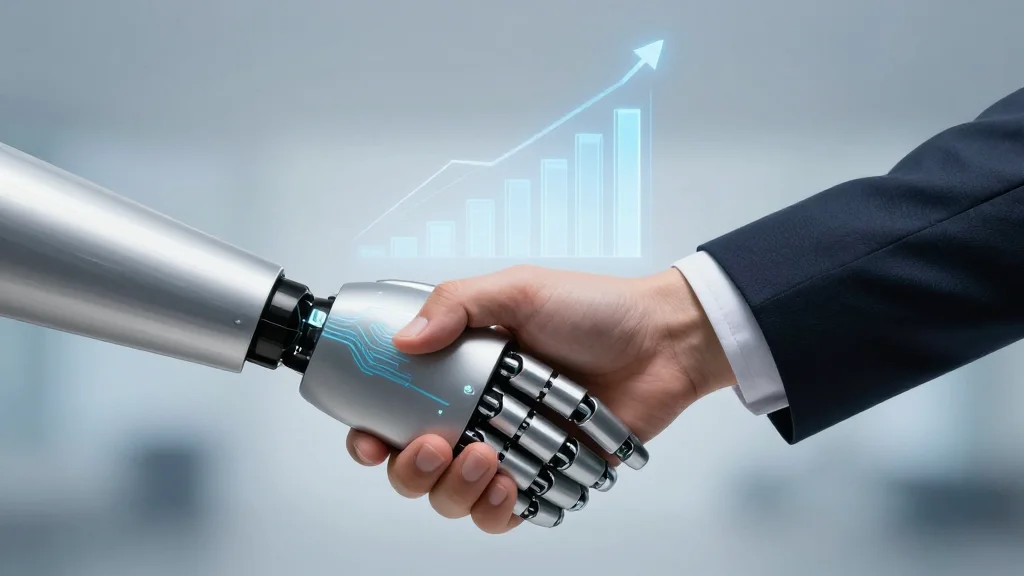
SaaStr AI Annual 2026 Q&A Shows AI Sales Agents Outperform Humans by 120% and Puts Growth First

Companies Mentioned

Why It Matters
The revelation that AI agents can outperform human reps by 120% forces sales organizations to rethink talent allocation, compensation, and training. If AI can reliably handle lead qualification and routine negotiations, human sellers must pivot to roles that require deep product mastery and strategic insight, raising the bar for hiring and onboarding. Moreover, the growth‑first mantra signals a shift away from relationship‑centric metrics toward measurable, short‑term ROI, which could compress sales cycles and reshape go‑to‑market strategies across B2B SaaS. For investors, the data point validates a wave of funding into AI‑enabled sales platforms and forward‑deployed engineering services. Companies that can marry high‑velocity AI agents with expert human oversight are poised to capture market share, while those clinging to legacy “schmoozing” models risk obsolescence.
Key Takeaways
- •AI sales agents reported to deliver 120% of human productivity at SaaStr AI Annual 2026.
- •Growth‑first strategies were declared the primary metric for sales success.
- •Sales reps must become product experts; traditional relationship‑selling is declining.
- •Marc Benioff advocated for Forward Deployed Engineers to deliver value before contracts.
- •Future SaaStr workshops will focus on building AI‑first sales stacks and FDE integration.
Pulse Analysis
The SaaStr AI Annual 2026 Q&A marks a watershed for sales automation, moving the conversation from speculative hype to concrete performance benchmarks. A 120% productivity claim, while still anecdotal, suggests that AI agents are no longer experimental add‑ons but core revenue generators. Historically, sales technology has progressed in incremental steps—CRM, email automation, predictive analytics—but the current wave combines real‑time natural language processing with domain‑specific knowledge bases, enabling agents to handle complex objection handling that previously required senior reps.
This shift has two immediate competitive implications. First, incumbents that have already embedded AI into their sales motions—such as Salesforce’s Einstein and HubSpot’s AI assistant—will likely accelerate adoption, leveraging their data advantage to fine‑tune agent performance. Second, a new class of niche players will emerge, offering specialized FDE‑style services that train AI agents on proprietary product stacks, effectively turning the sales function into a hybrid of software engineering and consultancy. Companies that fail to integrate these capabilities risk longer sales cycles and higher churn, as customers gravitate toward vendors who can demonstrate immediate, measurable outcomes.
Looking ahead, the pressure will be on to validate the 120% claim at scale. Early adopters will need robust metrics to prove ROI, and investors will scrutinize unit economics—especially the cost of training and maintaining AI agents versus the incremental revenue they generate. If the growth‑first mantra holds, we may see a re‑alignment of sales compensation toward outcome‑based payouts, further incentivizing the deployment of AI agents that can deliver rapid, quantifiable results. The next quarter will be a litmus test for whether AI‑augmented sales can sustain the promised productivity gains across diverse market segments.
SaaStr AI Annual 2026 Q&A Shows AI Sales Agents Outperform Humans by 120% and Puts Growth First
Comments
Want to join the conversation?
Loading comments...