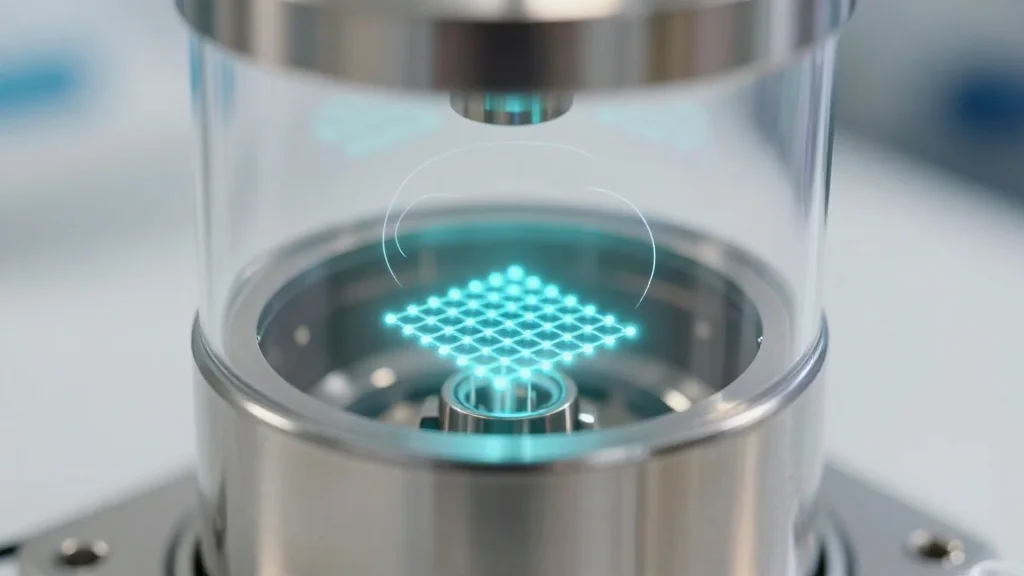
Digital Quantum Magnetism on a Trapped-Ion Quantum Computer
Companies Mentioned
Why It Matters
The study proves that near‑term trapped‑ion processors can reliably simulate intricate magnetic systems, opening a pathway for quantum computers to tackle problems inaccessible to classical methods and accelerating research in condensed‑matter physics and materials design.
Key Takeaways
- •Demonstrated digital simulation of 2D Heisenberg magnet on 20+ ion chain
- •Achieved error rates below 1% per Trotter step via optimized gates
- •Observed prethermalization dynamics matching theoretical predictions
- •Scaled simulation beyond classical tractability for frustrated spin models
- •Highlights trapped‑ion platforms as viable near‑term quantum simulators
Pulse Analysis
The quest for practical quantum simulators has long centered on two competing architectures: superconducting circuits and trapped‑ion arrays. Trapped‑ion systems excel in coherence time and all‑to‑all connectivity, traits that make them especially suited for digital quantum simulation of many‑body Hamiltonians. By encoding spin‑½ degrees of freedom into hyperfine states and using laser‑driven entangling gates, researchers can implement Trotterized evolutions with high fidelity. Recent advances in pulse shaping and error‑mitigation protocols have pushed gate errors into the sub‑percent regime, opening the door to experimentally explore phenomena that are out of reach for classical computers.
In the latest Nature article, the Quantinuum team employed its H2 trapped‑ion processor to realize a digital simulation of a two‑dimensional Heisenberg magnet with more than twenty ions. The experiment leveraged a carefully optimized Trotter sequence that reduced per‑step error to under 1 %, allowing the observation of pre‑thermal plateaus and the gradual approach to thermalization. Measured spin correlations and entanglement growth matched state‑of‑the‑art tensor‑network predictions, confirming that the quantum device can faithfully reproduce dynamics of frustrated spin models that would require exponential resources on a classical computer.
The successful demonstration signals a turning point for near‑term quantum hardware. By showing that trapped‑ion processors can handle non‑trivial lattice geometries and capture subtle many‑body effects, the work paves the way for practical applications in material discovery, quantum chemistry, and high‑energy physics where magnetic interactions dominate. Industry players are already investing in scaling ion‑trap modules and integrating cryogenic control electronics, aiming to reach hundreds of qubits within the next few years. As error rates continue to fall, digital quantum simulators are poised to become indispensable research tools, complementing classical supercomputers and accelerating the path toward quantum advantage.
Digital quantum magnetism on a trapped-ion quantum computer
Comments
Want to join the conversation?
Loading comments...