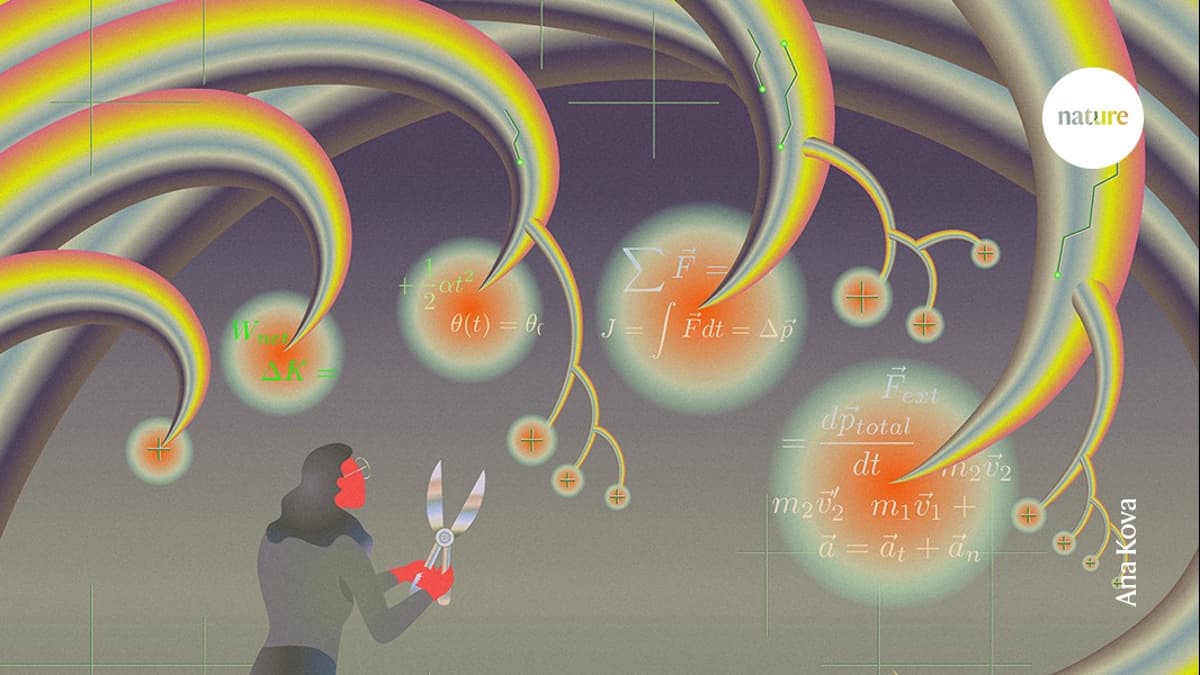
How AI Is Reshaping Discovery in Maths and Physics
Companies Mentioned

Why It Matters
AI‑driven proof assistance and conjecture generation accelerate discovery cycles, lowering error rates and expanding the pool of verifiable mathematics for both academia and industry.
Key Takeaways
- •AI proof assistants now catch errors faster than human review
- •Aristotle and Axiom Math solved open Erdős‑style problems
- •AI‑generated conjectures still require human validation
- •Formalizing maths with AI builds larger verified training corpora
- •Early AI "scientist" prototypes automate experiments but face physical limits
Pulse Analysis
The surge of artificial intelligence in the mathematical sciences reflects a broader shift toward computational augmentation of human intellect. Unlike experimental physics, where laboratory logistics and noisy data slow progress, pure mathematics offers clean, instantly reproducible datasets. This environment lets AI excel at tasks such as exhaustive proof checking, counterexample generation, and pattern discovery across massive repositories like the OEIS or arXiv. By offloading routine verification, researchers can devote more time to the creative leaps that drive breakthroughs.
Commercial ventures are turning these capabilities into marketable tools. Harmonic’s Aristotle system has cracked several long‑standing Erdős problems, while Palo Alto’s Axiom Math claims to have solved research‑level questions that have eluded experts. Tech giants OpenAI and DeepMind have demonstrated comparable prowess on the First Proof Project, showcasing that large language models can produce novel, verifiable results when guided by rigorous formalism. These successes also feed a virtuous cycle: each verified proof enriches the training data for future models, gradually expanding AI’s mathematical fluency and its utility for scholars worldwide.
Nevertheless, AI remains a complement, not a substitute, for human insight. The intuition to pose the right question, assess relevance, and interpret nuanced results still resides with researchers. Future work will focus on integrating AI into the early stages of the research pipeline—prioritizing promising conjectures and automating formalization—while preserving the critical human judgment that defines scientific discovery. As AI tools mature, they promise to democratize access to high‑quality proof verification and accelerate interdisciplinary breakthroughs across mathematics and theoretical physics.
How AI is reshaping discovery in maths and physics
Comments
Want to join the conversation?
Loading comments...