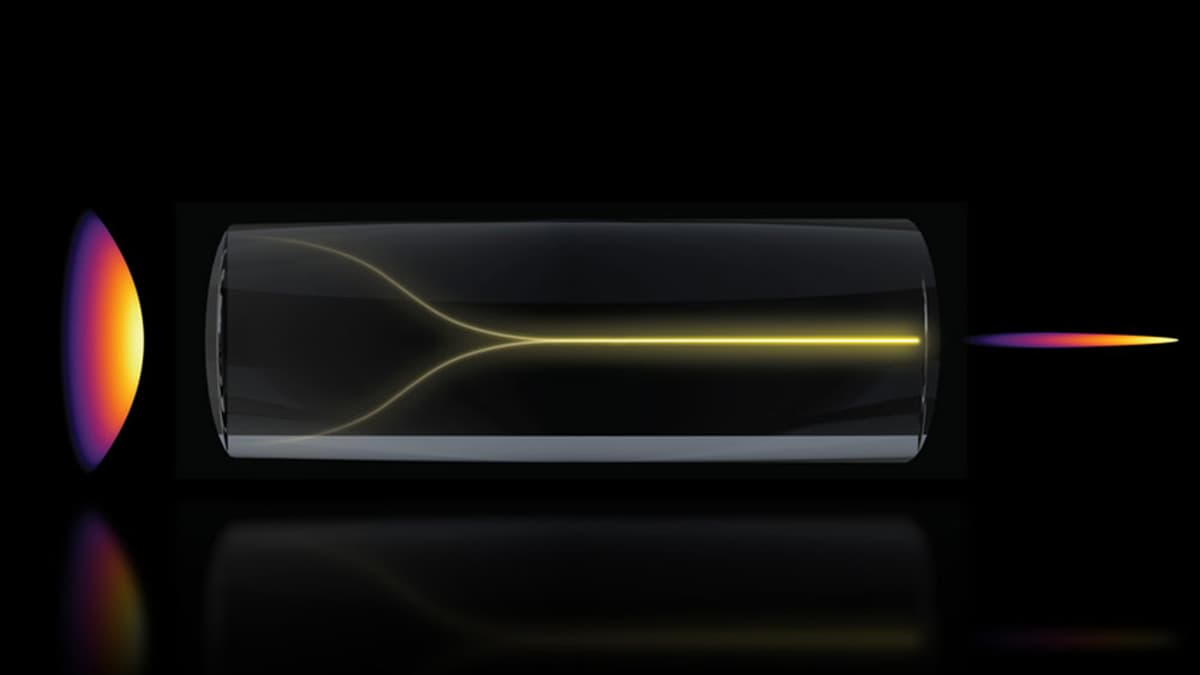
Self-Organizing ‘Pencil Beam’ Laser Could Help Scientists Design Brain-Targeted Therapies
Why It Matters
The breakthrough offers a faster, high‑resolution imaging tool for drug delivery studies, addressing a major bottleneck in neuro‑pharmaceutical development. It also opens a low‑cost pathway for advanced microscopy across biomedical research.
Key Takeaways
- •Chaotic laser light self‑organizes into a stable pencil beam.
- •Pencil beam images blood‑brain barrier 25× faster than gold standard.
- •No custom beam‑shaping needed; only precise alignment and high power.
- •Enables real‑time drug uptake tracking without fluorescent tags.
- •Could speed neuro‑drug development and broaden tissue‑imaging applications.
Pulse Analysis
The discovery hinges on a counter‑intuitive optical physics effect: when a multimode fiber is fed laser light at a perfect zero‑degree angle and pushed to a critical power level, the inherent disorder of the fiber is neutralized by nonlinear interactions, causing the light to collapse into a needle‑sharp pencil beam. This self‑organization sidesteps the decades‑long challenge of correcting modal chaos with elaborate wavefront‑shaping devices, offering a simpler, more robust solution that can be implemented with standard laboratory equipment.
In biomedical terms, the pencil‑beam technique transforms how researchers visualize the blood‑brain barrier, a critical gateway that blocks most therapeutics. By delivering a high‑intensity, tightly focused light sheet, scientists captured volumetric images of cellular drug uptake 25 times faster than the gold‑standard two‑photon microscopy, without relying on fluorescent labels. This speed‑resolution combo enables real‑time screening of candidate compounds, helping pharmaceutical firms identify molecules that truly cross the barrier—a frequent failure point in Alzheimer’s and ALS drug pipelines.
Beyond brain‑targeted therapies, the method’s simplicity and scalability suggest broader adoption across tissue‑engineered models, neuroscience, and even industrial inspection where high‑resolution, deep‑focus imaging is prized. Ongoing work aims to decode the underlying physics further and adapt the beam for in‑vivo neuron imaging, positioning the technology for commercial microscopy platforms. If successful, it could lower entry barriers for labs worldwide, accelerate pre‑clinical drug validation, and ultimately shrink the time and cost of bringing neuro‑drugs to market.
Self-Organizing ‘Pencil Beam’ Laser Could Help Scientists Design Brain-Targeted Therapies
Comments
Want to join the conversation?
Loading comments...