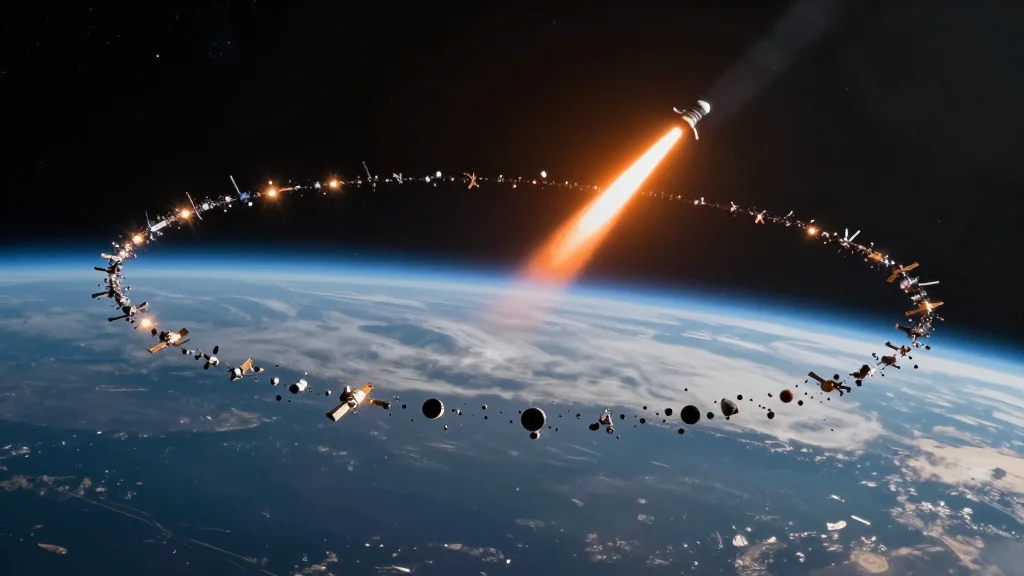
Study Shows How Sunspot Activity Speeds up Reentries
Companies Mentioned


Why It Matters
Understanding solar‑cycle‑driven drag improves debris‑removal forecasting and helps operators schedule avoidance maneuvers, protecting costly assets and crewed stations in an increasingly crowded LEO.
Key Takeaways
- •Sunspot peaks double EUV flux, increasing LEO debris drag
- •Study tracked 17 debris objects across four solar cycles (≈40 years)
- •Polar-orbit debris showed less sensitivity to EUV‑driven decay
- •Findings help schedule re‑entry predictions and collision‑avoidance maneuvers
- •SpaceX performed 50,000+ avoidance burns in early 2024, highlighting operational relevance
Pulse Analysis
Solar activity follows an 11‑year cycle that modulates the Earth’s upper atmosphere. When sunspot numbers surge, extreme ultraviolet radiation intensifies, heating and expanding the thermosphere. This puffed‑up layer creates higher atmospheric density at typical LEO altitudes, increasing drag on objects that lack propulsion. The resulting orbital decay can shorten a satellite’s lifespan by months or even years, a factor that becomes critical when thousands of new satellites and fragments share the same orbital shells.
The Indian research team leveraged the historic Space‑Track catalog, selecting 17 long‑lived debris pieces—including the 1959 Explorer 7—to trace decay rates across solar cycles 22 through 25. By correlating decay velocity with EUV flux measurements from NASA/ESA’s SOHO mission, they isolated EUV as the primary catalyst, eclipsing geomagnetic storms. Notably, two objects in high‑inclination polar orbits exhibited resilience, hinting that orbital inclination and local atmospheric dynamics can mitigate EUV‑driven drag. This nuance adds depth to predictive models that have traditionally treated LEO as a uniform environment.
For operators, the study offers a data‑driven timetable for when drag‑induced re‑entries will peak, enabling more precise planning of collision‑avoidance burns and end‑of‑life de‑orbit strategies. As mega‑constellations like Starlink conduct tens of thousands of avoidance maneuvers annually, integrating solar‑cycle forecasts could reduce fuel consumption and operational costs. Moreover, regulators and debris‑remediation firms can use these insights to prioritize high‑risk objects during solar maxima, enhancing overall space‑traffic safety as humanity’s orbital footprint expands.
Study shows how sunspot activity speeds up reentries
Comments
Want to join the conversation?
Loading comments...