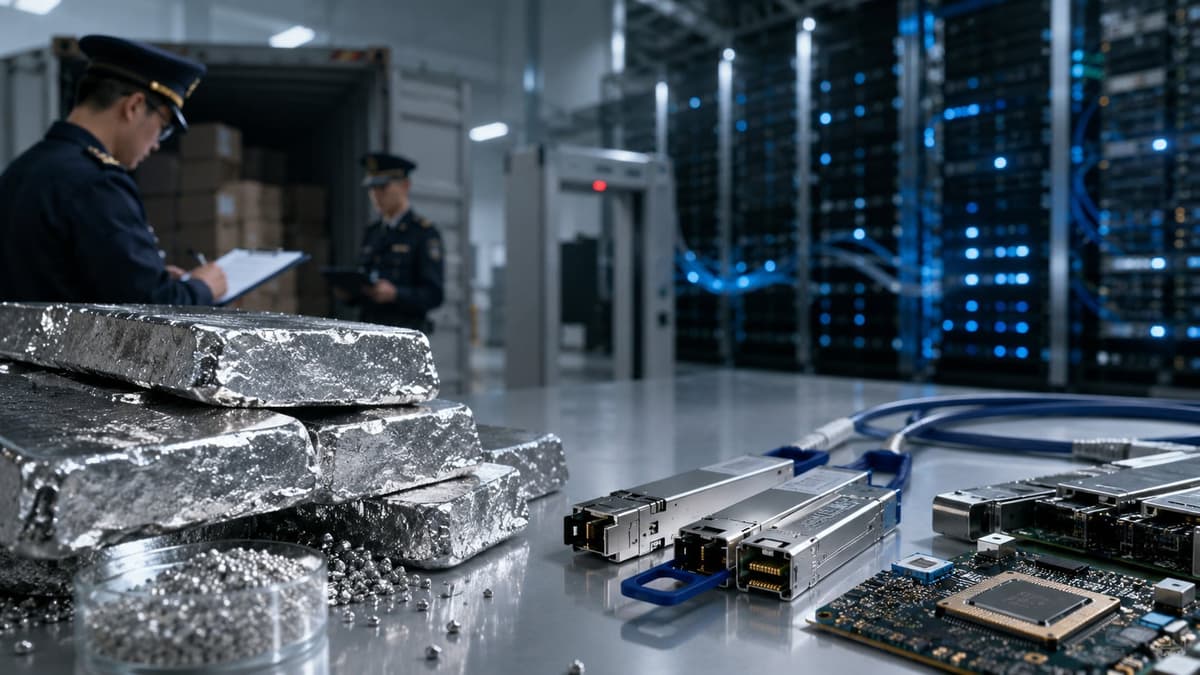
China Tightens Indium Inspections: A Niche Metal Becomes a Risk for Optical AI Interconnects
Key Takeaways
- •China produces ~70% of world indium, mainly as zinc by‑product
- •New customs checks add days to indium shipments for Western buyers
- •Indium phosphide is essential for lasers and modulators in 800 Gb‑1.6 Tb AI links
- •Companies such as Coherent and AXT report order backlogs due to approvals
- •U.S. Defense Logistics Agency plans to stockpile 403 tons of indium
Pulse Analysis
Indium’s strategic importance stems from its role as the feedstock for indium phosphide, a semiconductor material that powers the lasers and photodiodes at the heart of ultra‑fast optical transceivers. Because indium is extracted almost exclusively as a zinc by‑product, expanding primary production is costly and time‑consuming, leaving the market heavily dependent on existing refining capacity. China’s dominance—about 70% of global output—means that any policy shift or administrative hurdle on its side can reverberate through the entire AI‑focused photonics supply chain, from raw metal to wafer fabrication.
The recent tightening of export inspections has turned a routine customs process into a strategic choke point. European and North American customers now face multi‑day delays as authorities demand detailed end‑user disclosures, a step previously handled in hours. Companies that rely on InP components, such as Coherent, Lumentum and AXT, report backlogs and qualification bottlenecks that could slow the rollout of 800 Gb/s and upcoming 1.6 Tb/s interconnects. The uncertainty also prompted the U.S. Defense Logistics Agency to earmark a three‑year, 403‑ton indium reserve, underscoring the metal’s perceived relevance to both commercial AI infrastructure and national security.
In response, firms are accelerating recycling programs, diversifying supplier bases, and investing in alternative photonic platforms like silicon photonics and co‑packaged optics. However, these alternatives still rely on III‑V light sources, keeping indium in the loop. Policymakers may consider strategic stockpiles or bilateral agreements to mitigate supply risk, but the long lead times for new processing capacity mean that short‑term disruptions could translate into costly project delays. Monitoring Chinese regulatory signals and building flexible supply strategies will be essential for maintaining the momentum of AI data‑center expansion.
China Tightens Indium Inspections: A Niche Metal Becomes a Risk for Optical AI Interconnects
Comments
Want to join the conversation?