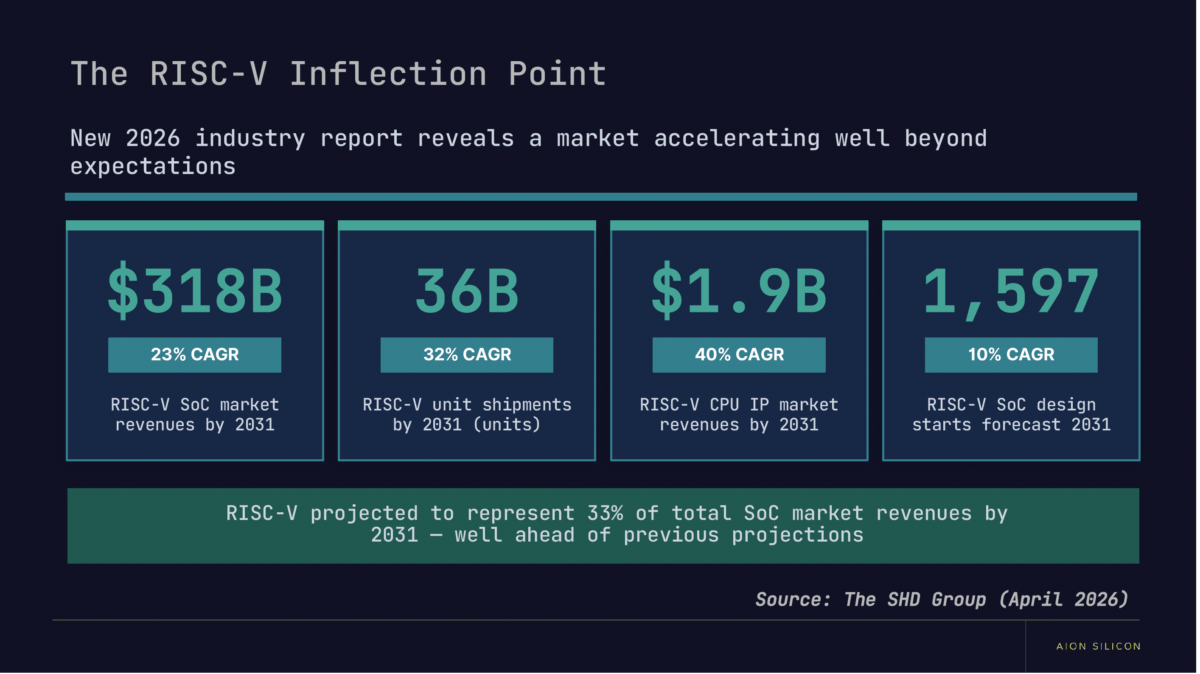
RISC-V: From Niche Architecture to Strategic Foundation
Key Takeaways
- •RISC‑V cores now control AI accelerators in hyperscale deployments
- •Customization via ISA extensions boosts performance‑per‑watt for AI workloads
- •Heterogeneous SoCs embed RISC‑V alongside Arm and x86 CPUs
- •Ecosystem collaborations lower adoption barriers and accelerate production silicon
Pulse Analysis
The semiconductor market is undergoing a paradigm shift where raw transistor density no longer guarantees competitive advantage. Artificial‑intelligence workloads demand specialized compute blocks that can be fine‑tuned for particular algorithms, and RISC‑V’s open ISA provides the flexibility to add custom instructions without licensing constraints. This extensibility translates into measurable gains in performance‑per‑watt, allowing designers to squeeze more inference capability into power‑limited edge devices while still supporting high‑throughput datacenter engines.
RISC‑V’s most visible impact is within heterogeneous system‑on‑chip (SoC) architectures. Rather than replacing entrenched Arm or x86 cores, it is being deployed as a lightweight control plane or as a domain‑specific offload engine, orchestrating data movement and managing peripheral interfaces. This coexistence model reduces risk for OEMs and accelerates integration cycles, but it also introduces verification and toolchain complexity. Companies like Aion Silicon mitigate these challenges by adopting early, cycle‑accurate system‑level modeling that evaluates memory, interconnect and I/O bottlenecks before RTL commitment, ensuring that custom extensions deliver real‑world efficiency.
The momentum behind RISC‑V is amplified by a rapidly maturing ecosystem of IP providers, EDA tools, and design services. Partnerships such as the one between Aion Silicon and Andes streamline access to verified cores, software stacks and verification suites, lowering the barrier for first‑time adopters. As the ecosystem expands, economies of scale drive down development costs, making RISC‑V an increasingly attractive option for both edge volume and high‑value datacenter segments. For executives charting silicon roadmaps, embracing RISC‑V now means securing a flexible, future‑proof foundation that can evolve alongside AI’s relentless demand for custom compute.
RISC-V: From Niche Architecture to Strategic Foundation
Comments
Want to join the conversation?