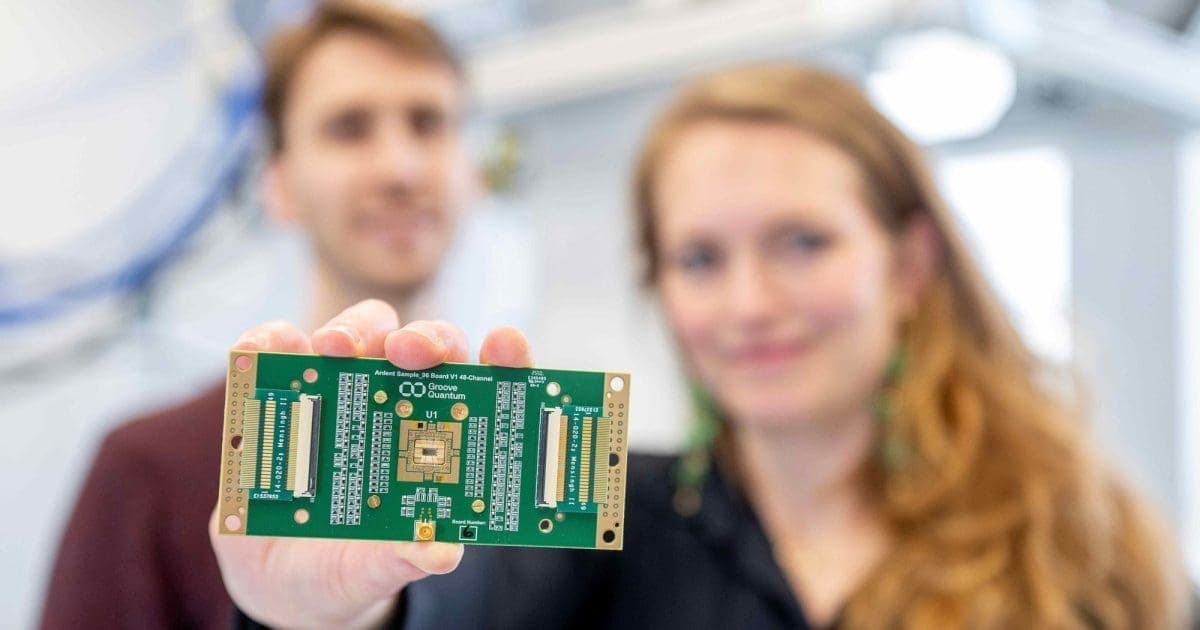
Semiconductor Qubits Target 2% of Global Energy Use

Key Takeaways
- •Groove Quantum runs 18 germanium qubits, outpacing peers.
- •Germanium offers better scalability than silicon for semiconductor qubits.
- •Quantum simulations could cut fertilizer sector’s ~2% global energy use.
- •Leveraging 80‑year chip manufacturing expertise speeds quantum hardware scaling.
- •Investors favor realistic timelines amid deep‑tech bureaucracy challenges.
Pulse Analysis
Quantum computing has long been split between superconducting circuits and trapped ions, but semiconductor qubits are gaining traction because they can tap into the massive existing chip‑fabrication ecosystem. Groove Quantum’s choice of germanium, rather than the more common silicon, stems from its higher hole mobility and lower decoherence rates, which translate into longer qubit lifetimes and easier integration into dense arrays. By building on eight decades of lithography, doping and wafer‑scale processing, the company hopes to sidestep the custom‑foundry bottlenecks that have slowed many rivals, accelerating the path toward hundreds‑of‑qubit systems.
The immediate commercial lure lies in industries that burn large amounts of energy for complex chemical transformations. Fertilizer production alone accounts for roughly two percent of global electricity consumption, and quantum‑accelerated simulations could redesign catalytic cycles to slash that demand. Similar computational chemistry gains would benefit pharmaceutical pipelines, enabling rapid screening of molecular candidates that are currently out of reach for classical supercomputers. Grid operator Alliander and financial firms are also probing quantum optimisation for load balancing and portfolio management, suggesting a broad, cross‑sector appetite for the technology once it reaches practical fidelity.
Groove Quantum’s progress arrives at a pivotal moment for European deep‑tech funding, with EU grants and patient capital filling the gap left by traditional venture streams that shy away from long‑horizon hardware bets. The startup’s realistic timeline—favoring incremental qubit upgrades over headline‑grabbing leaps—appeals to investors seeking measurable milestones. If the germanium platform can demonstrate clear quantum advantage in real‑world problems, it could catalyse a wave of manufacturing‑scale quantum processors, reshaping the competitive landscape and giving Europe a foothold in the emerging quantum economy.
Semiconductor Qubits Target 2% of Global Energy Use
Comments
Want to join the conversation?