Trusted Convergence Governance: Preserving Admissibility Integrity Across Heterogeneous Semiconductor Systems
Key Takeaways
- •TCG adds a trust gate before evidence influences convergence decisions.
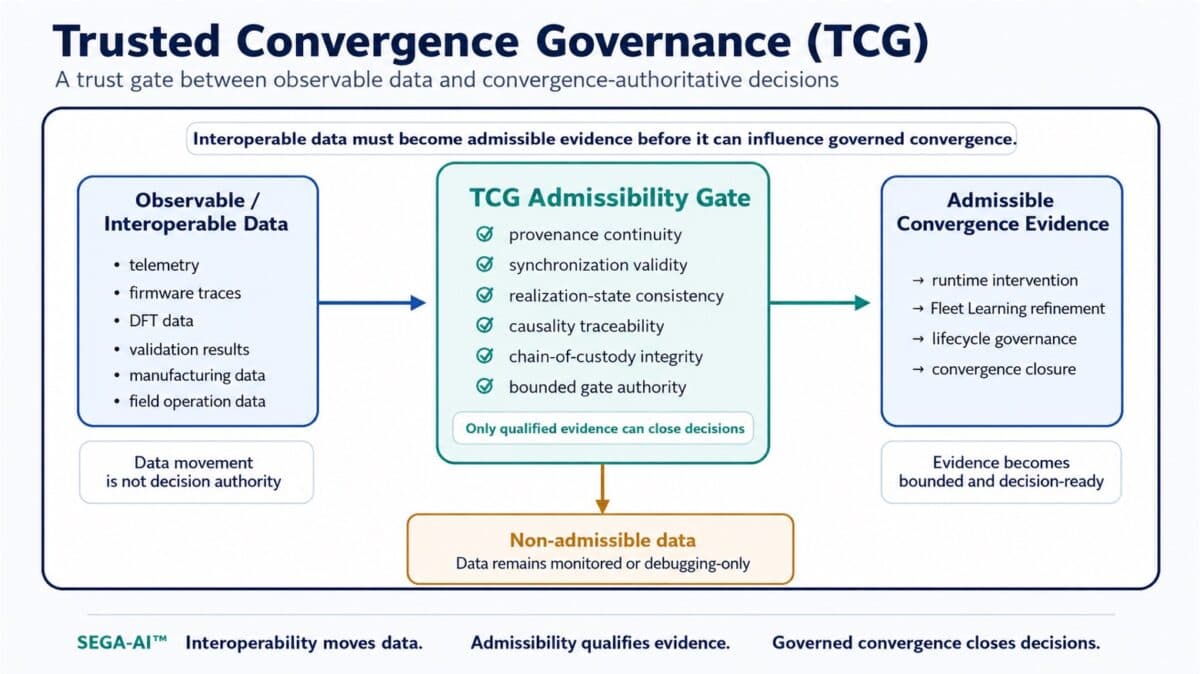
- •Provenance, synchronization, and realization-state checks ensure data admissibility.
- •Interoperability alone cannot guarantee trustworthy convergence in heterogeneous systems.
- •Fleet Learning must use admissible evidence to avoid convergence drift.
- •SEGA‑AI™ implements deterministic governance through bounded admissibility gates.
Pulse Analysis
The semiconductor industry is rapidly moving toward heterogeneous integration, where chiplets, 2.5D and 3D packaging, and distributed observability converge on a single platform. This architectural shift creates a flood of operational evidence—telemetry, firmware traces, manufacturing data—that must be evaluated in real time. Traditional workflows relied on pre‑silicon simulation and static sign‑off, but those methods cannot keep pace with the dynamic, field‑generated data streams that now drive runtime adaptation and fleet‑scale optimization. Trusted Convergence Governance (TCG) emerges as the missing layer, inserting a deterministic gate that validates evidence before it can affect system convergence.
TCG’s core function is to enforce admissibility criteria that go far beyond basic security. It verifies provenance continuity, ensuring each data point can be traced back to its origin, and checks synchronization integrity so that evidence aligns with the correct realization state—encompassing die configuration, firmware version, workload, thermal conditions, and manufacturing history. Realization‑state consistency guarantees that telemetry collected under one set of conditions remains valid when the system transitions to another. By demanding causality traceability, TCG distinguishes physics‑grounded explanations from mere statistical correlations, preventing AI‑driven pattern recognition from corrupting decision logic. Unlike generic cybersecurity, which blocks unauthorized access, TCG safeguards the decision‑making loop itself.
For businesses, adopting TCG translates into measurable risk reduction and operational efficiency. Companies can confidently deploy fleet learning at scale, knowing that only admissible, synchronized evidence feeds back into convergence models, thereby avoiding drift that could lead to costly field failures or warranty claims. Deterministic governance also streamlines compliance with industry standards and accelerates time‑to‑market for advanced packaging solutions. As AI‑enabled hardware becomes a cornerstone of data‑center and edge computing strategies, TCG provides the trust infrastructure necessary to protect both performance and brand reputation.
Trusted Convergence Governance: Preserving Admissibility Integrity Across Heterogeneous Semiconductor Systems
Comments
Want to join the conversation?