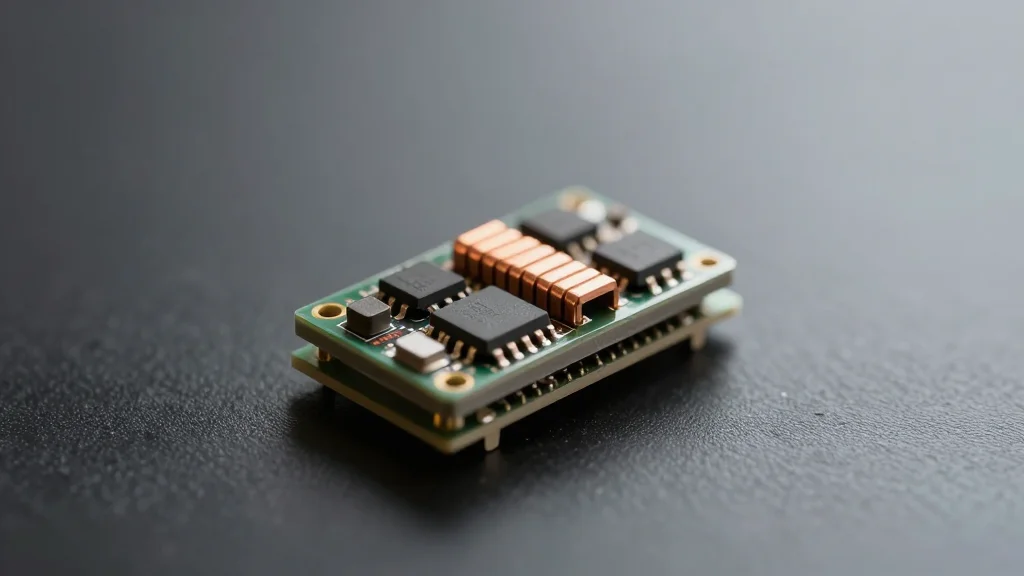
APEC 2026: Infineon Addresses AI Data Center Power Density Challenges with TLVR Quad-Phase Module
Why It Matters
The module tackles AI data‑center power‑density limits, enabling faster transient response and smaller footprints, which are critical as GPU workloads and rack power exceed 500 kW. Its efficiency gains can lower cooling costs and accelerate adoption of high‑voltage DC distribution.
Key Takeaways
- •TLVR quad-phase module packs 320 A peak current in 9×10×5 mm³
- •Reduces output capacitance up to 50 % versus traditional buck designs
- •Supports high‑voltage DC distribution for racks exceeding 500 kW
- •Integrates OptiMOS‑6 MOSFETs with embedded magnetics for compactness
Pulse Analysis
AI‑driven workloads are pushing data‑center power density to its limits, forcing designers to rethink traditional buck converters that rely on large inductors and capacitor banks. Infineon's TLVR (trans‑inductor voltage regulator) architecture creates magnetic coupling between phases, dramatically widening the control bandwidth without raising switching frequencies. The result is a faster transient response that can handle rapid GPU load swings while halving the required output capacitance, translating into smaller, more efficient power modules that free up valuable board space.
Beyond the point‑of‑load solution, Infineon highlighted a broader industry shift toward high‑voltage DC distribution as rack power climbs past 500 kW. Their 800 V input reference designs, paired with a versatile digital controller pre‑loaded with firmware for multiple topologies, simplify the transition from legacy AC‑centric architectures. By delivering 20 A in a 3 × 3 mm package and integrating monolithic point‑of‑load regulators, Infineon enables tighter power‑train integration, reducing conversion losses and improving overall rack efficiency.
The commercial impact is significant. Data‑center operators stand to lower both capital and operational expenditures through reduced component count, smaller cooling footprints, and higher power‑delivery efficiency. OEMs that adopt TLVR‑based modules can differentiate their AI servers with superior performance and density, positioning themselves ahead of competitors still tied to bulkier, less responsive power solutions. As AI workloads continue to scale, the demand for such advanced semiconductor‑driven power architectures is likely to accelerate, making Infineon's announcement a pivotal moment in the evolution of data‑center power infrastructure.
APEC 2026: Infineon addresses AI data center power density challenges with TLVR quad-phase module
Comments
Want to join the conversation?
Loading comments...