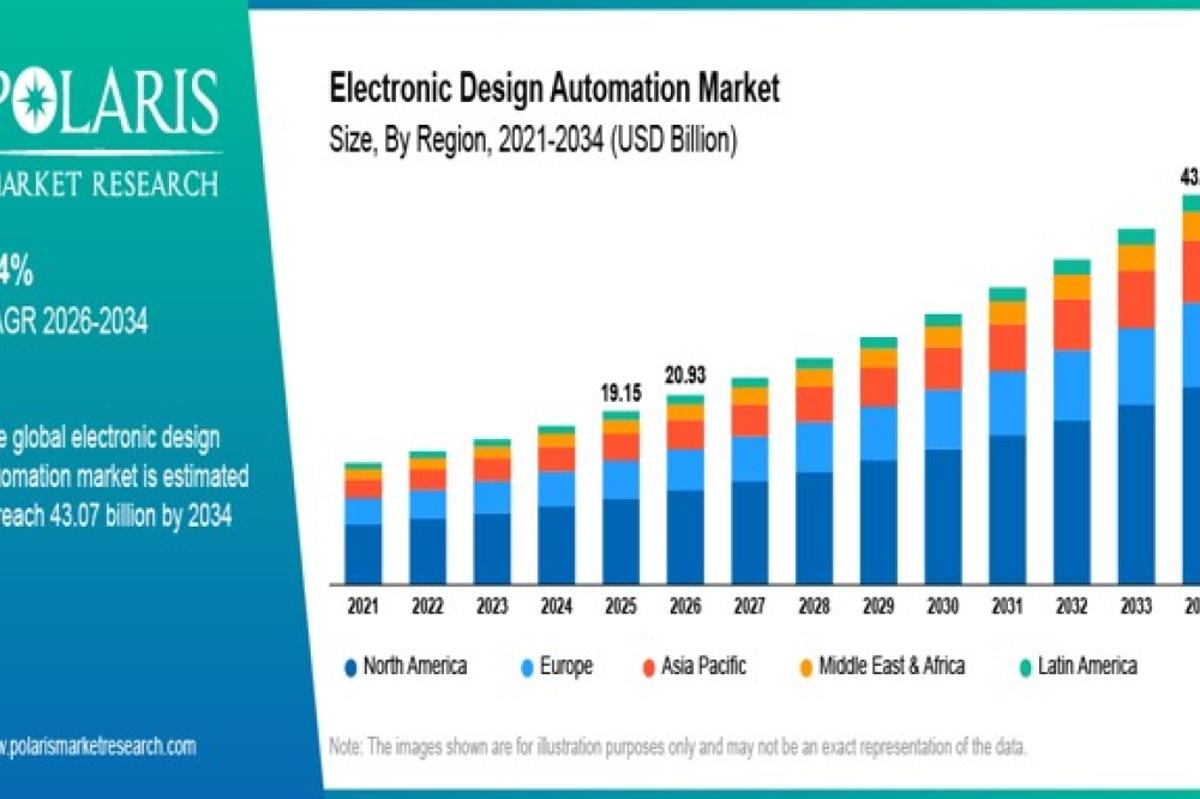
Electronic Design Automation Market Size Worth $43.07 Billion by 2034
Companies Mentioned
Why It Matters
The rapid expansion confirms EDA as the foundational infrastructure for next‑generation chips, shaping semiconductor R&D budgets and accelerating time‑to‑market for AI, 5G and autonomous‑vehicle technologies.
Key Takeaways
- •EDA market to reach $43.07 bn by 2034, 9.4% CAGR.
- •Cloud‑native EDA held 67.1% of 2025 revenue, democratizing access.
- •AI‑driven tools cut design cycles, boosting silicon quality.
- •Automotive electronics demand propels fastest regional growth in Asia‑Pacific.
- •Semiconductor IP segment grows at 9.8% CAGR, becoming key revenue driver.
Pulse Analysis
The Electronic Design Automation sector is entering a period of unprecedented growth, driven by the relentless miniaturization of semiconductor nodes and the corresponding explosion in design complexity. As transistors shrink to 5 nm and below, traditional manual workflows become untenable, prompting chipmakers to invest heavily in sophisticated simulation, synthesis and verification suites. This capital shift not only inflates the market size but also raises the bar for tool performance, pushing vendors to innovate faster than ever before.
Artificial intelligence and cloud computing are redefining how EDA solutions are delivered and consumed. AI‑enabled algorithms now automate routine layout checks, predict timing violations and explore broader design spaces, shaving weeks off development cycles. Meanwhile, cloud‑native platforms eliminate the need for costly on‑premise hardware, allowing startups and midsize fabs to access world‑class tools on a pay‑as‑you‑go basis. The convergence of these technologies democratizes chip design, accelerates time‑to‑market, and creates new revenue models for software providers.
Geographically, North America continues to dominate with nearly half of global EDA spend, buoyed by the U.S. CHIPS and Science Act and a dense ecosystem of fabless firms. Asia‑Pacific, however, is the fastest‑growing region, reflecting massive investments from Taiwan, South Korea, Japan and China in advanced node R&D. Competitive dynamics are intensifying as incumbents like Cadence, Synopsys and Siemens double down on AI and cloud capabilities, while niche players forge strategic foundry partnerships. For investors and industry strategists, the trajectory signals a lucrative, technology‑centric market that will underpin the next wave of semiconductor innovation.
Electronic Design Automation market size worth $43.07 billion by 2034
Comments
Want to join the conversation?
Loading comments...