Imec Extends UWB Ranging with First IEEE 802.15.4ab Narrowband Receiver
Companies Mentioned
Why It Matters
Extending UWB range while maintaining low power and interference resilience opens new markets for precise positioning in dense IoT, automotive and wearable ecosystems, accelerating adoption of next‑generation short‑range radio standards.
Key Takeaways
- •Imec's narrowband receiver extends UWB range up to fourfold.
- •Chip consumes less than 6 mW power, 9 dB dynamic‑range gain.
- •Supports IEEE 802.15.4ab NBA, tolerates –32 dBm Wi‑Fi blockers.
- •Demonstrated full transceiver achieving up to 32× ranging improvement.
- •Targets robotics, AR glasses, and future low‑power Bluetooth bands.
Pulse Analysis
The impulse‑radio ultra‑wideband (IR‑UWB) market has long been hampered by interference from ubiquitous Wi‑Fi and other 5‑6 GHz signals, limiting its range and reliability. The forthcoming IEEE 802.15.4ab standard tackles this issue with narrowband assistance (NBA), a hybrid approach that uses a narrowband link for synchronization and discovery while preserving UWB’s high‑precision ranging. By integrating these two domains, the standard promises scalable, energy‑efficient positioning solutions for dense IoT deployments.
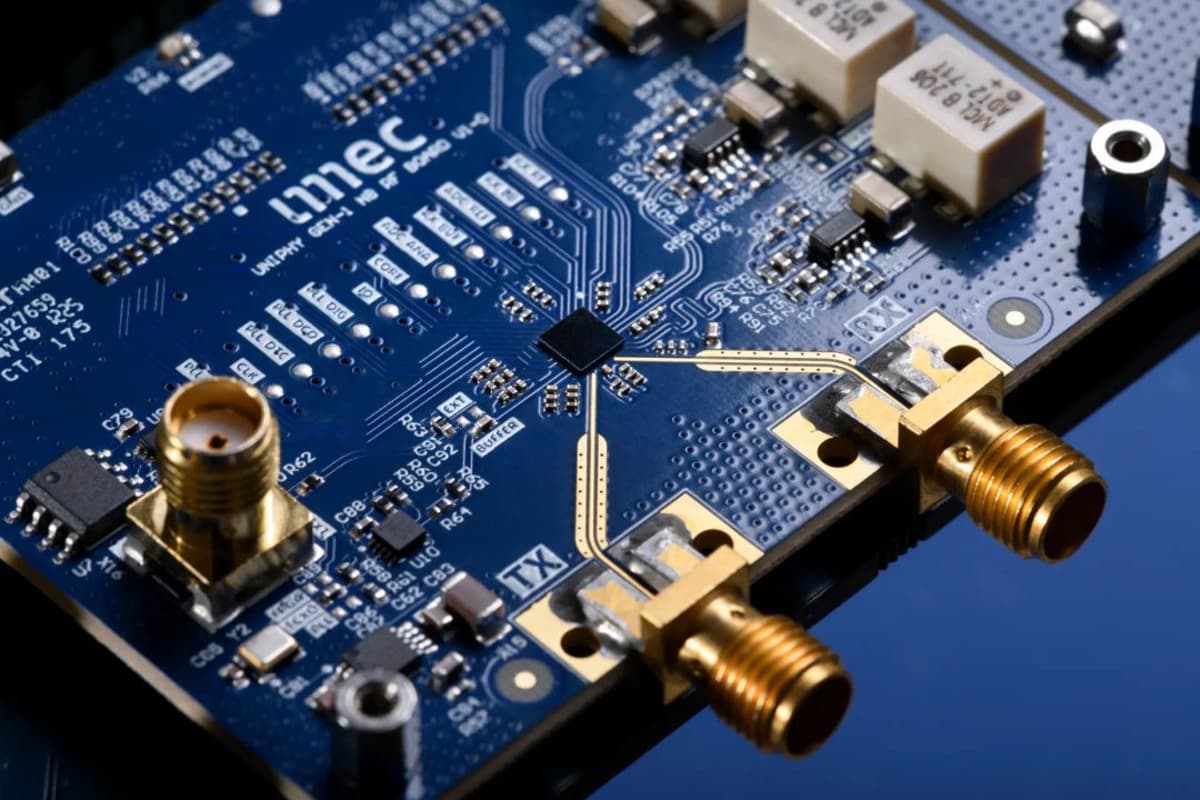
Imec’s newly announced receiver chip embodies the NBA concept with a 22 nm CMOS architecture centered on a second‑order transimpedance amplifier and early‑stage filtering. The design achieves a low noise figure of 3.2 dB and a dynamic‑range gain of 9 dB, all while drawing under 6 mW of power. A built‑in high‑dynamic‑range clip detector dynamically switches filtering and gain modes, allowing the receiver to stay sensitive to weak signals even when strong Wi‑Fi blockers are present. These innovations translate into a four‑fold extension of UWB ranging distance and, when combined with a matching transmitter, a reported 32× overall performance boost.
The commercial implications are significant. Longer, more reliable UWB links enable robot‑to‑robot coordination, precise AR headset tracking, and advanced driver‑assistance systems without the latency penalties of traditional Bluetooth or Wi‑Fi solutions. Imec’s roadmap also hints at extending NBA techniques to future Bluetooth higher‑band variants, suggesting a broader convergence of low‑power wireless standards. As industry partners begin IP transfer and integration, the technology could become a cornerstone of next‑generation smart‑device ecosystems, reinforcing the strategic value of UWB in the competitive landscape of short‑range connectivity.
Imec extends UWB ranging with first IEEE 802.15.4ab narrowband receiver
Comments
Want to join the conversation?
Loading comments...