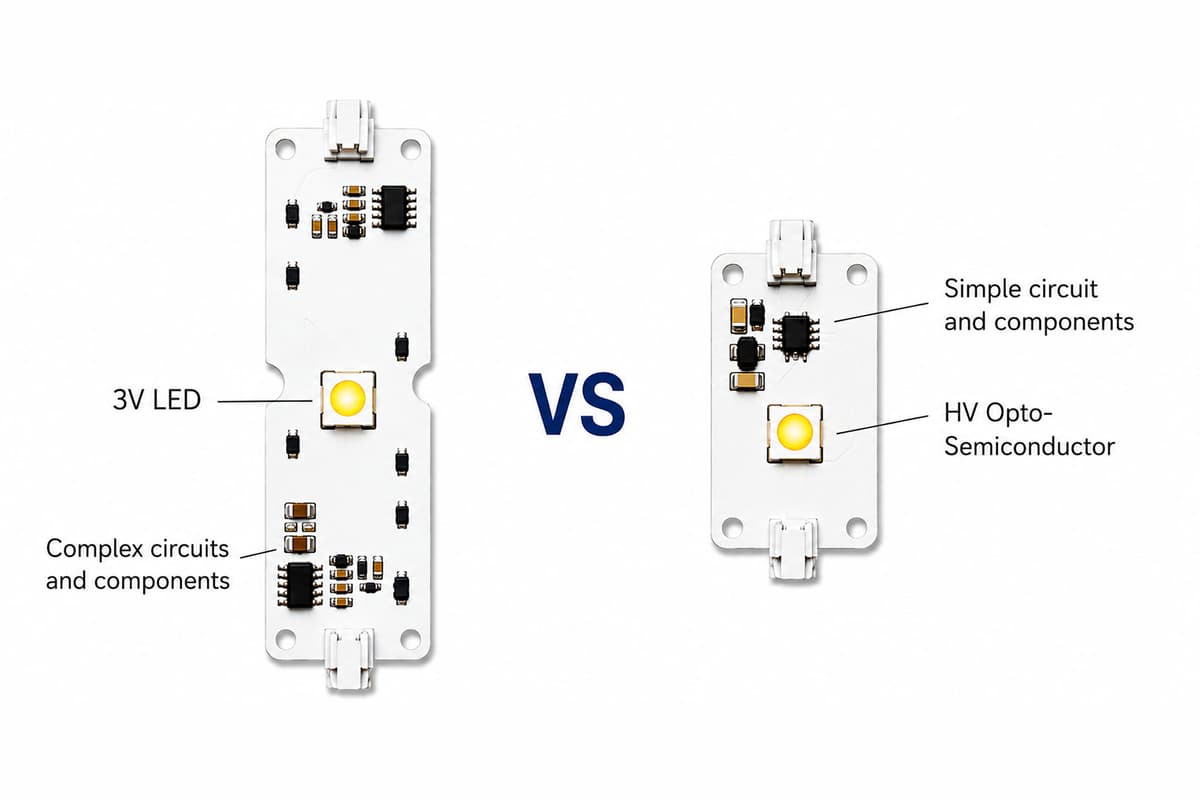
Seoul Semiconductor Launches HV Opto-Semiconductor for EVs
Why It Matters
The technology simplifies EV electrical architectures, cutting cost and weight while boosting efficiency—key levers for scaling affordable electric mobility. Its adoption signals a shift toward higher‑voltage optoelectronics that could reshape supplier dynamics in the auto sector.
Key Takeaways
- •HV opto‑semiconductor cuts driver parts by >10% in EVs
- •Enables 12 V single‑chip operation versus traditional 3 V LEDs
- •Reduces conversion loss from 1/100 to 1/10 for 300 V systems
- •Seoul targets top‑10 auto brands, expanding automotive division revenue
- •Opto‑semiconductor market to quadruple as price rises to $200
Pulse Analysis
The electric‑vehicle market is entering a phase where every gram and every cent count. Automakers are under pressure to streamline wiring harnesses and reduce the number of discrete components that must survive harsh automotive environments. High‑voltage opto‑semiconductors address this need by consolidating multiple functions into a single chip that can operate directly from a vehicle’s 12 V architecture, eliminating the need for separate driver circuits and lowering overall system complexity.
Technically, Seoul Semiconductor’s HV opto‑semiconductor leverages a multi‑junction P‑N structure that dramatically improves voltage conversion efficiency. Traditional LED drivers step down 300 V battery voltage through a 1/100 ratio, incurring sizable losses. The new design shrinks that ratio to 1/10, cutting conversion losses and reducing power draw by about 10 %. Backed by hundreds of HV opto‑semiconductor patents and over 50 driver patents, the platform offers a robust IP moat while delivering measurable gains in thermal performance and reliability—critical factors for automotive qualification.
From a business perspective, the timing aligns with a projected surge to 40 million EVs sold annually within five years. As vehicle functions become more sophisticated, the per‑vehicle value of opto‑semiconductors is expected to climb from $100 to $200, potentially quadrupling the market size. Seoul Semiconductor’s aggressive push to secure top‑10 OEM partnerships and elevate its automotive division reflects a strategic bet that high‑voltage optoelectronics will become a standard building block in next‑generation EVs, reshaping the competitive landscape for both semiconductor suppliers and vehicle manufacturers.
Seoul Semiconductor launches HV opto-semiconductor for EVs
Comments
Want to join the conversation?
Loading comments...