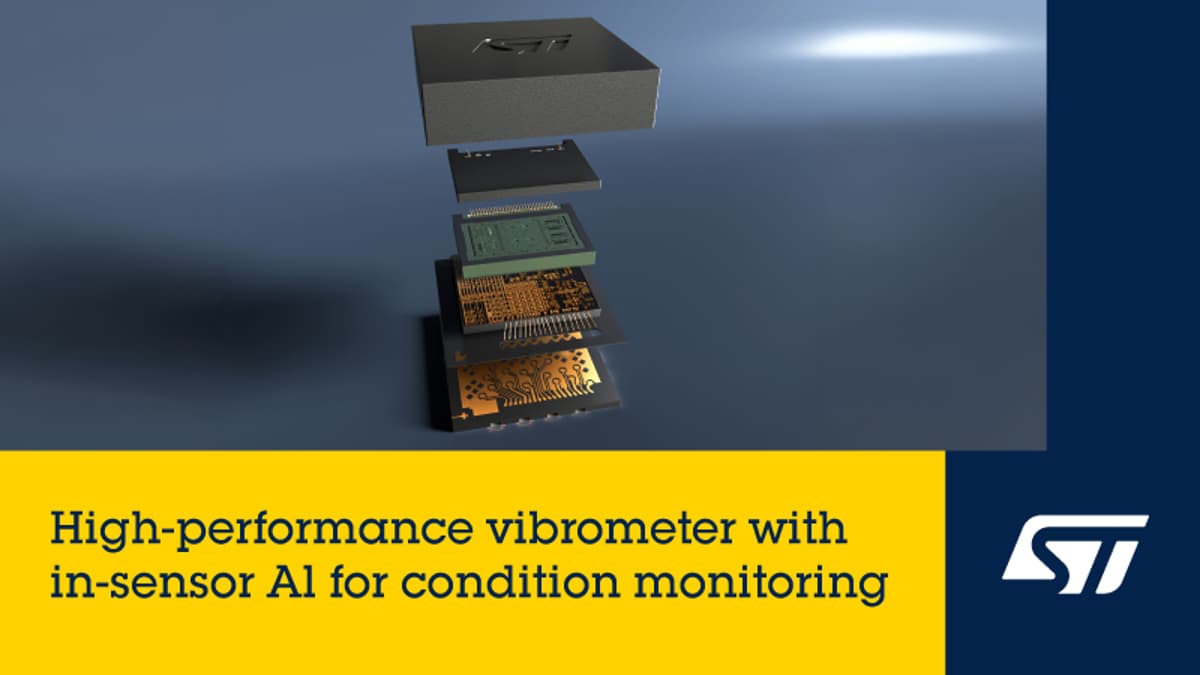
ST Launches AI-Enabled MEMS Vibration Sensor for Industrial Condition Monitoring
Companies Mentioned
Why It Matters
By moving signal processing and AI inference to the sensor, manufacturers can detect faults earlier, lower downtime, and reduce system power budgets, accelerating adoption of smart predictive maintenance.
Key Takeaways
- •IIS3DWB10IS measures up to 200g, 10 kHz+ bandwidth.
- •Integrated ISPU 2.0 offers 40 MIPS and 40 MFLOPS processing.
- •On‑sensor AI reduces latency and power consumption in monitoring.
- •10‑year longevity program ensures reliability up to 125 °C.
Pulse Analysis
Vibration analysis has long been the backbone of predictive maintenance for rotating equipment such as motors, pumps and compressors. Historically, piezoelectric accelerometers dominated the market because of their wide bandwidth and low noise, but they require external signal conditioning and consume significant power. As factories pursue Industry 4.0 goals, the demand for compact, low‑power sensors that can feed data directly into edge analytics platforms is rising. MEMS technology, with its small footprint and batch‑manufacturing economics, is now positioned to replace legacy solutions in many high‑value applications.
STMicroelectronics’ IIS3DWB10IS combines a wide‑band MEMS accelerometer with the company’s ISPU 2.0 intelligent sensor processing unit. The device captures accelerations up to 200 g and frequencies above 10 kHz, while delivering a noise floor of 35 µg/√Hz—on par with premium piezoelectric parts. ISPU 2.0 provides up to 40 MIPS and 40 MFLOPS, four times the compute of the prior generation, and includes hardware accelerators for real‑time FFT, envelope analysis and edge‑AI anomaly detection. By executing these algorithms on‑sensor, latency drops and power consumption falls, enabling battery‑operated or wireless monitoring nodes.
The IIS3DWB10IS arrives at a pivotal moment as OEMs and system integrators look to embed intelligence at the edge. Priced at $25 per thousand units and backed by a 10‑year longevity program, the sensor offers a cost‑effective alternative to traditional accelerometers for large‑scale deployments in automotive factories, oil‑and‑gas plants and renewable‑energy turbines. Its small LGA package and wettable flanks simplify automated assembly, accelerating time‑to‑market for smart maintenance solutions. Competitors are likely to follow suit, spurring a broader shift toward AI‑enabled MEMS across the industrial IoT landscape.
ST launches AI-enabled MEMS vibration sensor for industrial condition monitoring
Comments
Want to join the conversation?
Loading comments...