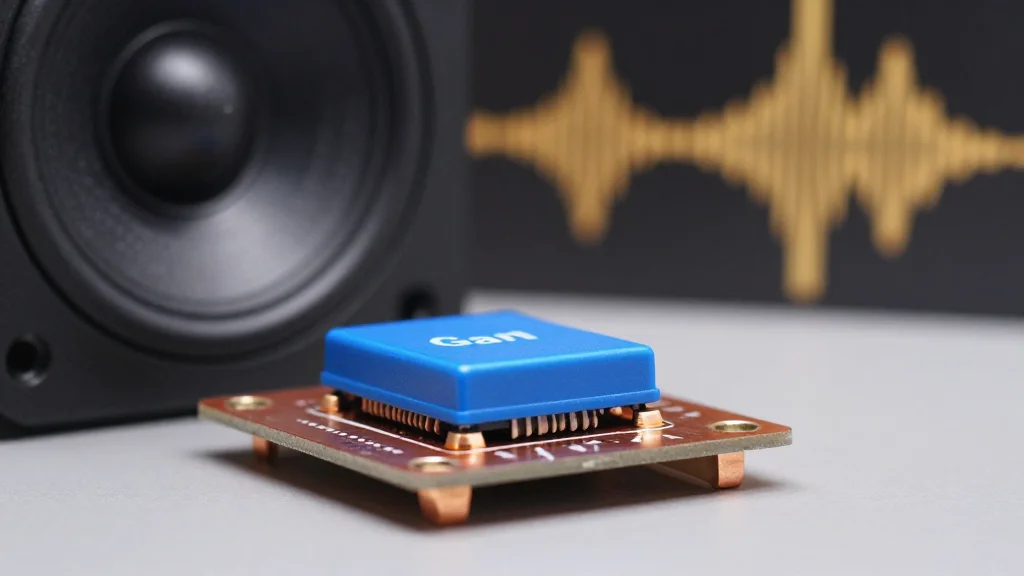
The Case for GaN HEMTs in Class-D Audio
Companies Mentioned

Why It Matters
GaN HEMTs unlock higher efficiency and smaller form factors for Class‑D amplifiers, accelerating adoption in power‑constrained devices and premium audio systems, and reshaping the $10 billion‑plus market through lower thermal budgets and superior sound quality.
Key Takeaways
- •GaN HEMTs cut switching losses up to 10× versus silicon MOSFETs
- •Class‑D market projected to grow from $3.7B (2025) to $10.3B (2036)
- •GaN enables ~1 MHz switching, allowing smaller inductors and tighter layouts
- •EPC9192 demo board achieves >96% efficiency at 700 W per channel
- •THD remains ~0.3% at 1 W, with SNR over 122 dB
Pulse Analysis
The shift from linear to switching amplification mirrors the broader move toward power‑efficient electronics. Class‑D amplifiers, driven by pulse‑width modulation, have become the default for high‑fidelity audio because they can deliver power with minimal heat. However, the silicon MOSFETs that once dominated this space suffer from high gate charge and slow reverse‑recovery, which inflate switching losses and complicate thermal design. GaN HEMTs, with their low parasitic capacitance and near‑zero reverse‑recovery charge, allow designers to push switching frequencies toward 1 MHz, dramatically shrinking the required filter inductors and enabling tighter PCB layouts.
Market analysts forecast the global Class‑D audio amplifier sector to expand from roughly $3.7 billion in 2025 to over $10 billion by 2036, driven by smart‑home adoption, wireless speakers, and increasingly sophisticated in‑vehicle infotainment. Automotive applications demand rugged, compact solutions that can survive vibration while maintaining high efficiency, whereas home‑audio designs prioritize ultra‑low distortion and seamless integration with IoT ecosystems. GaN’s superior thermal performance and smaller silicon footprint address both constraints, offering manufacturers a path to higher power density without sacrificing acoustic quality.
Real‑world prototypes illustrate GaN’s impact. The EPC‑9192 demoboard, built around 200 V eGaN FETs, delivers 96%+ efficiency at 700 W per channel, with idle losses under 0.1 W and a flat frequency response within ±0.5 dB from 20 Hz to 20 kHz. Measured total harmonic distortion hovers around 0.3% at 1 W, while signal‑to‑noise ratios exceed 122 dB, confirming that the higher switching speed does not compromise audio purity. As GaN production scales and costs fall, its adoption is set to become the cornerstone of next‑generation Class‑D amplifiers, reshaping the audio landscape across consumer, professional, and automotive domains.
The Case for GaN HEMTs in Class-D Audio
Comments
Want to join the conversation?
Loading comments...