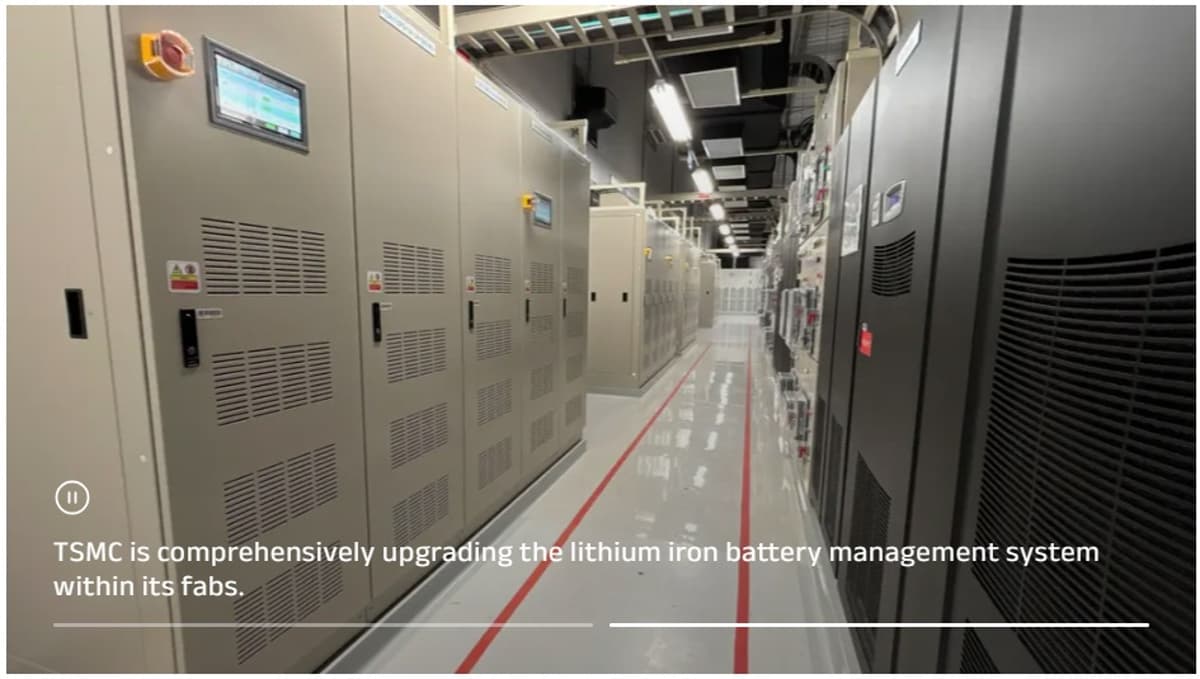
TSMC Powers Up: 408,000 Batteries Get a Safety Intelligence Upgrade
Key Takeaways
- •408,000 LFP batteries upgraded across TSMC fabs worldwide
- •Third‑gen BMS adds real‑time current, temperature, SOC, SOH monitoring
- •Integrated SCADA link enables predictive diagnostics and 25% faster response
- •Thermal‑runaway tests validate safety, reducing fire risk
- •Upgrade supports sustainability, cutting electricity use by 17 M kWh annually
Pulse Analysis
Power continuity is a make‑or‑break factor for semiconductor fabs, where a single outage can erase millions of dollars of wafer output. To address this, Taiwan Semiconductor Manufacturing Company has embarked on its “Lithium Iron Battery Generation Upgrade Project,” retrofitting roughly 408,000 lithium‑iron‑phosphate (LFP) batteries in both domestic and overseas facilities. Replacing legacy lead‑acid units with LFP cells delivers higher round‑trip efficiency, longer service life and a markedly lower carbon footprint, reinforcing TSMC’s broader sustainability agenda that already saves about 17 million kilowatt‑hours of electricity each year.
The upgrade has progressed through three generations of battery‑management systems. The latest, third‑generation BMS, developed with key suppliers, monitors voltage, current, temperature, state‑of‑charge and state‑of‑health in real time and streams the data directly into the fab’s SCADA architecture. This continuous feed enables centralized analytics, predictive fault detection and an emergency‑response time that is roughly 25 percent faster than previous versions. In practice, the system can isolate abnormal cells instantly and trigger protective breaker interlocks, dramatically lowering the chance of cascading failures.
Beyond TSMC, the project signals a shift in how the semiconductor ecosystem treats energy storage—not merely as backup power but as an intelligent safety platform. As AI‑driven chips push fab sizes and power densities higher, industry peers are likely to emulate the LFP‑BMS model to meet IEC 62619 safety standards and ESG expectations. The combination of renewable‑energy commitments, reduced operational costs and heightened reliability positions TSMC to maintain its leadership in advanced node production while setting a new benchmark for operational resilience across the global chip supply chain.
TSMC Powers Up: 408,000 Batteries Get a Safety Intelligence Upgrade
Comments
Want to join the conversation?