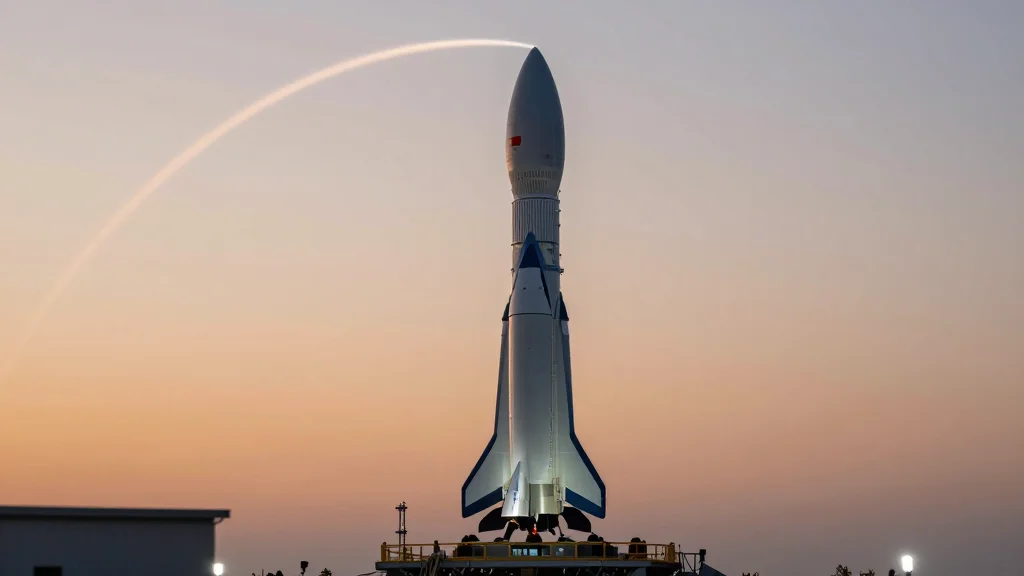
LandSpace’s Stretched Zhuque‑2E Returns to Flight, Deploys Qianfan Megaconstellation Satellites

Companies Mentioned
Why It Matters
The Zhuque‑2E Y5 success signals that China’s private launch sector is maturing enough to handle heavy‑payload, multi‑satellite missions, a domain previously dominated by state‑run launchers. By proving a reliable, high‑mass capability, LandSpace can become a key partner for the Qianfan broadband constellation, accelerating China’s push to compete with global satellite‑internet providers. The upcoming IPO also tests market appetite for Chinese commercial space firms. A strong valuation would provide capital for reusable‑rocket development, potentially lowering launch costs and reshaping the economics of megaconstellation deployment both domestically and internationally.
Key Takeaways
- •Zhuque‑2E Y5 lifted off on May 13 p.m. Eastern from Jiuquan, inserting a 2,800 kg payload into a 900 km polar orbit
- •Launch added a new batch of Qianfan megaconstellation satellites, expanding China’s broadband network
- •Vehicle upgrades now allow 4,000 kg to 500 km SSO and 6,000 kg to LEO, demonstrating heavy‑lift capability
- •LandSpace is pursuing a STAR Market IPO targeting $1 billion in funding and an $11 billion valuation
- •The flight marks the fourth Zhuque‑2E launch and the 29th Chinese launch in 2026, intensifying commercial competition
Pulse Analysis
LandSpace’s Y5 flight is more than a technical checkpoint; it is a strategic lever in China’s broader commercial space agenda. By delivering a heavy payload and deploying Qianfan satellites in a single mission, the company showcases an integrated service model that could attract large‑scale customers seeking cost‑effective, high‑frequency launch windows. This contrasts with the traditional reliance on state‑run Long March rockets, which, while reliable, are often booked months in advance and priced higher.
The IPO ambition adds another layer of significance. If investors assign the projected $11 billion valuation, it would signal confidence that private Chinese launch firms can generate sustainable cash flows, especially from megaconstellation contracts. That capital could accelerate reusable‑rocket development, narrowing the cost gap with SpaceX’s Falcon 9 and Starship. However, the market will scrutinize LandSpace’s ability to translate flight success into repeat business, given the August 2025 failure that still looms in the company’s risk profile.
Looking ahead, the real test will be whether LandSpace can secure a pipeline of Qianfan or other commercial payloads and execute the planned Zhuque‑3 recovery. Successful reusability would not only improve margins but also cement LandSpace’s role as a cornerstone of China’s “new pillar” space industry, potentially reshaping global launch dynamics.
LandSpace’s Stretched Zhuque‑2E Returns to Flight, Deploys Qianfan Megaconstellation Satellites
Comments
Want to join the conversation?
Loading comments...