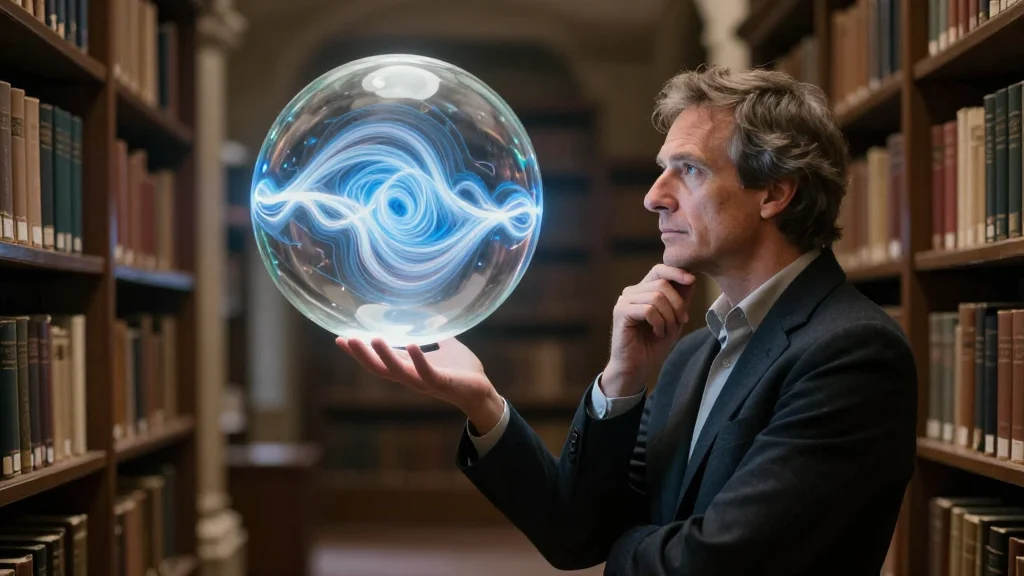
Andrea Oldofredi Argues Quantum World Lacks Objects, Linking Hume to Consciousness

Why It Matters
The claim that quantum reality lacks objects challenges long‑standing metaphysical assumptions that underpin both scientific models and many spiritual worldviews. By reframing reality as a web of relations, the argument invites a re‑examination of consciousness as potentially relational rather than localized, offering a bridge between contemporary physics and traditions that emphasize unity and interdependence. This shift could influence how spiritual practices conceptualize the self, the nature of enlightenment, and the role of observation in shaping experience. Moreover, the debate highlights the importance of interdisciplinary dialogue. As philosophers like Oldofredi bring Hume’s skepticism into conversation with cutting‑edge quantum interpretations, they create a fertile ground for new frameworks that may inform future research in cognitive science, theology, and quantum foundations. The outcome of this discourse could affect educational curricula, public understanding of science, and the way spiritual communities engage with scientific discoveries.
Key Takeaways
- •Andrea Oldofredi, postdoctoral fellow at the University of Lisbon, presented on IAI TV that quantum mechanics contains no objects.
- •He links David Hume’s philosophical skepticism with Carlo Rovelli’s relational quantum mechanics.
- •Relational QM posits observer‑dependent properties, denying intrinsic objecthood at the quantum level.
- •The view aligns with spiritual concepts of interdependence, prompting fresh dialogue on consciousness.
- •Critics cite alternative quantum interpretations that retain some notion of objects, keeping the debate active.
Pulse Analysis
Oldofredi’s relational argument arrives at a moment when both science and spirituality are wrestling with the limits of objectivity. Historically, physics has moved from Newtonian particles to field‑based descriptions, and now to relational networks that blur the line between subject and object. This trajectory mirrors a broader cultural shift toward seeing identity and reality as fluid rather than fixed. In the spiritual domain, traditions such as Advaita Vedanta, Buddhism, and certain mystic Christian strands have long taught that the self is not an isolated entity but a manifestation of a larger, interconnected reality. By providing a rigorous philosophical and scientific articulation of this idea, Oldofredi offers a common language that could reduce the perceived gap between empirical inquiry and spiritual experience.
However, the relational view also risks being co‑opted as a catch‑all justification for speculative metaphysics. Without empirical criteria to distinguish relational quantum mechanics from other interpretations, the claim that objects do not exist remains philosophically provocative but scientifically unsettled. Future work will need to clarify whether relational ontology can generate testable predictions or whether it will remain a conceptual bridge. If successful, it could inspire new experimental designs that treat measurement contexts as constitutive of reality, potentially reshaping quantum technologies and informing contemplative practices that emphasize mindful observation.
Ultimately, the significance of Oldofredi’s contribution lies less in proving a definitive answer about objects and more in opening a space where philosophers, physicists, and spiritual seekers can negotiate the meaning of reality together. The ongoing dialogue may yield novel interdisciplinary frameworks that respect both empirical rigor and the experiential depth of spiritual inquiry, a synthesis that could define the next chapter of the spirituality‑science conversation.
Andrea Oldofredi argues quantum world lacks objects, linking Hume to consciousness
Comments
Want to join the conversation?
Loading comments...