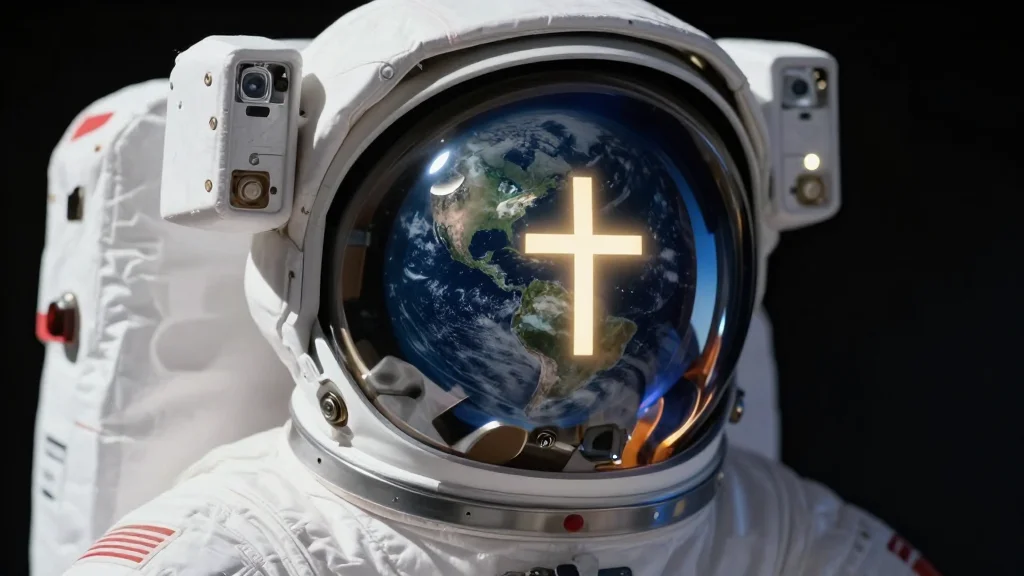
Astronauts Cite Divine Encounter on Artemis II, Sparking Global Spiritual Dialogue

Why It Matters
The astronauts’ open discussion of Christian belief from beyond Earth challenges the traditional separation between scientific endeavor and personal spirituality. It signals that as humanity pushes farther into space, the psychological and existential dimensions of crewed missions will demand attention alongside engineering challenges. For religious communities, the episode offers a high‑profile platform to connect faith with cutting‑edge exploration, potentially influencing public attitudes toward both science and religion. Moreover, the incident may prompt space agencies worldwide to revisit crew welfare protocols, ensuring that diverse spiritual needs are respected while maintaining mission safety. The dialogue could lead to the development of inclusive chaplaincy programs, interfaith resources, and guidelines for religious expression in microgravity, setting precedents for long‑duration voyages to Mars and beyond.
Key Takeaways
- •Artemis II crew publicly shared Christian reflections during a lunar flyby in April 2026.
- •Victor Glover delivered a Christ‑centered message, quoting Scripture and emphasizing love.
- •Social media reaction split between disappointment from some science fans and enthusiasm from faith groups.
- •NASA has not issued an official stance on the spiritual content, focusing on mission safety and technical outcomes.
- •The episode may influence future policy on religious accommodation for deep‑space crews.
Pulse Analysis
The Artemis II spiritual moment arrives at a crossroads where the commercialization of low‑Earth orbit and the resurgence of lunar ambitions intersect with a public yearning for meaning. Historically, spaceflight has been framed as a secular, scientific frontier, yet moments like Glover’s message echo earlier instances—such as the 1969 Apollo 8 reading of Genesis—that demonstrate how astronauts often turn to faith when confronting the sublime. What differentiates this case is the immediacy of the broadcast and the explicit Christian framing, which amplifies its resonance in a hyper‑connected media environment.
From a market perspective, the episode could catalyze a niche but growing sector of space‑related religious merchandise, media, and pilgrimages. Companies that produce faith‑based content for space enthusiasts may see a surge in demand, while NGOs focused on interfaith dialogue could leverage the moment to secure funding for research on psychological resilience in isolated environments. Conversely, skeptics warn that overt religious messaging could alienate segments of the public and complicate international collaborations where secularism is a diplomatic cornerstone.
Looking ahead, the key question is whether NASA and its partners will institutionalize spiritual support for crews or treat such expressions as individual choices. The answer will shape crew selection criteria, training curricula, and even spacecraft design—potentially incorporating dedicated quiet zones or multi‑faith prayer kits. As humanity prepares for the next decade of lunar and Martian missions, the Artemis II experience suggests that the conversation about what it means to be human in space will be as much about inner belief as it is about propulsion systems.
Astronauts Cite Divine Encounter on Artemis II, Sparking Global Spiritual Dialogue
Comments
Want to join the conversation?
Loading comments...