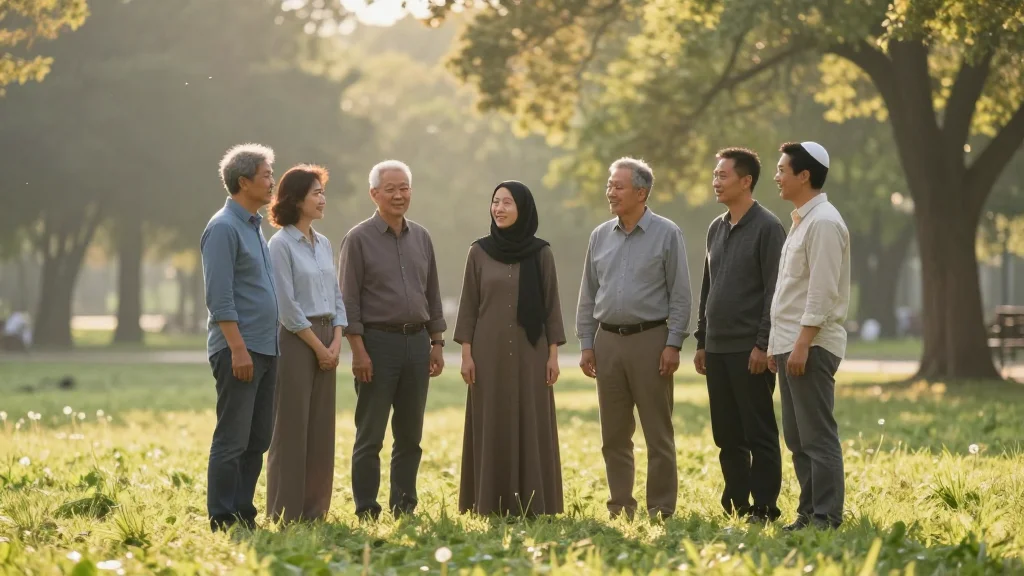
Hundreds Gather in Lüneburg for Historic Interfaith Peace Service

Why It Matters
The Lüneburg gathering highlights a growing recognition that spiritual and religious cooperation can act as a stabilizing force in an increasingly fragmented world. By demonstrating that diverse faith communities can convene without institutional pressure, the event offers a model for building trust across ideological lines, potentially reducing the social entropy that fuels conflict. Moreover, the gathering’s emphasis on face‑to‑face interaction challenges the prevailing narrative that digital platforms are the primary arena for interfaith dialogue. It suggests that tangible, high‑bandwidth experiences may be more effective at fostering empathy and shared purpose, a lesson that could reshape how NGOs, governments, and religious bodies design future peace initiatives.
Key Takeaways
- •Hundreds of participants from multiple faiths gathered in Lüneburg's Kurpark on May 25, 2026.
- •The service was framed as an "open‑source platform for human connection" to lower entry barriers.
- •Organizers used the public park setting to emphasize inclusivity and high‑bandwidth interaction.
- •The event is positioned as a proof‑of‑concept for decentralized, grassroots interfaith peacebuilding.
- •Follow‑up workshops and municipal calendar integration are planned to extend the initiative.
Pulse Analysis
Lüneburg’s interfaith Pentecost service arrives at a crossroads where spirituality intersects with social engineering. Historically, large‑scale ecumenical gatherings have been top‑down affairs, often orchestrated by state or religious hierarchies. This event flips that script by leveraging a community‑driven, low‑cost model that mirrors open‑source software development: transparent, collaborative, and adaptable. The choice of a public park as a venue is particularly telling; it transforms civic space into a neutral ground where doctrinal boundaries dissolve in favor of shared human experience.
From a market perspective, the gathering signals a potential shift in funding priorities for NGOs and philanthropic foundations. As donors increasingly seek measurable social impact, the Lüneburg model offers a tangible metric—participation volume and cross‑faith representation—that can be tracked and replicated. This could spur a new wave of micro‑grants aimed at scaling similar gatherings in other regions, especially those experiencing heightened sectarian strain.
Looking ahead, the real test will be whether the Lüneburg blueprint can transition from a one‑off event to a sustained network of interfaith hubs. If successful, it could redefine the role of spirituality in public policy, positioning faith‑based collaboration as a cornerstone of social resilience. The next six months will be critical as organizers roll out workshops and seek municipal endorsement, providing a clear barometer for the model’s scalability and its capacity to influence broader geopolitical narratives.
Hundreds Gather in Lüneburg for Historic Interfaith Peace Service
Comments
Want to join the conversation?
Loading comments...