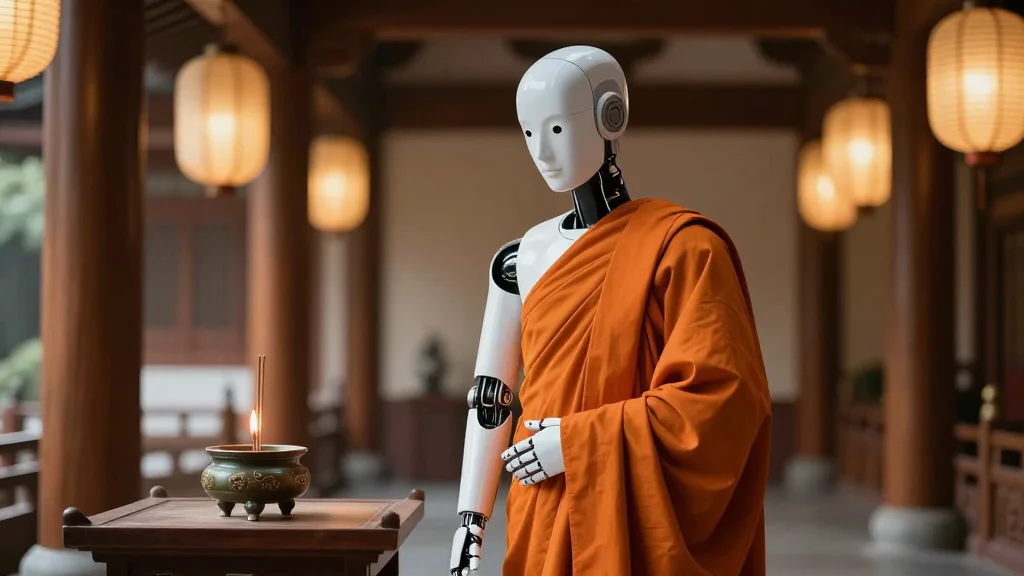
Unitree G1 Robot Ordained at Seoul’s Jogyesa Temple in $13,500 Ritual

Companies Mentioned
Why It Matters
The ordination of Gabi signals a watershed moment where religious tradition meets cutting‑edge technology, forcing both spiritual leaders and AI developers to confront ethical boundaries. By framing machine behavior in Buddhist moral terms, the Jogye Order offers a novel template for AI governance that could influence policy discussions worldwide. If successful, such religiously grounded frameworks might inspire other faiths to articulate similar guidelines, creating a pluralistic set of moral standards for AI that complements secular regulatory efforts. Conversely, the stunt could backfire, alienating traditional believers who view the robot as a gimmick, thereby deepening the generational gap the ceremony seeks to bridge.
Key Takeaways
- •Unitree G1 robot, priced at $13,500, was ordained at Jogyesa Temple on Wednesday.
- •The robot received the dharma name Gabi and recited a pre‑recorded vow to devote itself to the Buddha.
- •Jogye Order drafted a set of Buddhist precepts for machines covering safety, property, obedience, deception, and energy use.
- •South Korean Buddhism’s share of the population has fallen to about 16%, with most adherents over 60.
- •The ceremony’s Reuters video surpassed one million views, highlighting the power of tech‑driven religious outreach.
Pulse Analysis
The Jogye Order’s experiment reflects a broader trend of religious institutions leveraging technology to stay relevant. Historically, faith groups have adopted new media—from printing presses to radio—to reach congregants; AI now represents the latest frontier. By embedding Buddhist ethics into a robot’s operating principles, the order is not merely courting curiosity but attempting to shape the moral architecture of emerging intelligent systems.
From a market perspective, Unitree Robotics gains unprecedented brand exposure, positioning itself as a partner in ethical AI deployment rather than a mere hardware supplier. This could open doors to collaborations with other cultural or governmental bodies seeking to humanize technology. However, the stunt also underscores the tension between authenticity and spectacle: if the robot’s responses are entirely pre‑recorded and remote‑controlled, the ritual’s spiritual weight may be questioned, potentially eroding trust among devout followers.
Looking ahead, the success of Gabi could inspire a cascade of similar initiatives—AI‑guided meditation bots, virtual monastic mentors, or even AI‑led ceremonies. Regulators and ethicists will need to grapple with whether religious endorsement confers legitimacy on AI systems and how such endorsements intersect with existing AI governance frameworks. The Jogye Order’s bold move may thus become a case study in how spirituality can both shape and be shaped by the accelerating tide of artificial intelligence.
Unitree G1 Robot Ordained at Seoul’s Jogyesa Temple in $13,500 Ritual
Comments
Want to join the conversation?
Loading comments...