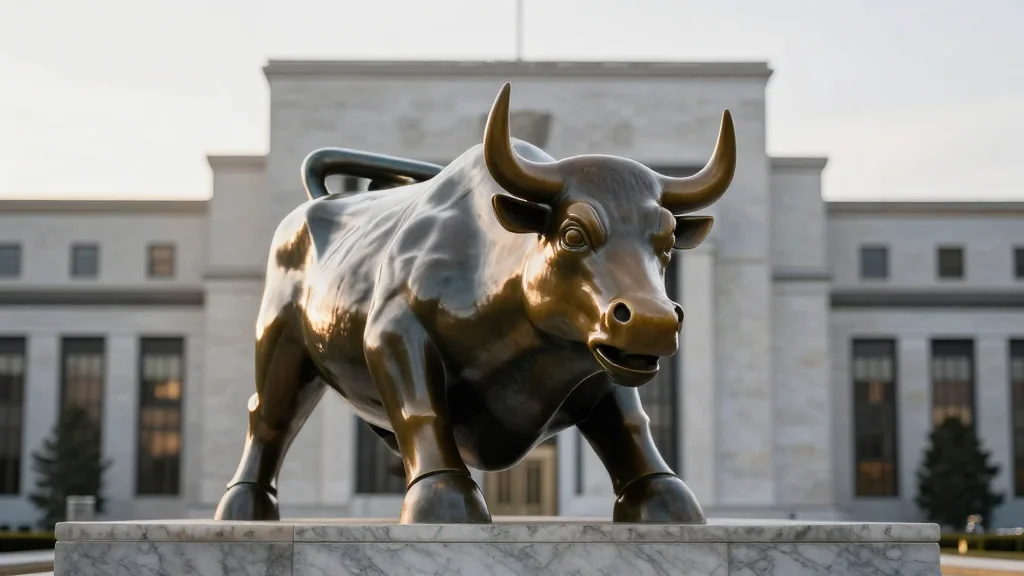
Fed Leaves Rates Steady but Signals Tougher Cut Path, Markets Slip

Companies Mentioned

Motley Fool

Reuters
Why It Matters
The Fed’s signaling of a tougher path to rate cuts reshapes the risk‑reward calculus for equity investors. Lower rates have historically buoyed stock valuations by reducing discount rates and supporting corporate borrowing; a prolonged higher‑rate environment compresses multiples and raises financing costs, especially for growth‑oriented companies. Moreover, the internal dissent highlights a potential shift in the Fed’s policy consensus, making future guidance less reliable and increasing market volatility. For long‑term investors, understanding how monetary policy dynamics affect sector performance and valuation models is essential for portfolio construction and risk management. Additionally, the upcoming leadership change to Kevin Warsh introduces uncertainty about the Fed’s strategic direction. While Warsh is perceived as dovish, the record dissent suggests that even a new chair may face constraints from within the committee. This internal friction could delay or dilute any future easing, reinforcing the need for investors to incorporate a broader range of macro‑economic scenarios into their investment theses.
Key Takeaways
- •Fed left the federal funds rate unchanged at 3.50%-3.75% but recorded a historic four‑member dissent.
- •Six rate cuts since September 2024 may be the last of the cycle, according to analysts.
- •Dow +0.31%, S&P 500 +0.29%, Nasdaq +0.89% on the day of the announcement.
- •Kevin Warsh, nominated by President Trump, will take over as Fed chair after May 15.
- •Market sectors sensitive to rates—REITs, tech, utilities—are poised for valuation adjustments.
Pulse Analysis
The Fed’s mixed signal is a textbook case of policy uncertainty translating into market volatility. Historically, a clear forward guidance path has allowed equity markets to price in expected rate cuts well in advance, supporting higher price‑to‑earnings multiples. The record dissent disrupts that narrative, injecting a risk premium that will likely elevate equity risk premia across the board. Investors should therefore re‑weight portfolios toward assets with lower sensitivity to interest rates, such as dividend‑yielding stocks and sectors with strong cash flow generation.
Warsh’s impending chairmanship adds a political dimension to monetary policy. While his dovish reputation suggests a willingness to ease, the internal split indicates that any aggressive move could be blocked by a sizable minority. This dynamic mirrors past periods where the Fed’s internal politics constrained policy action, leading to prolonged higher‑rate environments that pressured growth stocks. Forward‑looking investors will need to model multiple rate‑path scenarios, incorporating the probability of a neutral or even tightening stance beyond the current cycle.
Finally, the ripple effects extend beyond U.S. borders. Global equity markets, especially emerging economies with dollar‑denominated debt, will feel the pressure of a stronger dollar and higher U.S. yields. The prudent strategy for stock investors now is to diversify across geographies and asset classes, while maintaining a vigilant watch on Fed communications for any subtle shifts that could pre‑empt the next market move.
Fed Leaves Rates Steady but Signals Tougher Cut Path, Markets Slip
Comments
Want to join the conversation?
Loading comments...