Key Takeaways
- •RIS boosted mine tunnel coverage from 4 m to 22 m at 28 GHz.
- •Multi‑user RIS framework splits surface into sub‑units, lowering error rates.
- •Business matrix maps 6G tech choices to platform archetypes.
- •Empirical test confirms theoretical predictions within 1 dB accuracy.
- •Study underscores need for evidence before 6G standards finalize.
Pulse Analysis
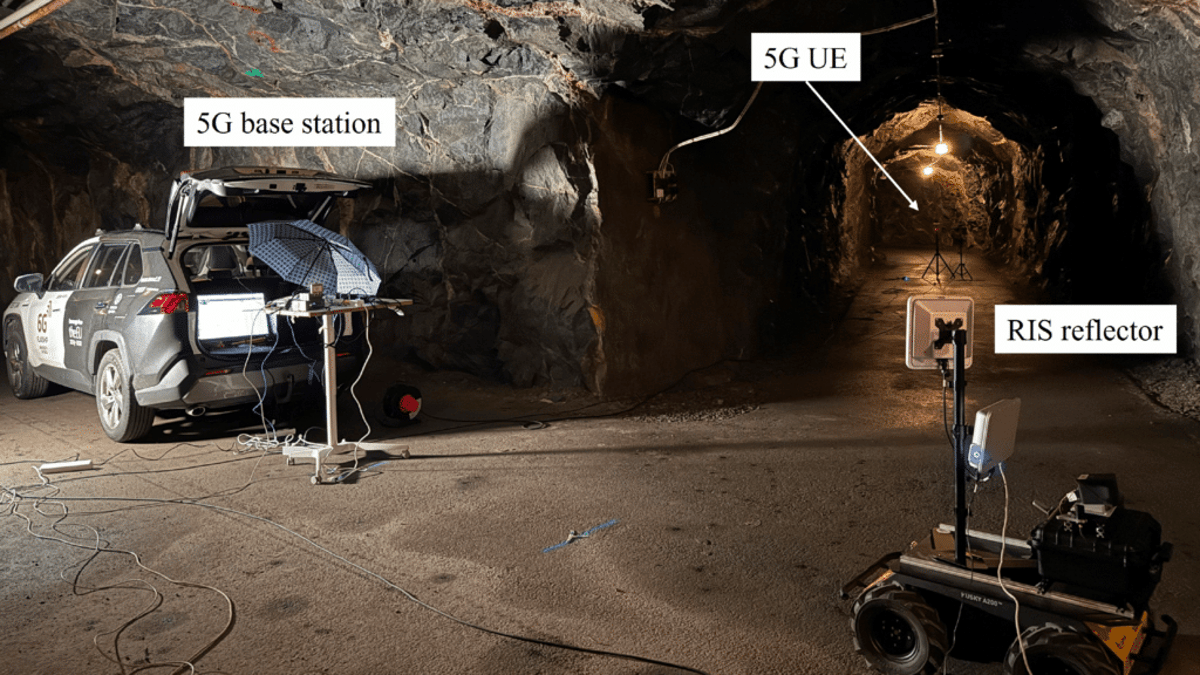
The latest 6G research is moving beyond white‑papers and simulations into real‑world validation. By deploying a 28 GHz millimetre‑wave base station and a reconfigurable intelligent surface inside the Mjölkuddsberget mine, Oulu and Luleå researchers proved that RIS technology can dramatically extend signal reach in environments where conventional mmWave signals die within a few metres. The measured coverage increase—from four to twenty‑two metres—matched radar‑cross‑section models to within one decibel, providing the empirical anchor that the 6G community has long needed to convince investors and regulators of the technology’s practicality.
Equally important is the algorithmic breakthrough that enables a single RIS to serve multiple users concurrently. By partitioning the surface into dedicated sub‑units and optimizing phase shifts based on channel state information, the Oulu team achieved lower error rates and faster convergence compared with traditional monolithic beamforming. This approach is critical for dense urban deployments, industrial IoT sites, and future autonomous‑vehicle corridors where users are spatially dispersed and demand heterogeneous data streams. The ability to embed reflection‑modulation further turns the RIS into a low‑power data source, opening new avenues for edge‑cloud integration and ultra‑reliable low‑latency communications.
Beyond the physics and algorithms, the research highlights how technology choices shape the business models of future 6G networks. By mapping enabling technologies—such as RIS, edge cloud, distributed ledgers, and AI‑RAN—onto digital‑business value layers and platform archetypes, the authors reveal that each technical decision nudges the ecosystem toward consortium‑based platforms, solution‑specific offerings, or fully decentralized autonomous networks. This structural proof equips operators, standards bodies, and policymakers with a strategic framework to align technical roadmaps with commercial objectives, ensuring that the rollout of 6G delivers both performance gains and sustainable business value.
Mining for proof
Comments
Want to join the conversation?