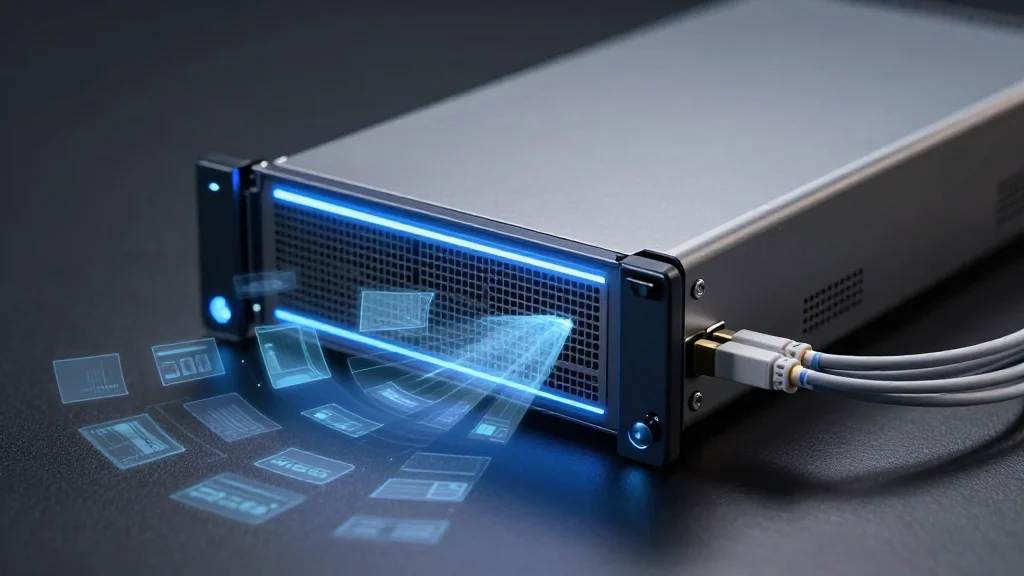
Advantech and NETINT Team Up to Power 384‑Stream 1U Video Servers

Why It Matters
The Advantech‑NETINT collaboration tackles two persistent challenges for telecom and broadcast operators: scaling live‑video capacity while controlling power and capital expenses. By delivering 384 simultaneous 1080p streams in a single 1U chassis, the solution reduces rack space, cooling requirements and electricity consumption—critical factors for edge deployments where space and power are at a premium. Moreover, the move toward ASIC‑based VPUs reflects a broader industry trend of offloading compute‑intensive video tasks from general‑purpose CPUs and GPUs, promising more predictable performance and lower total cost of ownership. For network operators, the ability to densify video processing directly at the edge can improve latency, enable localized content personalization, and free back‑haul bandwidth for other services. As 5G and edge‑cloud architectures mature, such high‑density, low‑power video infrastructure becomes a strategic asset, allowing carriers to monetize new revenue streams from live sports, e‑sports, remote production and immersive media without overhauling existing network footprints.
Key Takeaways
- •Advantech and NETINT announced a partnership on April 17, 2026 to deliver VPU‑powered video servers.
- •The VEGA‑7141 1U server can handle up to 384 simultaneous 1080p 30 fps streams using twelve Quadra T1U modules.
- •VEGA‑6321 supports 20 real‑time streams in a half‑rack 1U form factor, ideal for mobile broadcasting.
- •Solution leverages AMD EPYC 9005 CPUs, 100 GbE ST‑2110 networking, and three 2.5 GbE ports for high‑throughput IP video.
- •Demo and early testing slated for NAB Show Las Vegas 2026, with VEGA‑6321 already shipping.
Pulse Analysis
The Advantech‑NETINT deal is more than a product launch; it signals a decisive pivot toward ASIC‑centric video processing in the telecom ecosystem. Historically, broadcasters have relied on GPU farms to meet transcoding demands, a model that scales poorly at the edge due to high power draw and cooling overhead. By integrating NETINT’s Quadra VPUs, Advantech offers a purpose‑built alternative that aligns with the telecom industry’s push for energy‑efficient, high‑density compute.
From a competitive standpoint, the partnership puts pressure on incumbents such as Intel’s Quick Sync and Nvidia’s Jetson platforms, which have traditionally dominated edge video workloads. While those solutions provide flexibility, they cannot match the stream‑per‑watt efficiency that a dedicated VPU delivers. Operators that adopt the Advantech‑NETINT stack could achieve up to a 75 % reduction in server count for large‑scale live‑streaming, translating into lower CapEx and OpEx—a compelling value proposition as carriers grapple with margin compression in the post‑5G rollout era.
Looking ahead, the real test will be how quickly service providers can integrate these servers into existing orchestration frameworks and whether the VPU ecosystem can keep pace with emerging codecs like AV1 and VVC. If Advantech and NETINT can demonstrate seamless firmware updates and open‑API integration, they may set a new standard for edge video pipelines, prompting a wave of VPU‑first designs across the telecom supply chain.
Advantech and NETINT Team Up to Power 384‑Stream 1U Video Servers
Comments
Want to join the conversation?
Loading comments...