Best ISPs in Myanmar 2026: MPT, Myanmar Net, ATOM Power, or 5BB – Which Broadband Provider Is Best for Internet Customers?
Companies Mentioned
Why It Matters
The shift toward fiber and resilient broadband underpins Myanmar’s digital economy, enabling SMEs to adopt cloud services and supporting high‑growth gaming and streaming markets. Investors and policymakers must watch ISP competition and infrastructure funding as they shape the country’s connectivity future.
Key Takeaways
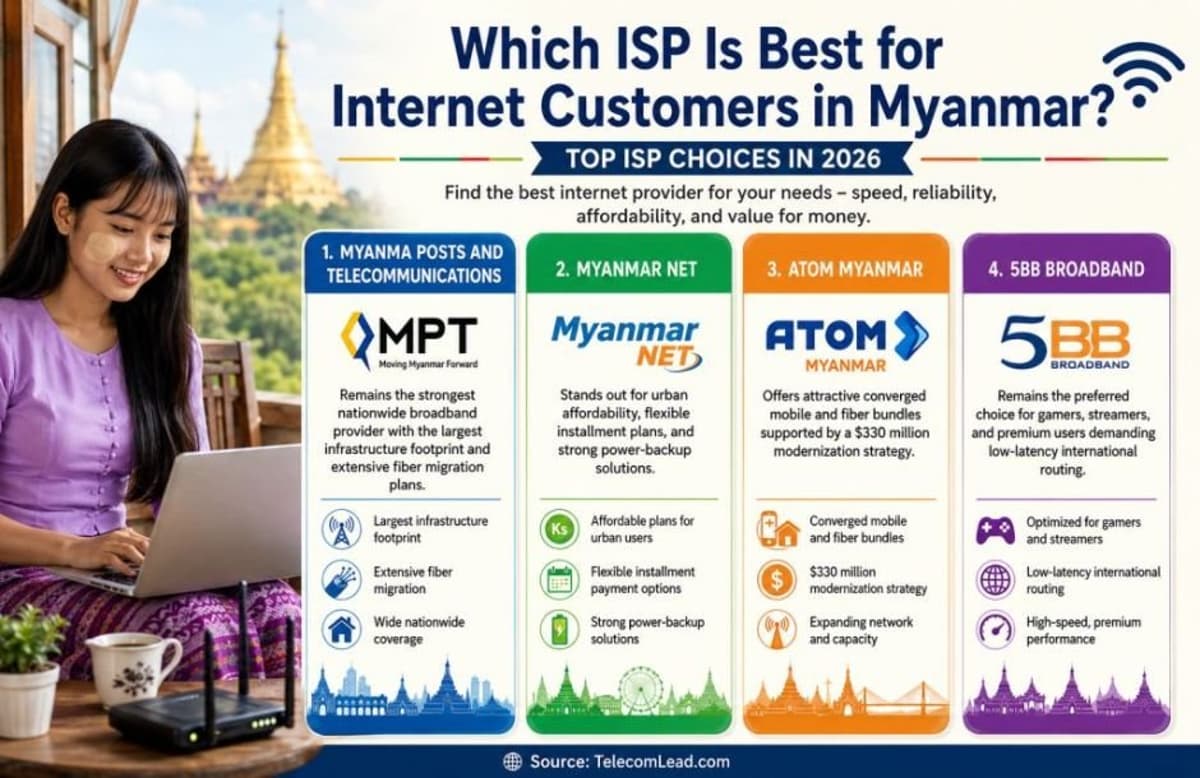
- •MPT holds 38% of fixed broadband, leading nationwide coverage
- •Myanmar Net’s urban FTTW offers affordable fiber with battery backup
- •ATOM invests $330 million in premium fiber and 5G‑ready services
- •5BB targets gamers with low‑latency FTTH and Singapore routing
- •SMEs drive 62% of ICT demand, boosting cloud‑integrated broadband
Pulse Analysis
Myanmar’s broadband sector is on the cusp of a structural shift, moving from a mobile‑centric model to a fiber‑first digital economy. With 1.62 million fixed‑line connections and a target of 8.1% household penetration by 2027, the market’s 8.2% CAGR signals robust demand from enterprises and consumers alike. The ICT ecosystem, now worth $2.58 billion, is buoyed by regional capital from Singapore, China, and Thailand, even as overall foreign direct investment slipped 16% in late 2024. The upcoming MIST submarine cable, a $400 million project delivering over 216 Tbps, will slash international bandwidth costs and improve latency for cloud and gaming applications, reinforcing Myanmar’s appeal as a regional connectivity hub.
Competition among the four leading ISPs reflects divergent strategies aimed at capturing distinct user segments. MPT leverages its national backbone and utility pole network to roll out FTTH across 64 townships, offering a 110 Mbps package for roughly $64, but it struggles with maintenance delays caused by road works. Myanmar Net differentiates itself with a cost‑effective Fiber‑to‑the‑Wireless mesh and a 66,000 Kyats (≈$31) Wi‑Fi battery that sustains four hours of service during outages, appealing to price‑sensitive urban households. ATOM’s $330 million modernization pushes premium fiber bundles and converged mobile‑fixed services, while 5BB focuses on low‑latency routes to Singapore and Thailand, catering to gamers, streamers, and high‑performance users despite reported support bottlenecks.
Looking ahead, the sector’s growth will be shaped by three forces: power‑resilient infrastructure, cloud‑centric SME demand, and continued investment in backbone capacity. Operators are already allocating an extra 15‑20% of capex to solar and diesel backup systems to mitigate chronic electricity shortages, a move that could become a competitive differentiator. As SMEs account for 62% of ICT spend and cloud adoption climbs at a 5.6% CAGR, bundled, pay‑as‑you‑grow packages will likely dominate new contracts. By 2031, the ICT market is projected to reach $5.40 billion, with FTTH comprising 85% of new installations, setting the stage for intensified rivalry over fiber resilience, transparent billing, and affordable installment financing.
Best ISPs in Myanmar 2026: MPT, Myanmar Net, ATOM Power, or 5BB – Which Broadband Provider Is Best for Internet Customers?
Comments
Want to join the conversation?
Loading comments...