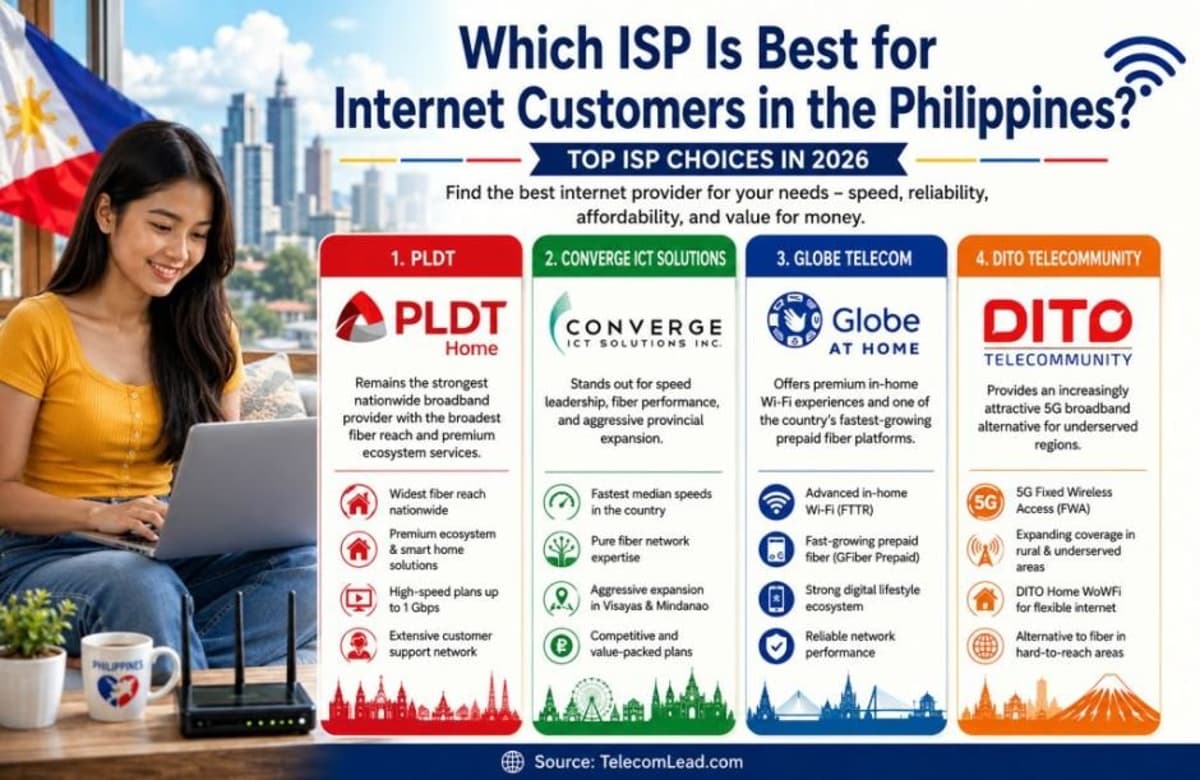
Best ISPs in the Philippines 2026: PLDT, Converge, Globe, or DITO – Which Broadband Provider Is Best for Internet Customers?
Companies Mentioned
Why It Matters
The move toward fiber and low‑cost prepaid options heightens competition, forcing ISPs to deliver faster, cheaper connectivity that underpins the Philippines' expanding digital economy and remote‑work surge.
Key Takeaways
- •PLDT holds 42% market share, largest fiber backbone.
- •Converge leads speed with 123 Mbps median, 30% share.
- •Globe's FTTR tech targets premium Wi‑Fi, 820k prepaid users.
- •DITO expands 5G FWA, aims 2 M subscribers by 2026.
- •Prepaid fiber plans start under $1/day, boosting low‑income adoption.
Pulse Analysis
The Philippine broadband landscape has undergone a rapid transformation, moving from a mobile‑centric past to a fiber‑first future. Over $8 billion in private investment, complemented by government‑backed projects like the 3,000‑km National Fiber Backbone, has driven median download speeds past the 100 Mbps mark and reduced latency to single‑digit figures in Metro Manila. This infrastructure boom not only supports high‑bandwidth activities such as 4K streaming and AI‑driven applications but also narrows the connectivity gap between Luzon, Visayas, and Mindanao.
Competition among the four main ISPs is sharpening. PLDT leverages its extensive fiber reach and a $7.3 billion capital outlay to offer premium "Total Home" bundles, yet it battles criticism over support response times. Converge, a pure‑play fiber player, differentiates itself with a 123 Mbps median speed and aggressive rollout of over one million new fiber ports, though some provincial users report signal instability. Globe focuses on in‑home Wi‑Fi excellence through FTTR technology and a fast‑growing prepaid segment that now serves 820,000 customers. DITO, the smallest player, sidesteps fiber constraints by expanding 5G Fixed Wireless Access, targeting underserved rural markets with a goal of 2 million subscribers.
The rise of prepaid fiber—priced under $1 per day—has democratized high‑speed internet, attracting renters, freelancers, and the unbanked. As broadband becomes more affordable and reliable, Philippine households are spending an average of 54 hours online weekly, fueling demand for integrated digital services, AI‑enhanced network management, and seamless cloud experiences. Looking ahead, ISPs that combine speed, price competitiveness, and superior customer support will likely dominate, while continued government subsidies and new subsea cables promise to keep wholesale costs low, further accelerating market growth.
Best ISPs in the Philippines 2026: PLDT, Converge, Globe, or DITO – Which Broadband Provider Is Best for Internet Customers?
Comments
Want to join the conversation?
Loading comments...