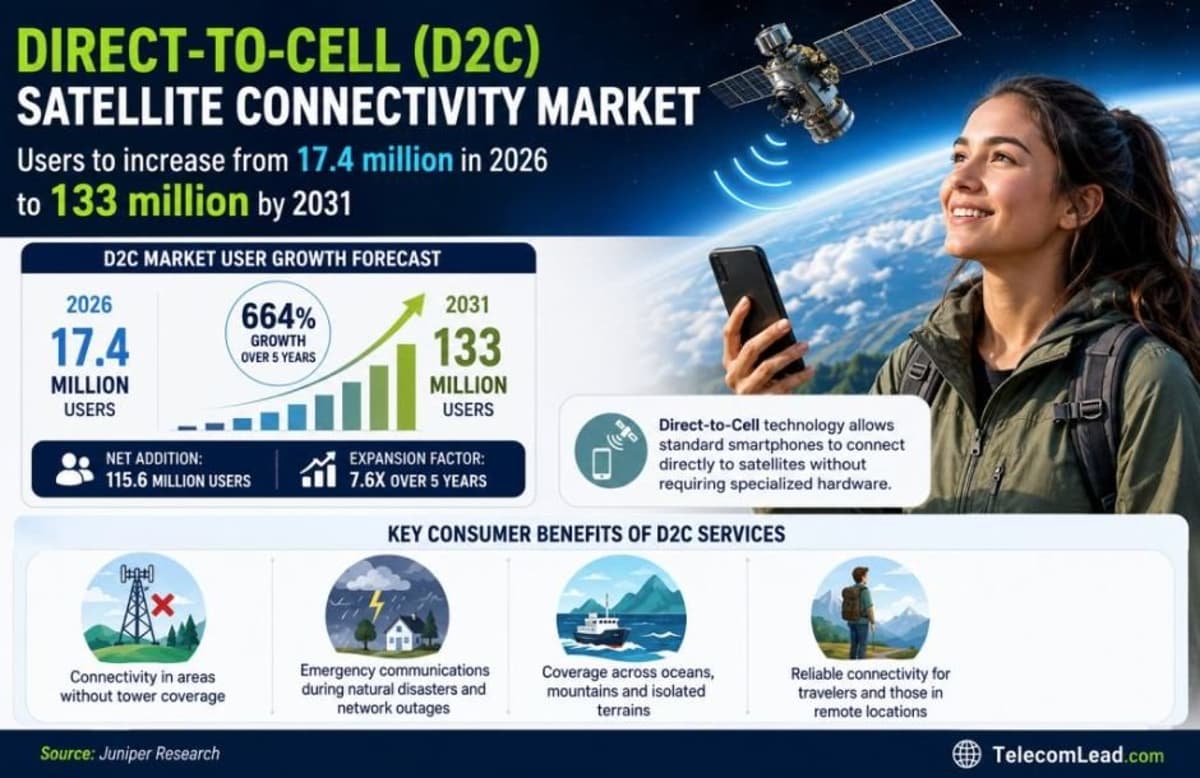
Direct-to-Cell Satellite Connectivity Market to Reach 133 Mn Users by 2031, Driven by Operator-Led Expansion
Why It Matters
The surge in D2C users will transform mobile coverage, unlocking connectivity for underserved regions and creating new revenue streams for operators and satellite vendors. It also establishes satellite‑mobile hybrid networks as a core layer of future global communications infrastructure.
Key Takeaways
- •D2C users projected 133 million by 2031, 664% growth.
- •Operators integrate satellite into 4G/5G, targeting rural coverage gaps.
- •AST SpaceMobile partners with 50+ operators, $1 bn revenue commitments.
- •Starlink plans 15,000‑satellite constellation, V2 boosts throughput 20×.
- •Canada, India, Europe see early rollouts, emphasizing emergency and maritime use.
Pulse Analysis
Direct-to-Cell technology is redefining the economics of mobile connectivity by allowing standard smartphones to link directly to low‑Earth‑orbit satellites. This eliminates the need for costly terrestrial tower rollouts in sparsely populated or hard‑to‑reach locations, making it attractive for operators seeking to meet universal service obligations while opening new subscription models for travelers, maritime crews, and disaster response agencies. The rapid adoption curve is underpinned by advances in NTN standards, AI‑driven network orchestration, and hybrid 4G/5G architectures that seamlessly blend satellite and ground resources.
The competitive landscape is coalescing around a few dominant satellite providers. AST SpaceMobile has secured partnerships with more than 50 mobile operators worldwide and locked in over $1 billion of committed revenue, positioning itself as the primary conduit for carrier‑directed D2C services. Meanwhile, SpaceX’s Starlink is expanding its Direct-to-Cell platform across 32 countries, with next‑generation V2 satellites promising 100‑fold data density improvements and 20‑times higher throughput. These capabilities enable operators to offer voice, SMS, and broadband packages that rival traditional cellular performance, especially in remote or disaster‑affected zones.
Geographically, the rollout is gaining momentum in markets with large underserved populations. In North America, AT&T, T‑Mobile and Verizon are integrating satellite links into their 5G roadmaps, while Bell Canada and Rogers are piloting nationwide services through AST and Starlink partnerships. Europe’s Orange and Vodafone are testing voice and data trials, and India’s Vodafone Idea is leveraging AST’s constellation to bridge its 1.1 billion‑subscriber base. As the user base expands toward the 133 million target, D2C is poised to become a foundational pillar of global mobile infrastructure, driving both revenue diversification for carriers and universal connectivity for consumers.
Direct-to-Cell Satellite Connectivity Market to Reach 133 mn Users by 2031, Driven by Operator-Led Expansion
Comments
Want to join the conversation?
Loading comments...