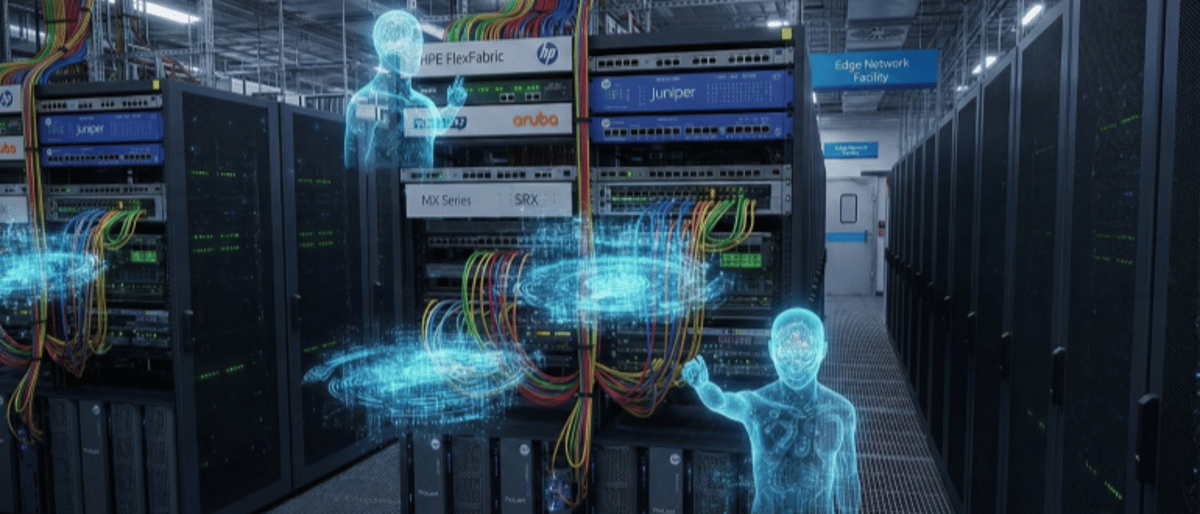
HPE Exposes Juniper Routers to Third-Party AI Agents
•February 24, 2026
0
Why It Matters
By allowing AI agents to manage routing infrastructure, HPE accelerates automated network operations and prepares enterprises for the imminent surge in AI‑generated traffic, strengthening its position in edge and telco markets.
Key Takeaways
- •HPE opens Juniper routers to third‑party AI agents
- •New PTX12000 line scales up to 518.4 Tbps
- •PTX10002 offers 14.4–28.8 Tbps in 2U form factor
- •ProLiant Gen12 servers bring edge compute to 1U/2U
- •AI traffic to jump 3%→15% in three years
Pulse Analysis
The convergence of networking hardware and artificial‑intelligence orchestration is reshaping enterprise infrastructure. HPE’s decision to expose Juniper routers to external AI agents reflects a broader industry shift toward AI‑native networking, where model‑driven APIs replace manual configuration. By leveraging the Model Context Protocol, third‑party agents can dynamically adjust routing policies, provision services, and troubleshoot issues, reducing operational overhead and accelerating time‑to‑value for AI‑centric applications.
Technical specifications underscore HPE’s ambition to dominate the edge market. The PTX12000 series, built on Juniper’s Express 5 ASIC, delivers up to 518.4 Tbps across a 12‑slot chassis, while the PTX10002 offers a compact 2U solution with up to 28.8 Tbps. Coupled with Gen12 ProLiant Telco Edge Compute servers, these platforms provide high‑density compute and networking in power‑efficient packages, addressing the latency constraints of emerging AI workloads that increasingly run close to the data source.
For IT organizations, the rollout signals a need to rethink network upgrade roadmaps. Research predicts AI traffic will swell from 3% to 15% of total flow within three years, pressuring bandwidth and management capabilities. Integrating AI agents into routing fabric simplifies multi‑domain oversight, but also demands robust security and governance frameworks. Enterprises that proactively adopt AI‑enabled routers and edge compute will gain a competitive edge, ensuring their networks can sustain the next wave of AI‑driven services without relying solely on distant cloud resources.
HPE Exposes Juniper Routers to Third-Party AI Agents
0
Comments
Want to join the conversation?
Loading comments...