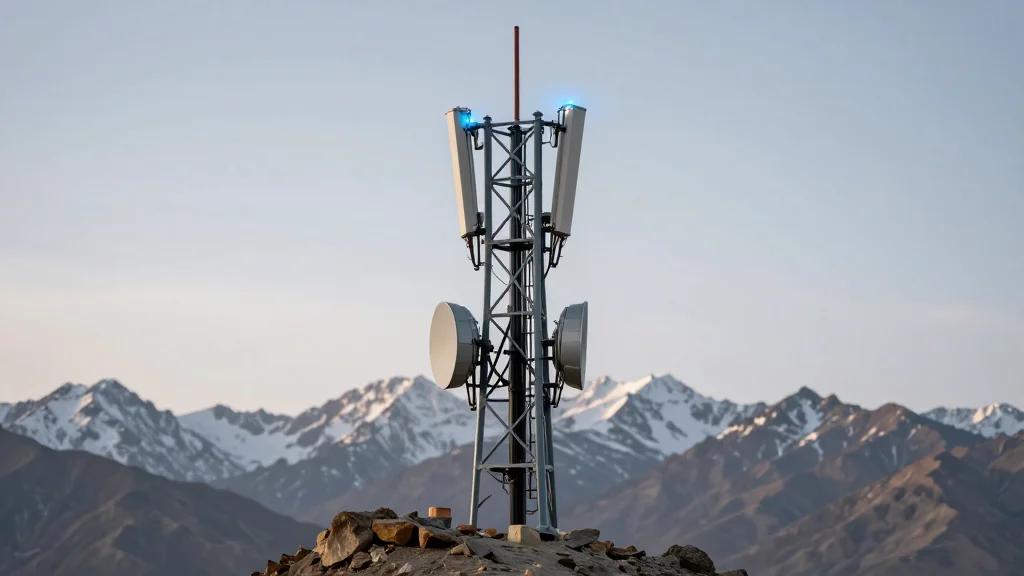
India Nears Full Mobile Coverage in Jammu & Kashmir and Ladakh, Connecting 6,226 Villages to 4G/5G

Why It Matters
Universal mobile coverage in Jammu & Kashmir and Ladakh closes a critical gap in India’s digital infrastructure, directly impacting education, healthcare, and commerce in some of the country’s most remote areas. By extending 4G and nascent 5G services, the government not only improves quality of life for millions but also creates a foundation for future technology deployments, such as IoT and smart agriculture, that can drive regional economic growth. The rollout also serves a geopolitical purpose, reinforcing the Indian state’s presence in contested border regions through tangible development projects. As connectivity improves, local populations gain greater access to government services and information, potentially reducing alienation and fostering greater national integration.
Key Takeaways
- •6,226 of 6,474 villages in Jammu & Kashmir now have mobile coverage
- •233 of 243 villages in Ladakh are connected to mobile networks
- •4G is available in 6,208 J&K villages and 229 Ladakh villages; 5G reaches 3,704 J&K villages and 22 Ladakh villages
- •24,263 mobile towers commissioned nationwide under 4G saturation and BharatNet programmes
- •Remaining gaps stem from difficult terrain, sparse population, and harsh weather conditions
Pulse Analysis
India’s telecom push in Jammu & Kashmir and Ladakh illustrates how government‑led infrastructure can accelerate market penetration in hard‑to‑reach areas. Historically, the region lagged behind the rest of the country due to security concerns and logistical hurdles. By leveraging the 4G saturation programme and the BharatNet fibre rollout, the Centre has effectively created a hybrid network model that blends mobile and wired broadband, a strategy that could be replicated in other mountainous or sparsely populated regions worldwide.
From a competitive standpoint, the near‑universal coverage narrows the advantage that private operators once held in urban markets, forcing them to innovate on service quality and pricing to retain customers in these newly connected villages. The rapid deployment of 5G, even in a limited number of villages, signals a willingness to future‑proof the network, positioning India to capture early benefits of low‑latency applications such as remote diagnostics and precision farming.
Looking ahead, the true test will be the sustainability of these networks. Maintenance costs in extreme environments are high, and the revenue potential in low‑density villages is modest. Public‑private partnerships, subsidies, and the integration of satellite backhaul could mitigate these challenges. If the government can sustain investment and address the remaining coverage gaps, the telecom sector will not only achieve a political win but also unlock a new wave of digital entrepreneurship and inclusive growth in the region.
India Nears Full Mobile Coverage in Jammu & Kashmir and Ladakh, Connecting 6,226 Villages to 4G/5G
Comments
Want to join the conversation?
Loading comments...